

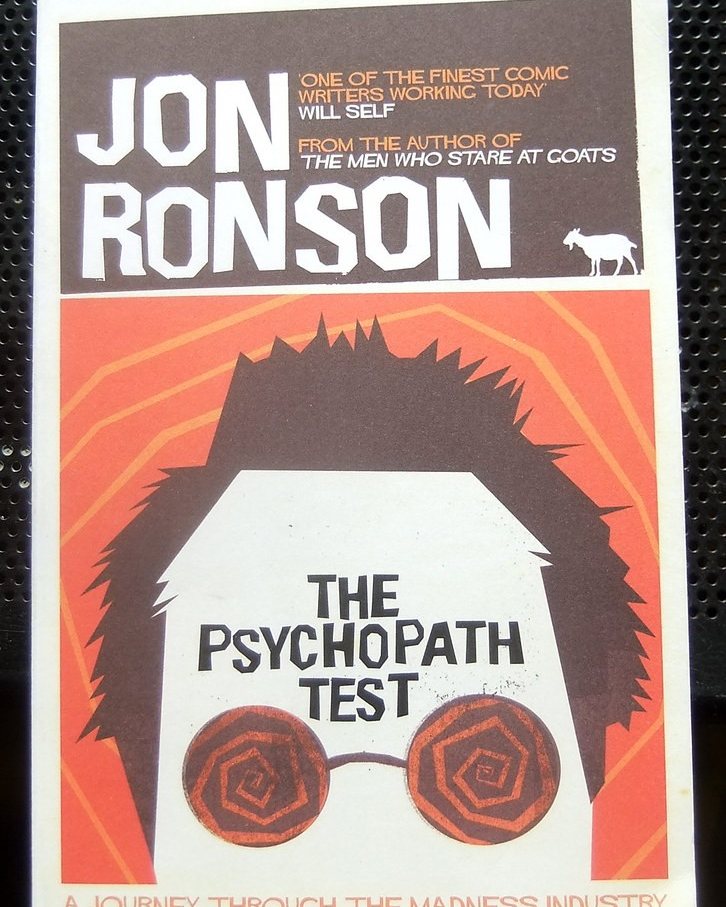
Author: Jon Ronson · Published: 2011 · Genre: Psychology, Journalism, Nonfiction
The Psychopath Test follows journalist Jon Ronson as he learns to spot psychopaths, starts seeing them everywhere, and then begins to doubt the whole enterprise. It’s funny, fast and smarter than its breezy tone suggests. It won’t teach you much hard science, but it’s a sharp look at how psychiatric labels are made and misused. Great for general readers; less so for anyone wanting a rigorous guide to psychopathy.
What it’s about
The book starts with a puzzle. Academics around the world receive a strange, cryptic book in the post, and Ronson is asked to find out who sent it. The trail leads to one eccentric man, and sets Ronson thinking about madness more broadly.
He visits Broadmoor, the high-security psychiatric hospital in England, to meet a man who says he faked mental illness as a young man to avoid prison, then found himself unable to convince anyone he was sane. That encounter leads Ronson to Robert Hare, the Canadian psychologist who created the Psychopathy Checklist, a 20-item tool used to assess psychopathy in prisons and courts. Ronson takes Hare’s training course and comes out eager to use it. The checklist scores traits such as glibness, grandiosity, lack of remorse and impulsivity, and once you know them, they seem to be everywhere.
Armed with the checklist, he goes hunting. He interviews Al Dunlap, the former Sunbeam chief executive famous for brutal layoffs, to test the idea that psychopaths thrive in business. He meets Emmanuel “Toto” Constant, the former leader of a Haitian paramilitary group. He also looks back at an experimental Canadian program from the late 1960s in which psychopathic patients took part in intense, drug-assisted group therapy, which later research suggested may have made them more likely to reoffend.
Then the book turns on itself. Ronson realizes he’s enjoying labeling people a bit too much, and examines how psychiatric diagnoses expand and how the media feed on extreme personalities.
What works
- It’s very funny. Ronson writes about his own anxiety and eagerness with self-deprecating honesty, and his interviews are full of awkward, revealing moments.
- The self-critical turn is the book’s real strength. Ronson questions his own conclusions, showing how easily an amateur, or a professional, can overreach with a checklist. That kind of doubt is rare in pop psychology.
- The Broadmoor story is unforgettable. It raises serious questions about how institutions decide someone is dangerous, and what happens when a label becomes impossible to shake.
- It handles the anti-psychiatry camp carefully. Ronson spends time with campaigners from a Scientology-founded group that attacks psychiatry, taking their criticisms seriously while staying clear about their agenda.
What doesn’t
The science is thin. Readers get a lively sense of Hare’s checklist but little on how psychopathy is actually researched, what brain studies do and don’t show, or the ongoing debates about whether psychopathy is a single condition.
The structure is loose. The opening mystery is fun but only loosely connected to the rest, and chapters often read like separate magazine pieces stitched together.
The business psychopath section is the weakest. The Dunlap interview is entertaining but proves little, and Ronson more or less admits it. The popular idea that executives are often psychopaths gets more attention here than the evidence supports.
His points about the overdiagnosis of psychiatric conditions, including in children, are important but argued through a few striking cases rather than data.
Who should read it
Readers who enjoy curious, character-driven nonfiction will love it, and it’s a good gateway into questions about diagnosis and mental health. Psychology students should treat it as an entertaining side read, not a textbook.
Rating: 4/5
Photo credits — Featured image: Photo by Gwydion M. Williams via Flickr, CC BY 2.0, cropped. In-article photo: Photo by el cajon yacht club via Flickr, CC BY 2.0, cropped.
