

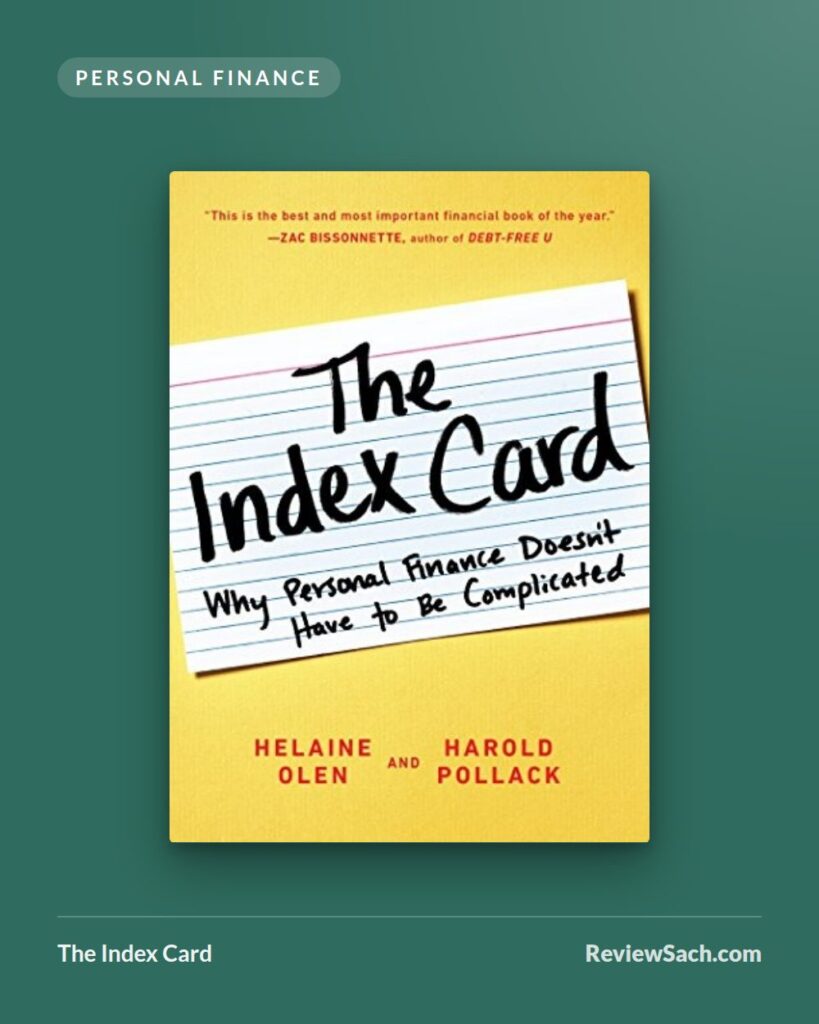
Author: Helaine Olen and Harold Pollack · Published: 2016 · Genre: Personal Finance, Investing
The Index Card argues that almost everything most people need to know about money fits on a single index card. It is short, sensible and refreshingly honest about the financial industry. Beginners will get a sound framework they can act on immediately; anyone who has read a few finance books will find little new.
The big idea
The book began in 2013, when Harold Pollack, a University of Chicago social policy professor, remarked in an interview that the best financial advice for most people would fit on an index card. Readers asked to see it, so he wrote one by hand in a few minutes, photographed it and posted it online, where it went viral. He then teamed up with Helaine Olen, a financial journalist and author of Pound Foolish, to turn it into a book.
Each chapter expands one rule: strive to save 10 to 20 percent of your income; pay your credit card balance in full every month; max out your 401(k) and other tax-advantaged accounts; never buy or sell individual stocks; buy cheap, well-diversified index funds; make any financial adviser commit to the fiduciary standard; buy a home only when you are financially ready; make sure you are properly insured; and support the social safety net.
The underlying argument is that the financial industry profits from complexity. Once you see how simple the right answers are, most sales pitches lose their power.
What works
- The fiduciary chapter. The authors explain clearly why it matters whether an adviser is legally required to put your interests first, and how commission-based advice can steer people into expensive products. Olen’s reporting on the industry gives this real bite. The rule’s practical meaning is simple: get any adviser to commit to acting as a fiduciary, and be wary of one who hedges or changes the subject.
- Brevity. Each rule gets a short, focused chapter. You can finish the book in an afternoon and act on it the next day.
- Evidence over hype. The case against picking stocks and paying high fees rests on long-run data rather than personality or anecdote.
- Realism. The first rule asks readers to strive for 10 to 20 percent, not to hit a heroic savings rate, and the book accepts that luck, health and low pay shape outcomes. That is why its final rule looks beyond individual choices.
What doesn’t
The main criticism is that the book adds little to the card. Publishers Weekly, for example, felt the rules were too familiar to justify a full book, and experienced readers will agree. The chapters on retirement accounts are also very American, so readers elsewhere must translate 401(k)s and IRAs into local equivalents.
The investing guidance is deliberately simple. It tells you to buy low-cost index funds and hold them, which is sound, but readers who want to understand how to split money between stocks and bonds, or how to draw down savings in retirement, will need a fuller guide.
The final rule, supporting the social safety net, split readers. Some see it as the book’s most honest point: individual discipline can’t protect everyone from illness, job loss or bad luck, so public programmes matter to personal finances. Others think political advocacy doesn’t belong in a money guide. Both reactions are fair, and readers should know it’s there.
Who should read it
People who want a trustworthy, one-sitting introduction to money, or a book to hand a young adult starting their first job. If you already buy index funds and pay off your card each month, you have absorbed the message and can skip it.
Rating: 3.5/5
Image credits — Cover image via Open Library. Cover design © the publisher, shown for review purposes.
