

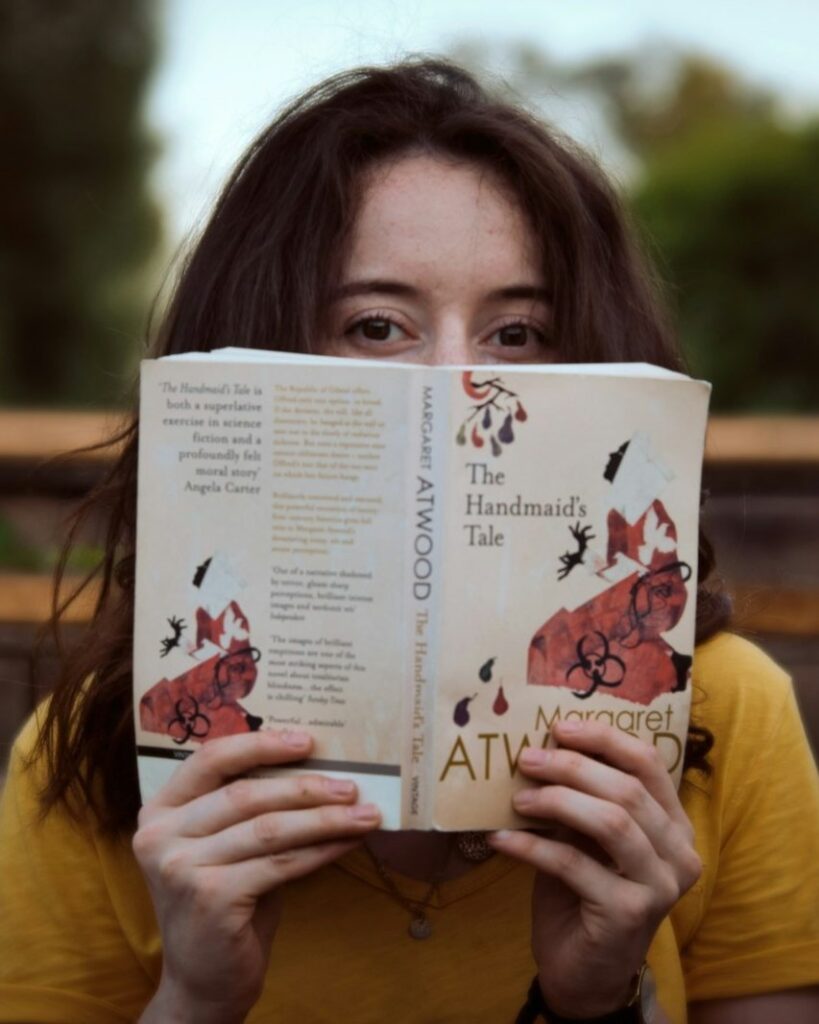
Author: Margaret Atwood · Published: 1985 · Genre: Dystopian Fiction, Literary Fiction
The Handmaid’s Tale imagines a United States taken over by a theocratic regime that strips women of their rights and forces fertile women to bear children for the elite. Four decades on, it remains the benchmark feminist dystopia: controlled, chilling and uncomfortably plausible. It’s slower and more interior than the TV series, but it’s the version worth your time.
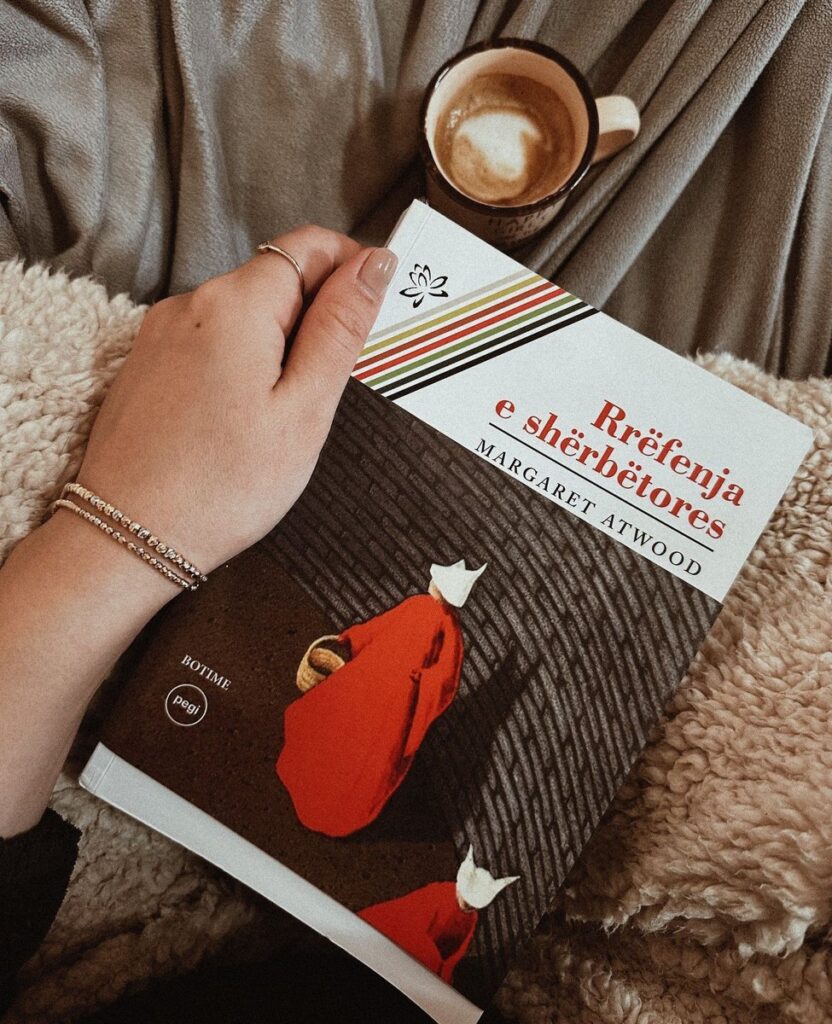
What it’s about
After a coup, a regime called the Republic of Gilead has seized power, and birth rates have collapsed. Offred, the narrator, is a Handmaid: a fertile woman assigned to the household of a powerful Commander and his wife, Serena Joy, to bear them a child. Her name marks her as the Commander’s property; her real name is never given. Women are sorted by function and color-coded clothing, forbidden to read, and watched constantly.
Offred’s present, a tightly controlled routine of shopping trips, ceremonies and silences, alternates with memories of her old life: her husband, Luke, her young daughter, her mother, and her rebellious friend Moira. The story tightens when the Commander starts inviting her to secret evening meetings and when she begins a risky relationship with Nick, the household’s driver. Meanwhile her walking partner, Ofglen, hints at a resistance network called Mayday.
What works
- The voice. Offred is observant, wry and frightened, and her narration moves between flat description and sudden flashes of anger or grief. You live inside her head, which makes the regime’s control feel intimate.
- Plausibility. Atwood has said she included nothing that humans hadn’t already done somewhere in history. That rule gives the book its lasting force: Gilead’s methods echo real regimes, movements and laws.
- Ambiguity. Atwood keeps you as unsure as Offred about whom to trust, and she refuses easy answers, even at the end.
- Language. Gilead controls words as tightly as bodies, through ritual greetings, renamed women and banned books. The novel is a lesson in how power works through vocabulary.
- The “Historical Notes.” A closing section, set at an academic conference in 2195, reframes everything before it. It’s a sly, bitter coda about how history treats women’s stories.
What doesn’t
The pace is slow, and the plot is thin until the final third. Offred is deliberately passive for much of the book, which some readers find frustrating, and the flashbacks can blur the timeline.
Critics have also pointed to blind spots. The novel says little about race beyond a brief mention that Black Americans have been forcibly resettled, and some argue that it centers white women’s experience while borrowing from abuses historically inflicted on enslaved Black women.
The controversy
The book has long been a target of censorship. The American Library Association placed it at number 37 on its list of the most frequently challenged books of the 1990s, and US school districts have removed it more than once, citing sexual content, violence or offense to Christian readers. Defenders point out the irony of banning a novel about a regime that forbids women to read. In 2022 Atwood created an “unburnable” copy, which sold at auction for $130,000 to support PEN America’s work against book bans. The 2017 TV series, starring Elisabeth Moss, brought the book a new generation of readers, and protesters in several countries have since worn the Handmaids’ red cloaks and white bonnets as a symbol of women’s rights.
Who should read it
Nearly everyone, and especially readers interested in feminism, religion and politics, or fans of 1984. It won Canada’s Governor General’s Award and the first Arthur C. Clarke Award, and was shortlisted for the Booker Prize. Its 2019 sequel, The Testaments, shared the Booker. If you’ve only seen the series, the book is shorter, stranger and more ambiguous.
Rating: 4.5/5
Photo credits — Featured image: Photo by Umid Akbarov on Unsplash. In-article photo: Photo by Book Hut on Pexels.
