

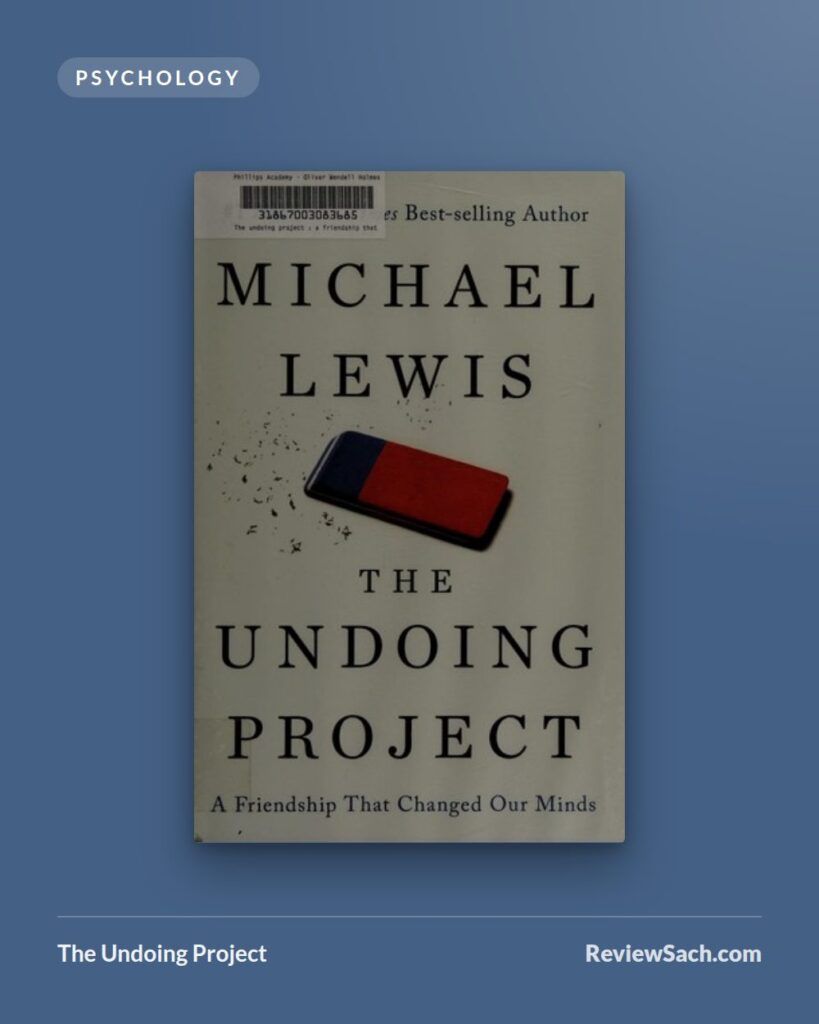
Author: Michael Lewis · Published: 2016 · Genre: Psychology, Biography, Nonfiction
The Undoing Project tells the story of Daniel Kahneman and Amos Tversky, the two Israeli psychologists whose work on judgment and bias laid the foundations of behavioral economics. Lewis makes their ideas vivid and their friendship genuinely moving. It’s less a science book than a portrait of a partnership, and it’s the most enjoyable introduction to the subject available. Anyone who liked Moneyball or found Thinking, Fast and Slow heavy going should read it.
What it’s about
Lewis begins with a puzzle left over from Moneyball: why do experts, like basketball scouts, misjudge talent so predictably? His opening chapter follows Daryl Morey, then general manager of the Houston Rockets, as he tries to strip bias from the NBA draft. That leads Lewis to the two men who explained why human judgment goes wrong.
The book then becomes a dual biography. Kahneman was a Jewish child who survived Nazi-occupied France and grew into a self-doubting, pessimistic thinker. Tversky was a confident, brilliant Israeli paratrooper, famous for his wit and for dominating any room he entered. At the Hebrew University of Jerusalem in the late 1960s, they began a collaboration so close that they wrote their papers together, sentence by sentence, and struggled to say whose ideas were whose.
Lewis explains their key findings through that partnership: the shortcuts of representativeness, availability and anchoring, the famous Linda problem, and prospect theory, which showed that people feel losses more sharply than equal gains. The title comes from their later work on how people mentally undo events, imagining the alternative paths that might have prevented a tragedy. Then he traces how the friendship frayed, as outsiders gave Tversky more of the credit and the two drifted apart after moving to North America.
What works
- The characters are unforgettable. Lewis’s portraits of the anxious, generous Kahneman and the dazzling, sometimes cutting Tversky are the book’s real achievement.
- The ideas are explained through stories. Lewis shows the findings mattering in the real world, including through Toronto doctor Donald Redelmeier, who applied their insights to medical decisions and errors.
- The ending is genuinely moving. The late chapters on the strain between them, Tversky’s illness and death in 1996, and Kahneman’s Nobel Prize in economics in 2002 give the book an emotional weight rare in popular science.
- The Israeli context adds depth. The pair’s military service, and the wars that shaped their early careers, show where their interest in real-world judgment came from. Kahneman’s work redesigning the army’s interviews for new recruits is a highlight.
What doesn’t
The opening chapter on Morey and basketball feels bolted on. It was clearly meant to link the book to Moneyball, and readers who came for Kahneman and Tversky may wonder why they’re reading about the NBA draft.
The science is thinner than in the pair’s own writing. Lewis explains the headline findings well but spends little time on methods, or on critics who argued that mental shortcuts are often smart adaptations rather than errors. The replication crisis, which has since touched some behavioral-science findings, barely registers. Readers who want the ideas in depth will still need Kahneman’s own Thinking, Fast and Slow.
The pacing is also uneven. Lewis spends long stretches on each man’s early life before the collaboration starts, and some middle chapters, heavy on how the papers were drafted, drag compared with the rest.
Who should read it
Readers new to behavioral economics, fans of Michael Lewis’s storytelling, and anyone interested in how great intellectual partnerships work will enjoy it. Those who already know the research well should read it for the human story rather than the science.
Rating: 4/5
Image credits — Cover image via Open Library. Cover design © the publisher, shown for review purposes.
