

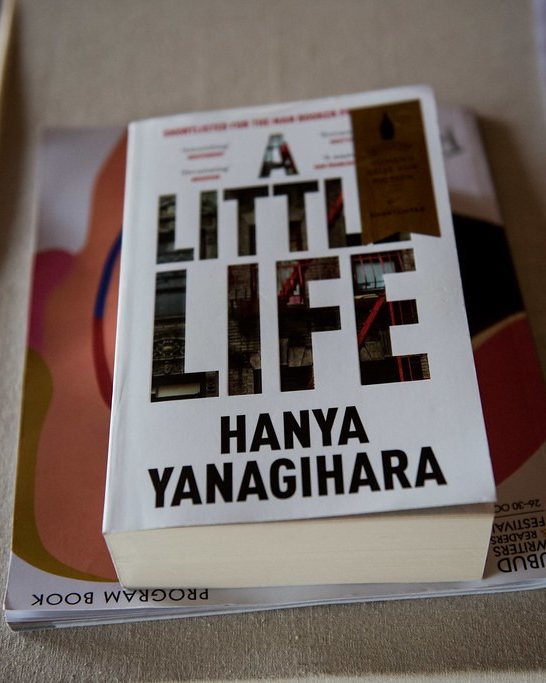
Author: Hanya Yanagihara · Published: 2015 · Genre: Literary Fiction
A Little Life is a 700-plus-page novel about four friends in New York, and above all about one of them, Jude St. Francis, whose childhood abuse shapes every year of his adult life. It is gripping, tender and often beautifully observed, but it piles on suffering to a degree many readers find punishing or even manipulative. Read it if you want total immersion and can handle very dark material; skip it if you’re in a fragile place.
What it’s about
Jude, Willem, JB and Malcolm meet at college and move to New York to build careers. Willem is an aspiring actor, JB a painter, Malcolm an architect, and Jude a lawyer with a brilliant mind, a damaged body and a past he refuses to discuss. The early chapters read like a group portrait of ambitious friends. Gradually the book narrows to Jude, as flashbacks reveal what was done to him as a child and the present shows how that history keeps hurting him: chronic pain from an old injury to his legs, self-harm he hides from almost everyone, and a conviction that he doesn’t deserve to be loved.
The novel covers roughly three decades but deliberately leaves out markers of time: no dates, almost no news events, no sense of the wider world. The effect is a sealed space, like a fable set in a Manhattan of successful people.
What works
- The friendships. The bond between Jude and Willem is one of the most detailed portraits of adult male friendship in recent fiction. Yanagihara puts tenderness and physical care at the center of men’s lives, which is rare.
- The adults who stay. Harold Stein, Jude’s former law professor who adopts him as an adult, and Andy, his long-suffering doctor, show love as repeated, stubborn effort. Harold’s chapters are among the most moving in the book.
- Momentum. For such a long book, it reads fast. The withheld backstory works almost like a thriller’s, pulling you forward even when you want to look away.
- Ambition. Few recent novels take this big a risk. Yanagihara commits completely to intensity and sincerity, with no ironic distance, and whatever you think of the result, it is unmistakably her own book.
What doesn’t
The central complaint is excess. Jude’s suffering is relentless, the book returns again and again to abuse and self-harm, and the kind people around him can change very little. Critics split sharply. Daniel Mendelsohn, in the New York Review of Books, found the violence gratuitous and the craft weak. Garth Greenwell, in The Atlantic, praised it as a landmark gay novel that dares to embrace melodrama. Readers still argue over whether the misery is honest testimony about trauma or a way of working on their emotions.
Other problems are easier to name. Most of the adult characters are rich, gifted and endlessly devoted to one another, which makes the world feel airless. JB and Malcolm fade once the focus narrows. And the prose, while clear, turns repetitive over so many pages, with the same patterns of crisis and recovery playing out several times.
A content note: the novel depicts child sexual abuse, self-harm and suicide at length. These are not side elements; they are the book.
Who should read it
Readers who love long, emotionally total novels, and anyone curious about the most debated literary bestseller of the 2010s. It was shortlisted for the Booker Prize, was a finalist for the National Book Award and won the Kirkus Prize for Fiction, all in 2015. If you have personal experience of abuse or self-harm, think carefully before starting. A 2023 London stage version starring James Norton showed how strongly the story still divides audiences.
Rating: 3.5/5
Photo credits — Featured image: Photo by Wirasathya Darmaja / Ubud Writers & Readers Festival (UWRF) via Flickr, CC BY 2.0, cropped.
