

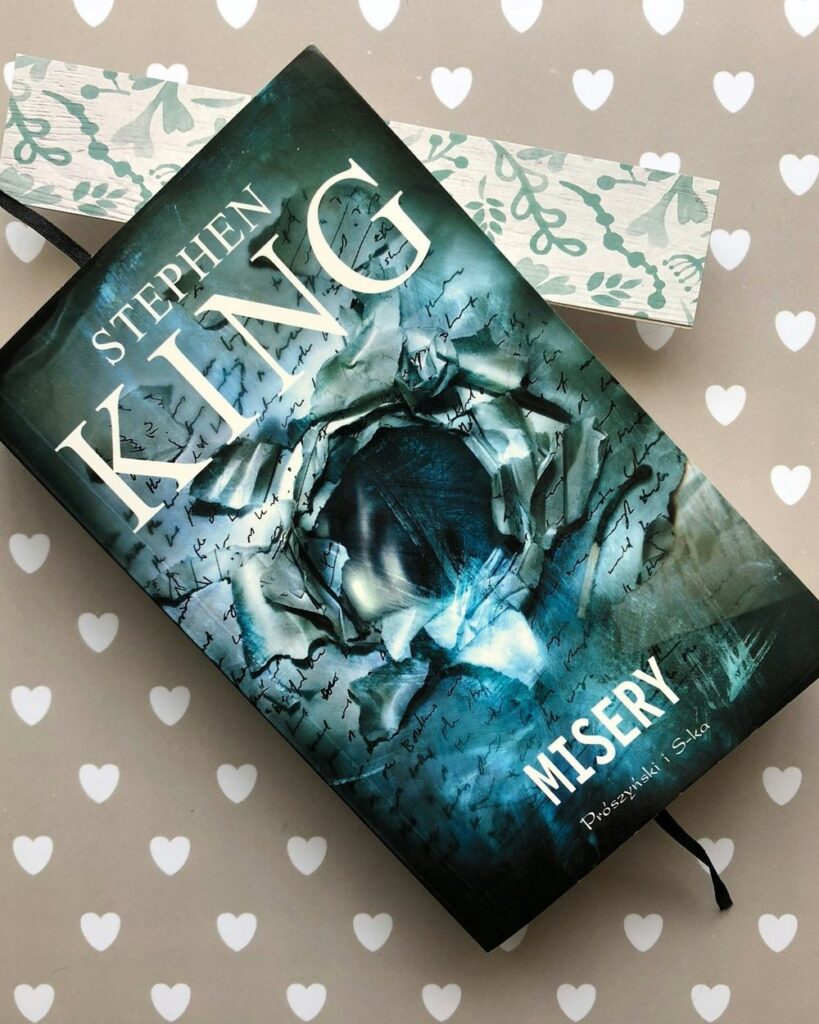
Author: Stephen King · Published: 1987 · Genre: Psychological Thriller, Horror
Misery is one of Stephen King’s best and most disciplined novels: a writer, a crazed fan and a locked house, with almost nothing supernatural in sight. It’s terrifying, darkly funny and sharp about addiction, fandom and why people write. It is also brutally violent. Read it if you can stomach that; it’s the best entry point for readers who think King isn’t for them.

What it’s about
Paul Sheldon is a bestselling novelist, famous for a series of Victorian romances about a heroine named Misery Chastain. He’s sick of her. In his latest Misery novel, he has killed her off, and he has just finished Fast Cars, the serious literary novel he hopes will make his name. Celebrating, he drives drunk into a Colorado snowstorm and crashes.
He wakes up with shattered legs in the remote farmhouse of Annie Wilkes, a former nurse who pulled him from the wreck. Annie is his number one fan. She is also dangerously unstable. When she reads the book in which Misery dies, she is enraged. She makes Paul burn his new manuscript and sets him up with an old typewriter, missing a key, to write a new novel bringing Misery back to life. Paul, dependent on the painkillers she controls, has no choice but to write for his life.
What works
- Annie Wilkes. She’s one of the great villains in popular fiction because she’s so specific: prudish, childishly refusing to swear, sentimental about her favourite books, and liable to switch from motherly to murderous in a sentence. King makes her frightening and, at times, oddly pitiable.
- Claustrophobia. Almost the whole novel takes place in one room, and King wrings enormous tension from small things: a wheelchair, a hairpin, a locked door, an unexpected visitor. It’s a masterclass in doing a lot with very little.
- Paul. He’s no saint. He’s vain, snobbish about the books that made him rich and contemptuous of his readers. His slow, grudging respect for his own popular work gives the story a real character arc, not just a survival plot.
- Writing about writing. Paul’s grudging rediscovery of his craft, as he tries to make Misery’s return good enough to satisfy Annie, is the book’s surprise. It’s a smart, honest look at storytelling and at the power readers can have over authors.
- The subtext. King later wrote that Annie stood for his own addictions to drugs and alcohol, and the book reads powerfully that way: a captor who feeds you and slowly destroys you.
What doesn’t
The violence is extreme. One scene in particular has made readers wince since 1987, and King describes injuries in lingering detail. If body horror bothers you, be warned.
The excerpts from Paul’s new Misery novel, printed in a different typeface, go on too long and slow the pace in the middle, where the cycle of Annie’s moods also starts to repeat. They also borrow the colonial adventure clichés of Victorian fiction, including a crudely stereotyped African setting, which reads badly today even as pastiche. Some readers also object to the way King describes Annie’s body, returning again and again to her size and comparing her to an idol, as if her weight were part of her monstrousness.
Rob Reiner’s 1990 film is excellent, and Kathy Bates won an Oscar for playing Annie, but the novel is darker and more interior.
Who should read it
Readers who like psychological thrillers, captivity stories and fiction about writers. It’s also the ideal King book for people who don’t read horror, since the monster is entirely human. Skip it if graphic violence is a dealbreaker.
Rating: 4.5/5
Photo credits — Featured image: Photo by Merylove Art on Unsplash. In-article photo: Photo by Sheila Sund via Flickr, CC BY 2.0, cropped.
