

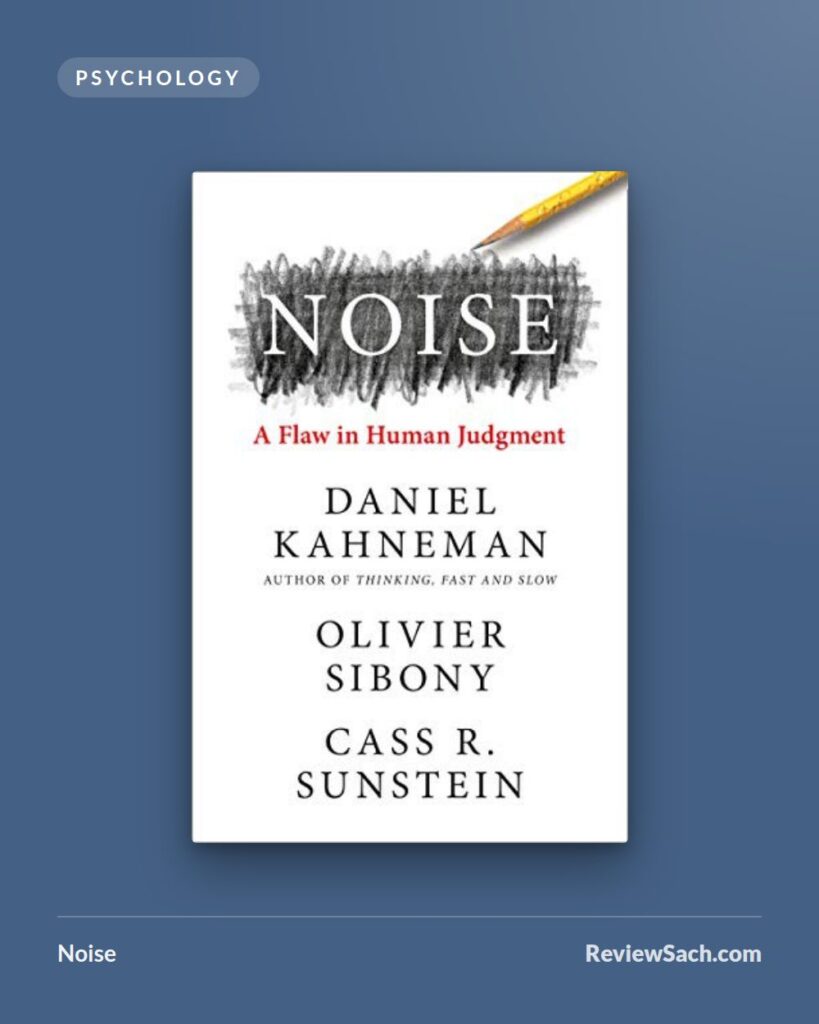
Author: Daniel Kahneman, Olivier Sibony and Cass R. Sunstein · Published: 2021 · Genre: Psychology, Decision-Making
Noise argues that professional judgment has a second flaw almost nobody measures: random scatter. Bias gets the headlines, but the authors show that doctors, judges, underwriters and hiring managers disagree wildly on identical cases, and that this inconsistency is just as costly. The idea is genuinely important. The book, though, is long and repetitive, so it’s best for people who make or manage judgments for a living.
The big idea
The book opens with teams of shooters at a target. A biased team clusters its shots, but off-center. A noisy team scatters them everywhere. Kahneman, Sibony and Sunstein define noise as unwanted variability in judgments that should be identical, and argue that organizations rarely notice it because nobody sees the other judgments.
They break it into parts. Level noise is when some judges are simply harsher than others across the board. Pattern noise is when individuals react in their own idiosyncratic way to particular cases. Occasion noise is the same person judging differently depending on mood, time of day or what came just before. In their error equation, noise counts as much as bias, so cutting either one reduces total error.
The remedy is what they call decision hygiene. First, measure noise with a noise audit. Then reduce it with structure: independent judgments averaged together, shared scales and guidelines, breaking a decision into separate assessments before any overall call, and, where possible, simple rules or algorithms.
What works
- The noise audit is a genuinely useful tool. The best example is an insurance company whose executives expected underwriters to differ by around 10% when pricing the same case. The actual median gap was about 55%. That story alone justifies the concept, and any organization can run a version of it.
- The sentencing material is sobering. The authors draw on studies where judges given the same case handed down wildly different sentences, and on Judge Marvin Frankel’s campaign for sentencing guidelines in the US. It makes the cost of noise concrete. It’s not a statistical abstraction; it’s years of someone’s life.
- The practical advice is solid. Having people judge independently before discussion, and delaying an intuitive overall verdict until separate factors have been scored, are cheap fixes that most teams could adopt tomorrow. The book formalizes this as the mediating assessments protocol, and it’s the most transferable idea here.
- It is honest about trade-offs. The authors admit that rigid rules can feel dehumanizing, that algorithms can encode unfairness, and that eliminating noise is sometimes not worth the cost.
What doesn’t
The main problem is length. The core argument fits in a long essay, yet the book runs past 400 pages and restates its central point many times. Several major reviews made the same complaint, and it’s hard to disagree.
The prose also shows its three authors. Some chapters read like Kahneman, others like a policy paper or a management text. The shifts in tone make it harder to read straight through than Thinking, Fast and Slow, and it lacks that book’s steady stream of memorable experiments.
Some critics also questioned how new the idea really is. Researchers have measured agreement between raters for decades, and the case for simple formulas over expert intuition goes back to Paul Meehl in the 1950s, whom the authors credit. The book’s contribution is emphasis and packaging rather than discovery.
Finally, the enthusiasm for rules and algorithms can feel a little too tidy. Variety of opinion is sometimes the point, in creative work, competitive markets or scientific debate, and the book deals with those cases only briefly.
Who should read it
Read it if you make repeated professional judgments, such as hiring, underwriting, grading, diagnosis or sentencing, or if you design the processes other people use. General readers will get most of the value from the opening chapters and the section on decision hygiene.
Rating: 3.5/5
Image credits — Cover image via Open Library. Cover design © the publisher, shown for review purposes.
