

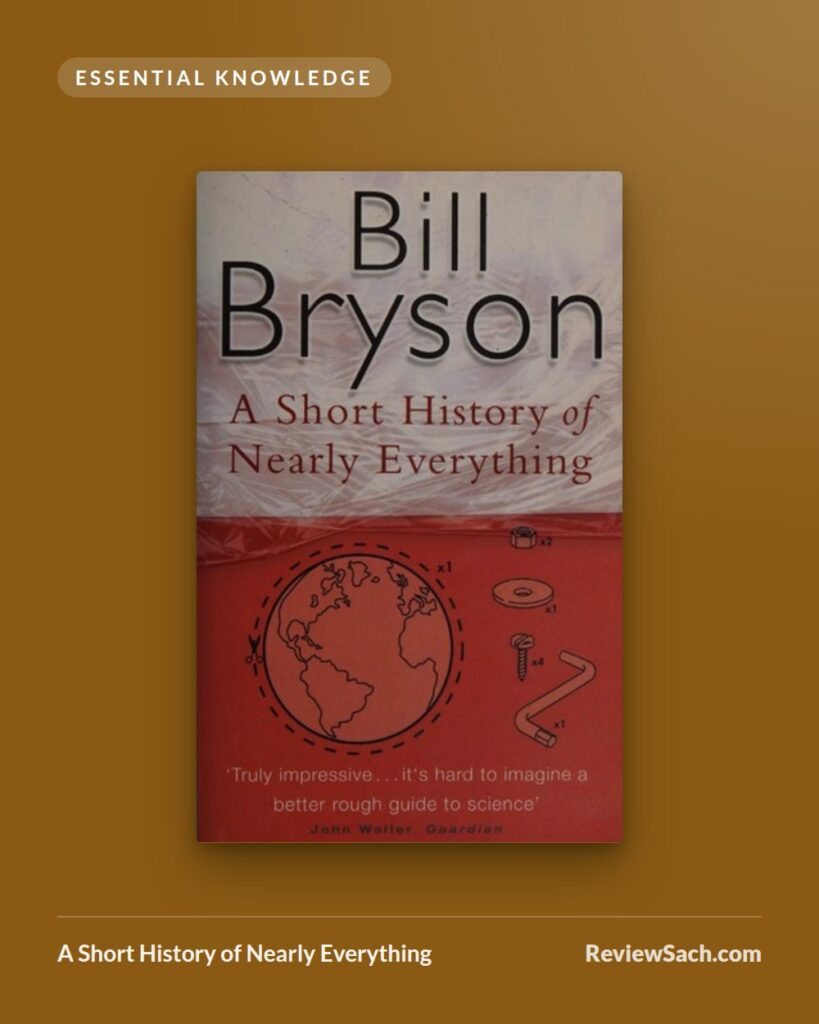
Author: Bill Bryson · Published: 2003 · Genre: Popular Science, History of Science
A Short History of Nearly Everything‘s biggest strength is its storytelling: Bryson turns how we learned the age of the Earth, the size of atoms and the history of life into funny, human stories about the eccentric people who worked it out. Its biggest weakness is that those stories often crowd out the science, so you finish knowing who discovered things better than how they work, and the original edition is now more than twenty years old. It’s the ideal book for curious adults who were bored by science at school.
The core ideas
Bryson, a travel writer rather than a scientist, set out to understand the basics he’d never grasped: how we know what we know about the universe, the Earth and life.
- The universe and the solar system. From the Big Bang to the sheer emptiness of space. Bryson points out that textbook diagrams can’t show the solar system to scale, because the distances are too vast to fit on a page.
- Measuring the Earth. Henry Cavendish weighing the planet with a delicate torsion balance, and Clair Patterson dating the Earth to about 4.5 billion years using lead isotopes, then spending years fighting leaded petrol after discovering how much lead humans had spread through the environment.
- A restless, dangerous planet. Plate tectonics, including how long Alfred Wegener’s idea of continental drift was dismissed, plus earthquakes, asteroid impacts and the supervolcano beneath Yellowstone.
- Life. Cells, bacteria, evolution, mass extinctions and human origins, ending with a sobering look at how many species humans have wiped out, from the dodo onward.
What’s great
- Very funny. Bryson’s humor makes dense material easy to read, and his sense of astonishment is contagious.
- Science as a human activity. You learn that science is done by rivals, obsessives and overlooked outsiders, from the fossil hunter Mary Anning to the engineer Thomas Midgley, whose inventions of leaded petrol and CFCs did enormous harm.
- Wide research. Bryson consulted many working scientists, and the book won the Aventis Prize for Science Books in 2004 and the EU’s Descartes Prize for science communication in 2005.
What’s weak
- Anecdotes over explanation. Hard topics like quantum mechanics and relativity get a quick, breezy treatment. You learn that they’re strange, but not much about why.
- Dated. The first edition predates the discovery that many living humans carry Neanderthal DNA (2010), the Higgs boson (2012), the first direct detection of gravitational waves (2015) and Pluto’s reclassification as a dwarf planet (2006).
- Secondhand. As a non-specialist working from interviews and secondary sources, Bryson sometimes passes on simplified stories, and some details haven’t held up. Correcting errors in the original was one stated aim of the 2025 revision.
- Uneven pacing. It’s a long book, and some chapters feel like strings of fascinating facts rather than an argument that builds.
Who should read it
Read it if you want a broad, entertaining overview of science and its history, or want to rekindle the curiosity school drained out of you. If you’re buying it now, choose A Short History of Nearly Everything 2.0, the fully revised edition published in October 2025, which covers two decades of new discoveries from Pluto’s demotion to newly identified early human species. Then follow up with a specialist book on whichever chapter grabbed you most.
Rating: 4.5/5
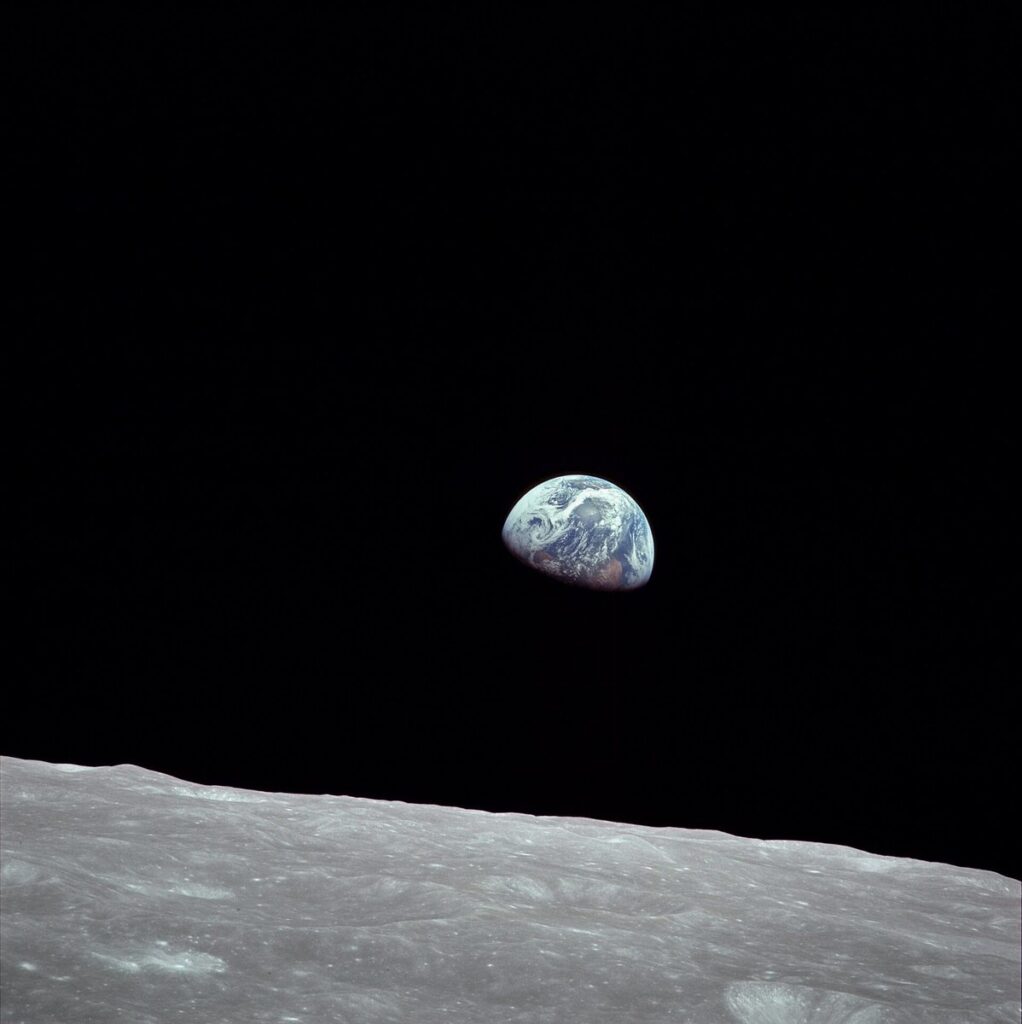
Image credits — Featured image: cover image via Open Library; cover design © the publisher, shown for review purposes. In-article images: Image by NASA / Bill Anders (Apollo 8) via Wikimedia Commons, Public Domain.
