

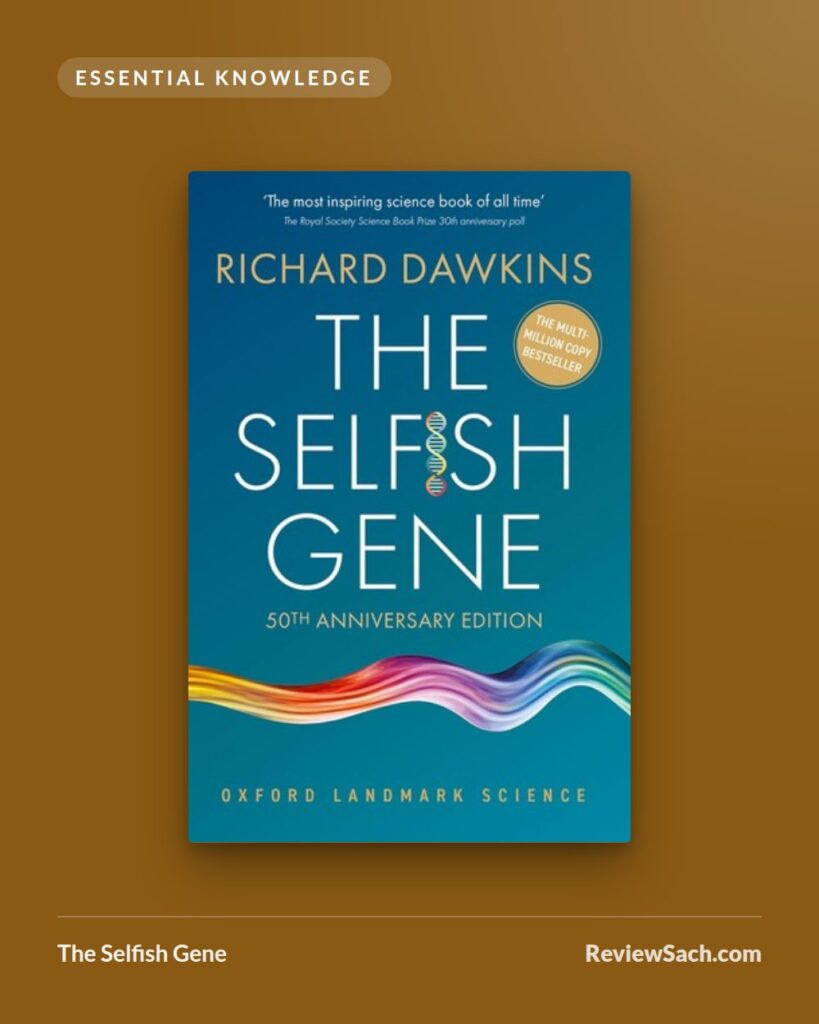
Author: Richard Dawkins · Published: 1976 · Genre: Science, Evolutionary Biology
The Selfish Gene‘s biggest strength is how clearly it explains a hard idea: natural selection makes most sense from the point of view of genes, and that view solves puzzles like self-sacrifice in social insects and parents. Its biggest weakness is its central metaphor, which invites the misreading that genes, or people, are selfish in a moral sense, and which critics say overstates the gene’s role. It’s essential for anyone interested in evolution, as long as you also read the objections.
The core ideas
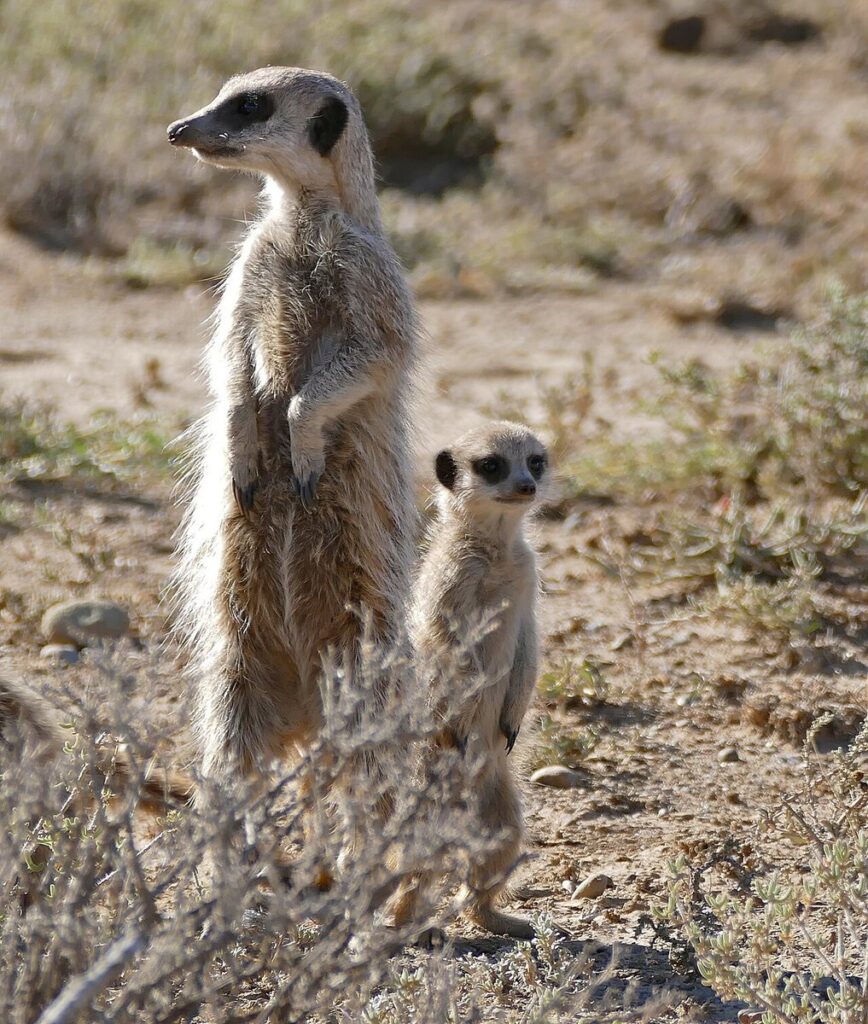
- Replicators and survival machines. Genes are what gets copied across generations; bodies are temporary survival machines that genes build to get themselves copied. “Selfish” only means that a gene which promotes its own replication spreads, while one that doesn’t disappears. Genes have no motives.
- Altruism from selfish genes. Building on W. D. Hamilton’s kin selection, Dawkins shows why an animal may help or even die for relatives who share its genes. Robert Trivers’s reciprocal altruism explains cooperation between non-relatives who can return the favor.
- Evolutionarily stable strategies. Using John Maynard Smith’s game theory, a simple hawks-and-doves model shows why animals often fight with restraint rather than all-out aggression.
- Memes. In the first edition’s final chapter, Dawkins coined “meme” for a unit of culture, such as a tune or a catchphrase, that spreads by copying.
Dawkins was synthesizing work by Hamilton, George C. Williams, Trivers and Maynard Smith, and he says so.
What’s great
- Superb explanation. Thought experiments like the “green beard,” a gene that makes its carriers recognize and help each other, make abstract theory intuitive.
- Strong later additions. The 1989 second edition added a chapter on how cooperation evolves in a repeated Prisoner’s Dilemma, drawing on Robert Axelrod’s computer tournaments, and one previewing The Extended Phenotype.
- Self-correcting endnotes. Later editions annotate the original text, flagging where Dawkins would now change his wording.
The controversy
The debate is mostly about framing, not basic facts.
- The metaphor. Philosopher Mary Midgley attacked the book in 1979 for treating genes as if they had motives, and Dawkins replied that “selfish” was technical shorthand. Still, many readers took the title to mean humans are naturally selfish, which the book doesn’t claim; Dawkins argues that we, uniquely, can rebel against our genes. He later granted that his editor’s suggested title, The Immortal Gene, might have been better.
- Is the gene the unit of selection? Stephen Jay Gould argued that selection acts on whole organisms and genes merely record the result. Advocates of multilevel selection, including David Sloan Wilson and E. O. Wilson, argue that selection between groups matters too. A 2010 Nature paper by Martin Nowak, Corina Tarnita and E. O. Wilson attacked kin selection theory, and well over a hundred evolutionary biologists signed a reply defending it. Many biologists now see gene-level and multilevel accounts as different bookkeeping for the same process rather than rival truths.
- Genes are messier than in 1976. Critics such as physiologist Denis Noble argue that gene regulation, development and epigenetics make genes far less like independent agents than the book implies. Defenders answer that the gene’s-eye view is about what persists over evolutionary time, not how cells work.
- Memes proved a catchy word but a weak research program.
Who should read it
Read it if you want to understand modern evolutionary thinking, and pair it with a critic such as Gould or Noble for balance. Get any edition from 1989 onward for the two added chapters and Dawkins’s endnotes.
Rating: 4.5/5
Image credits — Featured image: cover image via Open Library; cover design © the publisher, shown for review purposes. In-article images: Image by Bernard DUPONT via Wikimedia Commons, CC BY-SA 2.0.
