

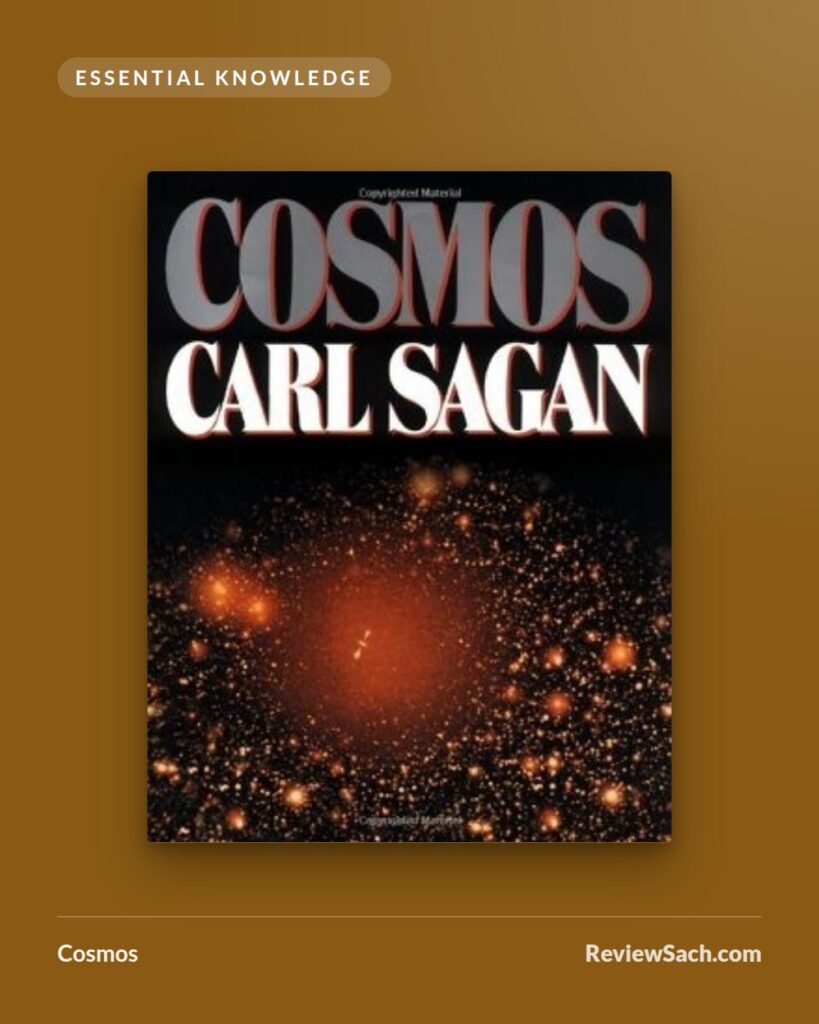
Author: Carl Sagan · Published: 1980 · Genre: Science, Astronomy
Cosmos‘s biggest strength is Sagan’s voice: nobody has better conveyed both what we know about the universe and why knowing it should move us. Its biggest weakness is its history, which often turns the past into a simple story of heroes of reason against villains of superstition, alongside planetary science that is now more than four decades old. It’s worth reading for anyone who wants to feel why science matters, not just learn what it says.
The core ideas
The book was written alongside Sagan’s 13-part TV series, Cosmos: A Personal Voyage, and its 13 chapters follow the episodes.
- We are part of what we study. The atoms in our bodies were forged inside earlier stars, which gives Sagan his most famous line: we are made of “star-stuff.”
- Science is a way of thinking. Sagan shows Eratosthenes estimating Earth’s circumference from shadows in two Egyptian cities, and Kepler abandoning his cherished geometric model of the planets because Tycho Brahe’s precise observations of Mars didn’t fit it.
- Life as chemistry plus time. He explains natural selection and speculates, carefully labeled as speculation, about how life could arise from simple chemistry.
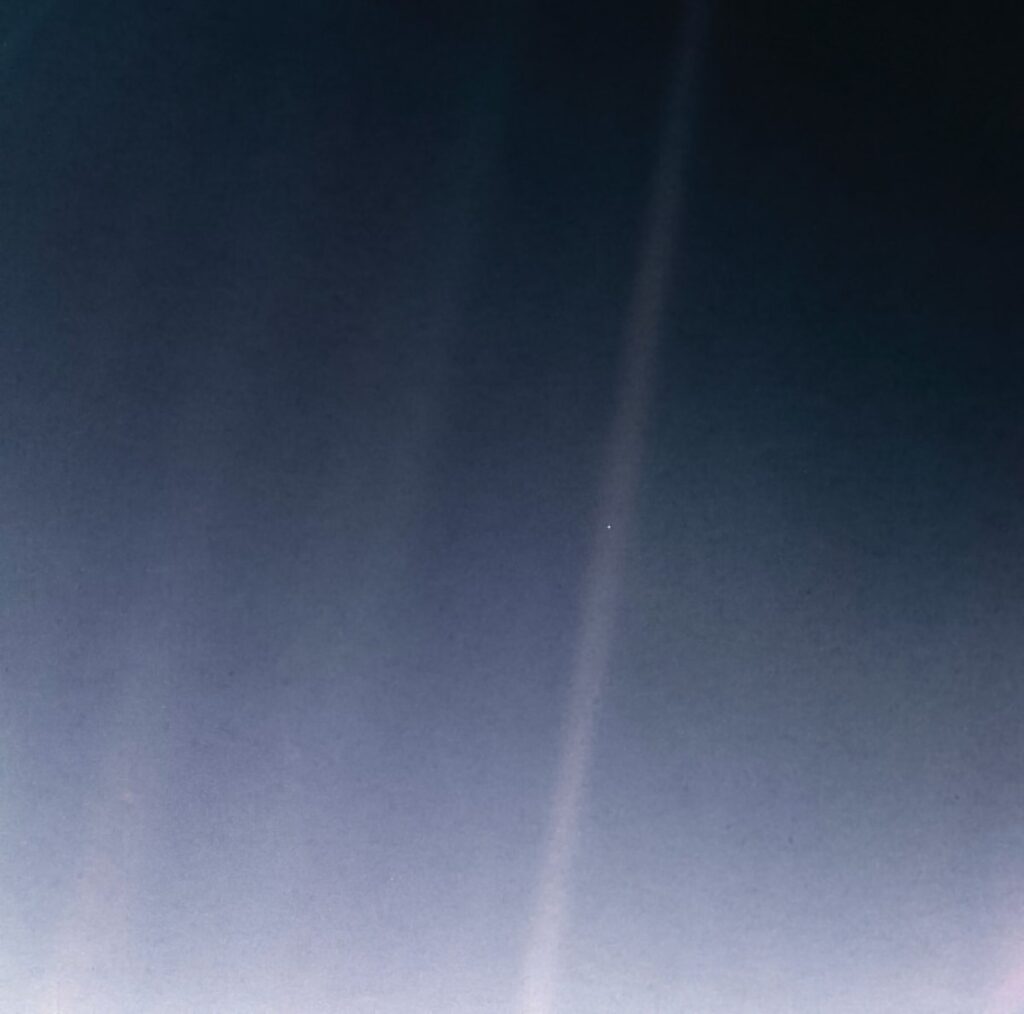
- Our neighbors in space. Chapters on Venus’s runaway greenhouse effect, the Viking landers’ search for life on Mars and the Voyager missions show planetary science as it stood in 1980, when Sagan was part of those missions.
- Are we alone, and will we last? He walks through the Drake equation for estimating how many communicating civilizations might exist, and ends with a plea to avoid nuclear war and treat Earth as fragile.
What’s great
- The prose. Sagan writes with warmth and rhythm, and makes enormous scales of time and space feel personal.
- Science as a human story. The chapter on Kepler, a man who gave up the theory he loved because the data said no, is one of the best short accounts of scientific honesty anywhere.
- Skepticism with humility. Sagan takes on astrology and pseudoscience directly, but keeps stressing how much we still don’t know.
- Still urgent. His warnings drawn from Venus about a runaway greenhouse, and about how easily we could wreck our own planet, read even more pointedly now.
What’s weak
- Dated science. Much of the solar-system material predates decades of discoveries, from the Mars rovers to the thousands of exoplanets found since the 1990s. The Cold War framing of the last chapter also dates it.
- Shaky history. Historians have criticized Sagan’s romantic account of the Library of Alexandria, including his portrait of the mathematician Hypatia as its last great scholar, since the great library had most likely declined long before her lifetime. His picture of the Middle Ages as a thousand years of darkness is a caricature most historians reject, and his treatment of Pythagoras and Plato as enemies of experiment is one-sided.
- The Heike crab. Sagan’s charming example of unintended artificial selection, Japanese crabs whose shells supposedly came to resemble samurai faces because fishermen threw those back, has been disputed. The ridges mark muscle attachments, similar patterns occur on related and fossil crabs, and people don’t really eat these crabs anyway.
Who should read it
Read it if you want to understand why people fall in love with science, especially if you’re a teenager or a lapsed science student. Treat it as inspiration rather than a current reference, and watch the original series alongside it. Neil deGrasse Tyson’s 2014 series, Cosmos: A Spacetime Odyssey, updates some of the science.
Rating: 4/5
Image credits — Featured image: cover image via Open Library; cover design © the publisher, shown for review purposes. In-article images: Image by NASA/JPL-Caltech via Wikimedia Commons, Public Domain.
