

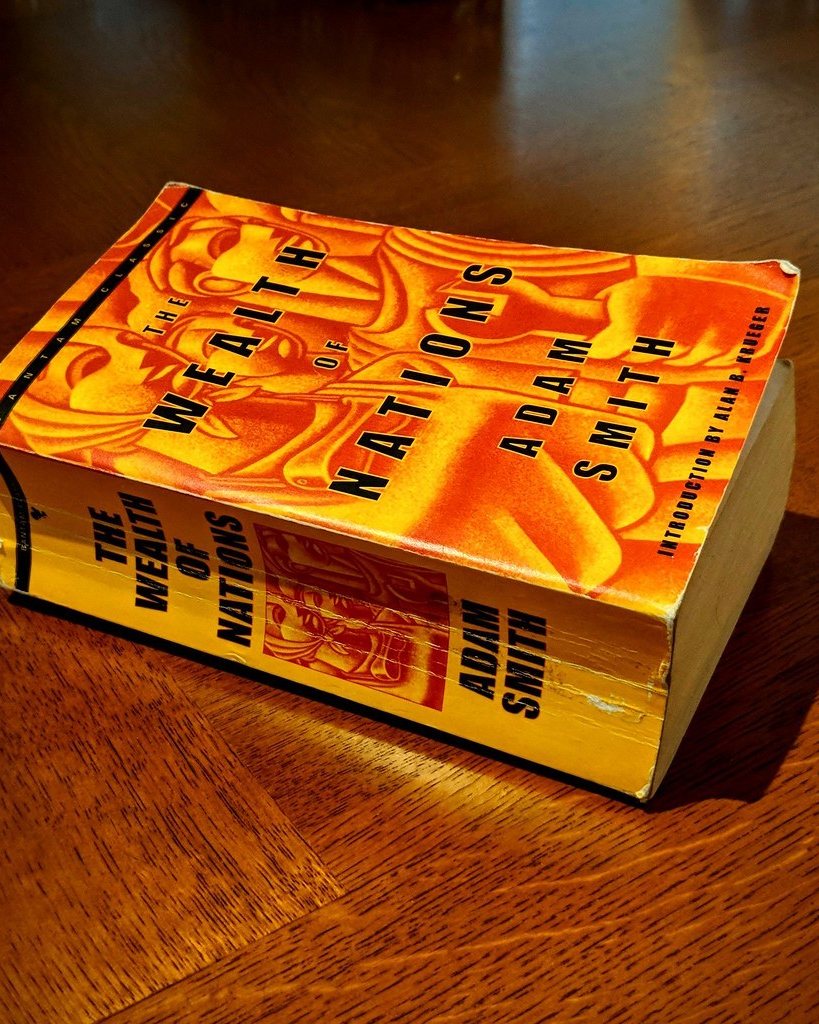
Author: Adam Smith · Published: 1776 · Genre: Economics, Political Philosophy
The Wealth of Nations is the book that turned political economy into a subject, and its biggest strength is how much of it still explains the world: specialization, markets, and the way special interests bend policy in their favor. Its biggest weakness is sheer bulk. It runs to five books, with long stretches of 18th-century detail on grain prices, colonial trade and the value of silver that are now mainly of historical interest. It’s worth reading, at least in large part, for anyone who argues about markets and wants to know what Smith actually said.
The core ideas
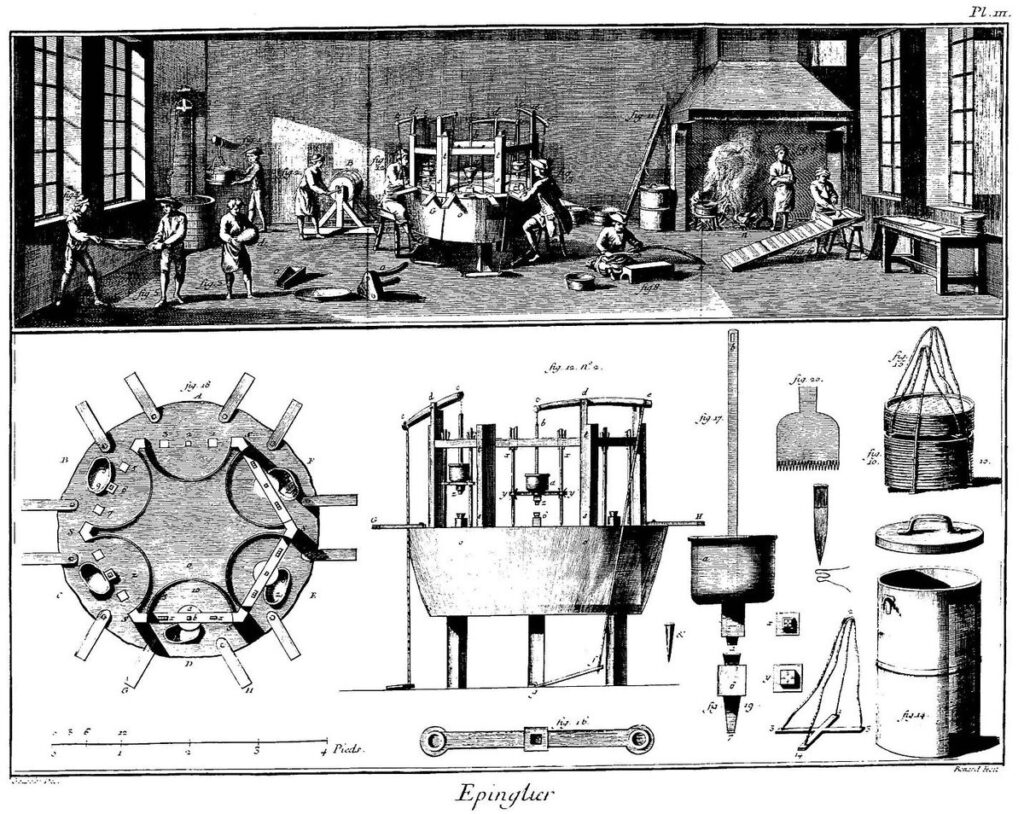
- Division of labor. In Smith’s famous pin factory, one untrained worker could barely make a single pin a day, but ten workers splitting the job into specialized steps could make tens of thousands. Specialization, not gold or land, drives wealth, and it is limited by the size of the market.
- Self-interest, coordinated by exchange. We get our dinner not from the kindness of the butcher, brewer or baker, but from their attention to their own interest. Competition pulls market prices toward a natural price, coordinating countless such choices without a central plan.
- The case against mercantilism. Smith attacks the idea that a nation grows rich by piling up gold and running trade surpluses. Real wealth is what people can produce and consume. Tariffs, monopolies and export subsidies mostly protect merchants at the public’s expense.
- A real role for government. Book V sets out the duties of the state: defense, justice, public works that private parties won’t build, and basic education for ordinary workers.
What’s great
Smith is far less of a cheerleader for business than his reputation suggests. He warns that people in the same trade rarely meet, even for fun, without the conversation turning into a plot against the public, and he treats merchants’ policy proposals with suspicion because their interests differ from society’s. His attacks on the East India Company and colonial monopolies are fierce.
He also sees the human cost of specialization. In Book V he worries that endlessly repetitive work can leave people ignorant and dull, and he proposes public schooling as a remedy. The “invisible hand,” now a slogan for unregulated markets, appears only once in the book, in a passage about investors preferring domestic industry.
The prose is clear and often dryly funny, and he reasons from concrete examples: the pin factory, the many trades that go into a laborer’s woollen coat, the Highland farmer who must be his own butcher, baker and brewer because the local market is too small.
What’s weak
Much of the book is dated. The long digression on the value of silver, the account of the Bank of Amsterdam and the detailed colonial trade figures will lose most modern readers. Smith’s theory of value also wavers between labor, cost of production and market price, an ambiguity that David Ricardo and Karl Marx later built on and that modern price theory replaced.
It is easy to misread in either direction. Free-market readers skip his support for some regulation, such as a legal ceiling on interest rates and the Navigation Acts, which he defended because defense matters more than wealth. Critics who treat him as a prophet of greed skip his earlier book, The Theory of Moral Sentiments (1759), about sympathy and moral judgment. Neither caricature survives a real reading.
Who should read it
Economics students, policy readers and anyone who quotes Smith should read at least Books I, IV and V. A good annotated or abridged edition makes the job much easier, and pairing it with The Theory of Moral Sentiments gives the fuller picture of the man.
Rating: 4/5
Image credits — Featured image: Image by steevithak via Flickr, CC BY-SA 2.0, cropped. In-article images: Image by quinet via Flickr, CC BY 2.0; Image by Encyclopédie of Diderot and d’Alembert (engraved by Robert Bénard after Louis-Jacques Goussier) via Wikimedia Commons, Public Domain.
