

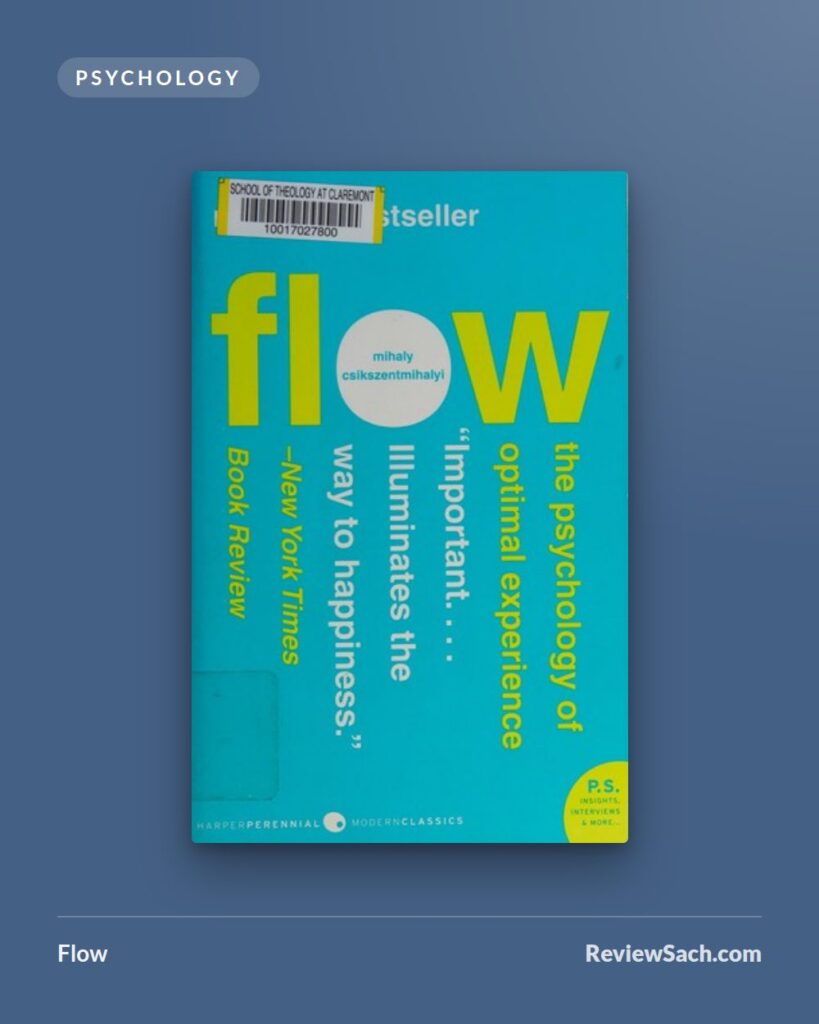
Author: Mihaly Csikszentmihalyi · Published: 1990 · Genre: Psychology, Positive Psychology
Flow argues that happiness comes less from pleasure or luck than from deep absorption in challenging activities. The core idea is important and has shaped decades of research on work, sport and creativity. The book itself is uneven: the first half is excellent, the second drifts into vague philosophy. Read it for the concept, and skim freely.
The big idea
Csikszentmihalyi, a Hungarian-American psychologist who spent much of his career at the University of Chicago, studied people who do demanding things for their own sake: rock climbers, chess players, dancers, surgeons. They described the same state. Attention locks onto the task, self-consciousness disappears, time seems to speed up or slow down, and the activity feels worth doing for itself. He called this state flow.
To study it in daily life, his team gave people pagers that beeped at random moments and asked them to note what they were doing and how they felt. This experience sampling method showed that flow is not rare or reserved for artists and athletes.
Flow tends to appear under specific conditions: clear goals, immediate feedback, and a close match between the challenge and your skills. Too easy produces boredom; too hard produces anxiety. The practical lesson is to shape your tasks so they sit in that narrow channel, and to develop what he calls an autotelic personality, one that finds reward in the activity itself rather than in outside payoffs.
What works
- A concept you can use. Once you understand the balance between challenge and skill, you can diagnose a dull job or a stalled hobby. Raise the stakes on easy work; break overwhelming work into pieces with quick feedback.
- The paradox of work. One of the book’s most striking findings is that people report flow far more often at work than in their free time, yet still say they would rather be at leisure. It is a sharp observation about how poorly we judge our own experience.
- Memorable examples. An assembly-line worker who turns a repetitive task into a personal race against his own best time shows that flow depends more on how you approach a job than on the job itself. An elderly woman farming in the Italian Alps describes her daily chores with the same satisfaction climbers describe a summit.
- A respectable counterweight to consumerism. The book makes a persuasive case that passive entertainment, like hours of television, rarely produces lasting satisfaction, while skills built over time do.
What doesn’t
The second half loses focus. Chapters on the body, thought, work, relationships and meaning cover so much ground that the specific science thins out. By the final chapter, Csikszentmihalyi is writing broad philosophy about bringing order to consciousness and unifying one’s goals, which is hard to disagree with and hard to put into practice.
The prose is dense and abstract. Coined terms such as psychic entropy add weight without adding much clarity, and the same points about attention and order recur chapter after chapter.
There are conceptual gaps too. Flow is easier to describe than to measure, and the book doesn’t clearly separate it from ordinary enjoyment or concentration. It also gives limited attention to the downside: people can find absorbing, flow-like states in gambling, compulsive gaming or risky pursuits that harm them and those around them.
Finally, it isn’t a how-to book, despite how it’s often sold. There are no exercises or step-by-step plans, and readers expecting a practical productivity guide may feel frustrated.
Who should read it
People interested in motivation, creativity or the design of work, and anyone who feels bored or anxious in their daily routine. If you want a shorter, more practical version, try his later Finding Flow first.
Rating: 3.5/5
Image credits — Cover image via Open Library. Cover design © the publisher, shown for review purposes.
