

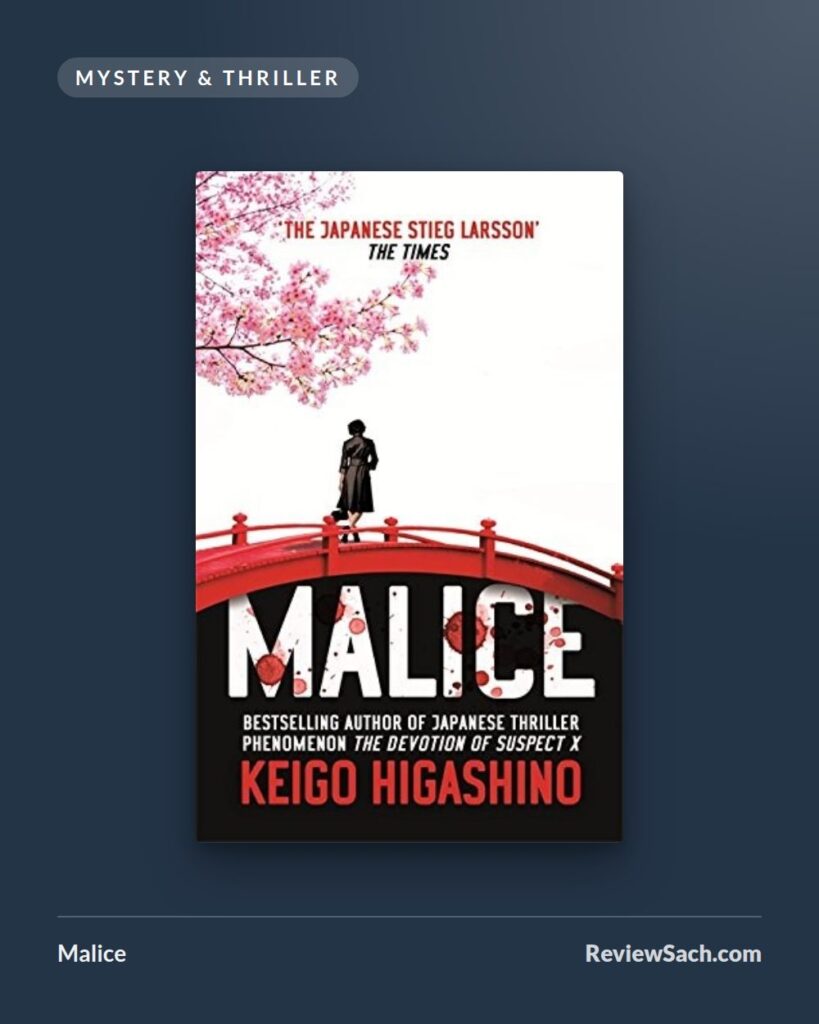
Author: Keigo Higashino · Published: 1996 · Genre: Mystery, Japanese Crime Fiction · Original title: Akui
Malice gets the question of who out of the way surprisingly early, then asks something harder: why. It is a quiet, cerebral novel built from written accounts and interview notes, and its structure is the star. Read it if you enjoy puzzles about people rather than footprints, but expect little action and very plain prose.
What it’s about Kunihiko Hidaka, a best-selling novelist, is found dead in his home office just before he is due to move to Vancouver. His body is discovered by his wife, Rie, and his old friend Osamu Nonoguchi, a writer of children’s books. The case goes to Detective Kyoichiro Kaga, who knows Nonoguchi from years earlier, when both men taught at the same school, before Kaga left teaching for the police.
The novel alternates between two kinds of document: Nonoguchi’s written account of events, and Kaga’s own notes and records of interviews. Each one asks you to trust it, and each one reframes what came before. The field of suspects narrows fast. The real investigation is into motive, and into the gap between what people write down and what actually happened.
Higashino shows his hand early on purpose. The suspense comes from Kaga’s patient digging, from interviews with old schoolmates and neighbours, and from rereading earlier chapters in a new light, rather than from a last-page surprise. It reads closer to a psychological case study than to a traditional whodunit.
What works – Structure as puzzle. Higashino turns the documents themselves into evidence. Who wrote what, when and for whom becomes the whole game. It is a book about storytelling disguised as a police procedural, and it rewards close reading. – Kaga. He is patient, polite and relentless, a detective who wins by noticing a slightly wrong word or a detail that is too convenient. His years as a teacher make him interested in people’s histories, and that instinct drives the case. – The slow reveal of motive. Every time you think you understand why the crime happened, the next chapter shifts the ground under you. The final picture is darker and more unsettling than the tidy opening suggests. – Fair play. The facts you need are laid out in front of you. A sharp reader can get close to the truth, though probably not all the way.
What doesn’t The style is very plain. Alexander O. Smith’s translation reads cleanly, but there is little atmosphere, and few characters come alive beyond their function in the plot. Much of the second half consists of interviews with former classmates, neighbours and acquaintances, and this stretch can feel like reading case files, which is more or less what it is.
Some readers find the whydunit format anticlimactic. If you read mysteries for the jolt of a hidden killer unmasked in the final chapter, Malice deliberately withholds that pleasure. Its big reveals are about character and history, and they ask you to accept a level of human spite that some will find overstated. The ending is quieter than the setup promises.
It also helps to know that this is one of several novels featuring Kaga, and it was the first of them published in English, in 2014, almost two decades after the Japanese original. You do not need the others to follow it, but Kaga’s background is sketched only lightly, so he can feel more like a function than a person on first meeting.
Who should read it Readers who loved The Devotion of Suspect X and want to see Higashino play with form. It suits fans of Columbo-style psychological cat-and-mouse and anyone interested in unreliable narration. If you want pace, atmosphere or a twist in the last line, start elsewhere.
Rating: 4/5
Image credits — Cover image via Open Library. Cover design © the publisher, shown for review purposes.
