

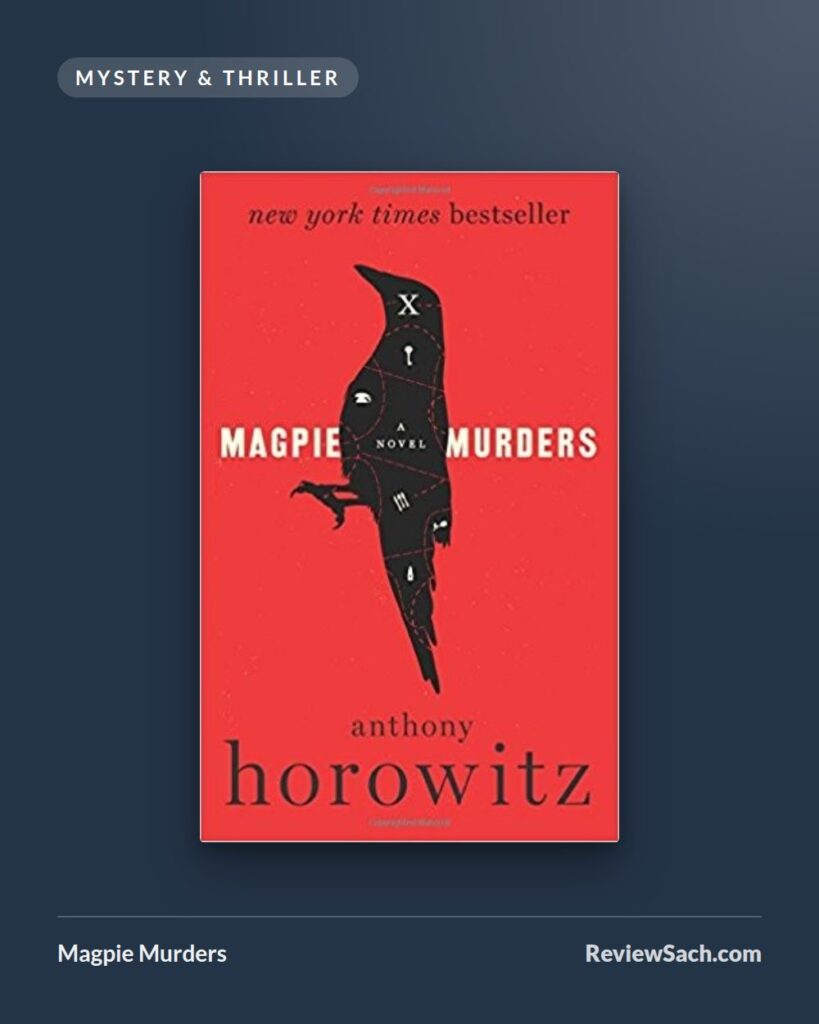
Author: Anthony Horowitz · Published: 2016 · Genre: Whodunit, Metafiction
Magpie Murders is two complete whodunits in one: a loving Agatha Christie pastiche set in 1955, wrapped inside a modern mystery about the man who wrote it. It’s clever, generous and fair, and it’s one of the most enjoyable puzzle mysteries of the past decade. The modern half is weaker than the vintage one, but fans of classic detective fiction should read it.
What it’s about
Susan Ryeland is an editor at Cloverleaf Books, a small London publisher. Its biggest earner is Alan Conway, author of a bestselling series about Atticus Pünd, a German refugee detective. Susan sits down to read the manuscript of Conway’s ninth Pünd novel, Magpie Murders, and so do we.
In that book, set in the village of Saxby-on-Avon in 1955, a housekeeper named Mary Blakiston dies after falling down the stairs at Pye Hall, the home of her employer, Sir Magnus Pye. Gossip spreads, grudges surface, and soon a second death follows. Pünd, who has just received grim news about his own health, arrives with his assistant, James Fraser, to investigate.
Then the manuscript stops. The final chapters, with the solution, are missing. Susan soon learns that Conway himself has died. Her boss, Charles Clover, has a letter that seems to explain everything, but Susan, who knew Conway well and never liked him, isn’t convinced. She sets out to find both the missing pages and the truth.
What works
- The pastiche. The Pünd novel is a superb imitation of a Golden Age mystery: a closed village, a big house, a vicar, secrets and a meticulous detective. It works as a satisfying mystery on its own terms, not just as a parody.
- Atticus Pünd. A quiet, courteous survivor of a Nazi concentration camp who is now facing his own mortality, Pünd is more than a Poirot knock-off. His illness gives the old-fashioned story unexpected weight.
- Fair play, twice. Both mysteries are properly clued. Horowitz plants details in plain sight and plays fair with the reader in both timelines.
- Book-world satire. Horowitz knows publishing, and the modern half is sharp on editors, bestseller economics and writers who resent their own creations. Conway’s contempt for the detective who made him rich is a nice joke about crime fiction itself.
- Wordplay. The book is full of names, puns and hidden games. Spotting them adds to the fun, and some of them matter more than you’d expect.
What doesn’t
The frame story isn’t as much fun as the book within the book. Susan is a capable but rather flat narrator, and after the cosy pleasures of Saxby-on-Avon, the modern investigation feels heavier and slower. Her subplot about her relationship and her future in publishing takes up space without adding much.
The structure also asks for patience. The Pünd novel occupies roughly the first half, so the modern mystery starts late, and readers who don’t care for pastiche may find it a long wait. Some of the metafictional cleverness can feel pleased with itself. The final explanation of the modern mystery is also long, with a great deal of exposition delivered at once.
The novel has two sequels featuring Susan, Moonflower Murders and Marble Hall Murders. The 2022 TV adaptation, with Lesley Manville as Susan, was well received.
Who should read it
Fans of Agatha Christie, Golden Age mysteries and fiction about books will love it. It’s also a treat for anyone who enjoyed Knives Out or Only Murders in the Building. Read it in print if you can: the book-within-a-book comes with its own title page and front matter, and the layout is part of the fun. If you want gritty realism, look elsewhere.
Rating: 4.5/5
Image credits — Cover image via Open Library. Cover design © the publisher, shown for review purposes.
