

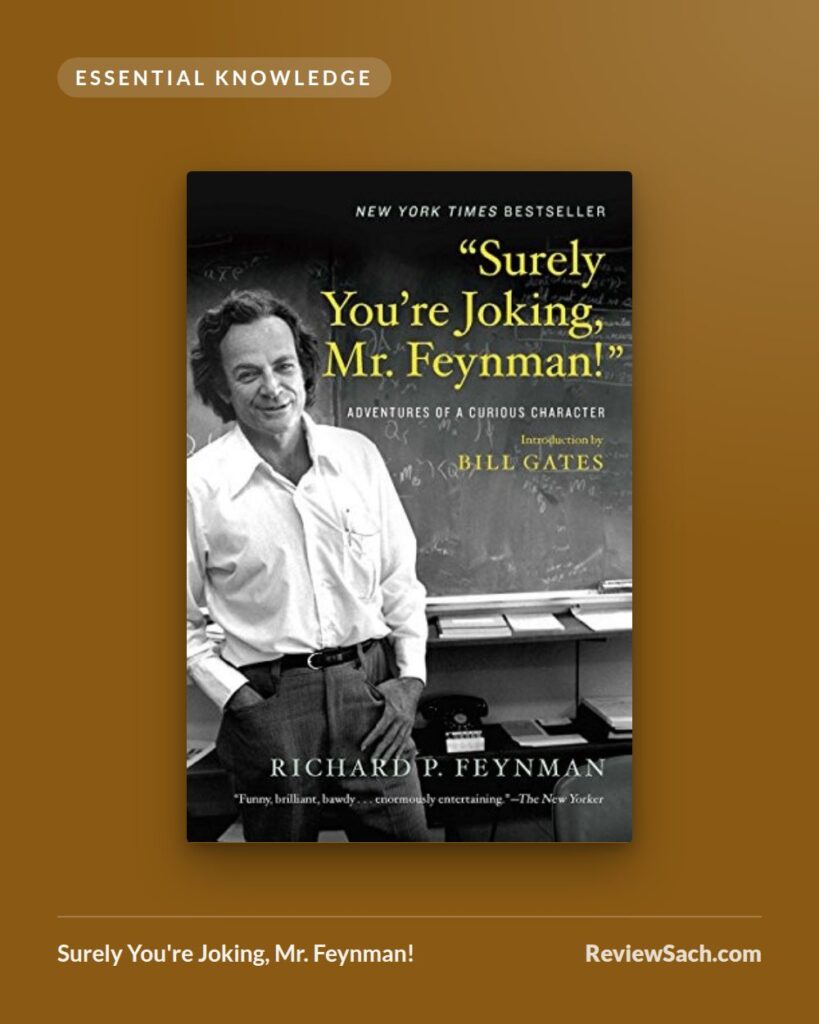
Author: Richard P. Feynman · Published: 1985 · Genre: Memoir, Science
Surely You’re Joking, Mr. Feynman! is the most entertaining case for curiosity you will find. Its biggest strength is that it shows a Nobel-winning physicist thinking out loud, and it makes you want to do the same. Its biggest weakness is that Feynman is the hero of every story, and his chapter on women has aged badly. Read it to see how a scientist’s mind works, not to learn physics.
The core ideas
The book is a string of stories Feynman told his drumming partner Ralph Leighton, who recorded and shaped them. There is no single thesis, but a few ideas run through everything:
- Figure it out yourself. As a boy he fixes radios by thinking about what must be wrong before touching anything. At Los Alamos he teaches himself to open the safes holding atomic secrets, mostly by noticing that people leave them on factory settings or write the combinations down.
- Play leads to serious work. Burned out at Cornell, he decides to do physics only for fun. He sees someone toss a plate in the cafeteria, works out its wobble for no reason, and says that idle game led him back to the work that later won the Nobel Prize.
- Understanding is not memorizing. Teaching in Brazil, he meets students who can recite definitions but can’t connect them to the world outside the window. On a California committee choosing school math textbooks, he finds reviewers rating a book whose pages were blank.
- Don’t fool yourself. The closing chapter, his 1974 Caltech commencement speech on “cargo cult science,” argues that integrity means reporting everything that could prove your result wrong, and that the easiest person to fool is yourself.
What’s great
- The voice. Feynman writes the way he talked: fast, funny, irreverent and allergic to pomposity. The Princeton tea party that gives the book its title, where he asks for both cream and lemon, sets the tone.
- Real lessons inside the jokes. The safecracking stories are about security theater: the locks were fine, the people weren’t. The Brazil chapter is a sharp critique of rote education that still applies in many classrooms.
- Range. He learns to draw and sells pictures under a pseudonym, plays percussion in a samba band in Rio, and treats each new hobby with the same obsessive curiosity as physics. The message is that expertise comes from paying attention, not from credentials.
What’s weak
- A curated self-portrait. Feynman always outwits the bureaucrat, the expert or the lock. His Caltech colleague Murray Gell-Mann complained that Feynman spent a lot of energy generating anecdotes about himself, and some stories feel polished for effect.
- Women. One chapter describes his strategy for picking up women in bars, which rests on treating them with contempt. Many readers now find it the book’s low point, and elsewhere women mostly appear as prizes or background.
- Little physics. If you want to understand quantum electrodynamics, try his short book QED instead. The Manhattan Project mostly serves as a backdrop for pranks, with only brief reflection on what the bomb meant.
Who should read it
Anyone curious about how scientists actually think, especially students who find science dry, will get the most from it. Read it for the attitude, not as a reliable biography: James Gleick’s Genius gives the fuller picture. The follow-up, What Do You Care What Other People Think?, covers his first wife’s death and his work on the Challenger inquiry and is more moving.
Rating: 4/5
Image credits — Featured image: cover image via Open Library; cover design © the publisher, shown for review purposes. In-article images: Photo by Roman Mager on Unsplash.
