

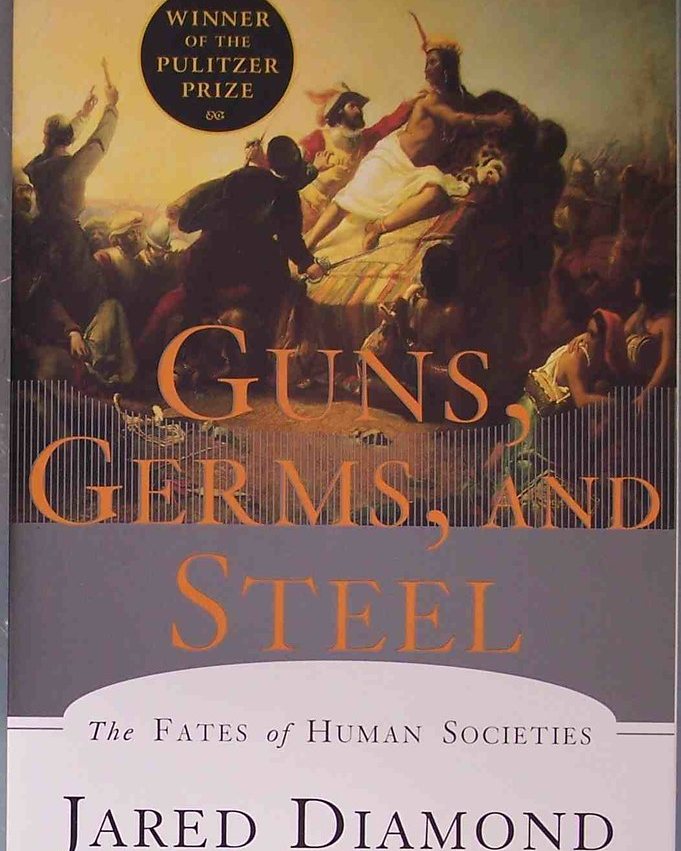
Author: Jared Diamond · Published: 1997 · Genre: History, Geography
Guns, Germs, and Steel asks why Europeans conquered the Americas rather than the reverse. Its biggest strength is the ambition of its answer: a single chain of causes running from wild plants and animals to empires, explained clearly enough to win the 1998 Pulitzer Prize. Its biggest weakness is that the chain is too neat, and many historians and anthropologists see it as geographic determinism that leaves little room for politics, culture and choice. It’s essential for anyone interested in world history, as long as you read the critics too.
The core ideas
- Yali’s question. The book starts from a New Guinean politician asking Diamond why white people had so much cargo and New Guineans so little. Diamond’s answer: environment, not race or intelligence.
- Food production is the root. The Fertile Crescent had wild wheat, barley and other plants that were easy to domesticate, plus animals such as sheep, goats and cattle. Of the 14 large mammals humans domesticated in ancient times, 13 came from Eurasia. Farming produced surpluses that fed soldiers, bureaucrats and inventors.
- Axes matter. Eurasia stretches east to west, so crops and ideas could spread across similar climates. The Americas and Africa run north to south, across barriers of climate and terrain.
- Germs did most of the killing. Living close to livestock gave Eurasians epidemic diseases and, over generations, some resistance. Smallpox and other diseases killed far more Native Americans than Spanish swords did.
What’s great
- The Cajamarca scene. Diamond reconstructs how Francisco Pizarro, with 168 Spaniards, captured the Inca emperor Atahuallpa in 1532, then peels back the immediate causes (steel, horses, writing, an empire already weakened by smallpox and civil war) to the deeper ones.
- A direct answer to racist explanations. The book sets out to show that differences between continents need no appeal to biological differences between peoples, and it makes that case forcefully.
- Range. Botany, epidemiology, linguistics and archaeology are pulled into one readable argument. The idea that most wild animals fail at least one of several requirements for domestication, which he calls the Anna Karenina principle, is a good example of his knack for memorable framing.

The controversy
- Determinism. Critics argue that Diamond turns history into the output of environment, with people as passive carriers. Anthropologist Jason Antrosio argued the book leaves almost no role for human agency and makes Europeans almost accidental conquerors, which downplays deliberate violence and colonial policy.
- Institutions over geography. Economists Daron Acemoglu, Simon Johnson and James Robinson argue that political institutions explain modern differences in wealth far better than geography does. Their statistical work found that geographic effects largely disappear once institutions are accounted for.
- Eurocentrism. Geographer James Blaut accused Diamond of a subtler Eurocentrism. Historians also note the book is much thinner on why Europe, rather than China, pulled ahead after 1500; the epilogue’s answer, Europe’s political fragmentation versus China’s unity, is brief.
In fairness, Diamond is explicit that he is explaining ultimate causes at the scale of continents, not the fate of individual nations, and some critics attack a cruder version of the book than the one he wrote.
Who should read it
Anyone who wants a framework for world history should read it, then follow it with Acemoglu and Robinson’s Why Nations Fail for the institutions side of the argument. Together they give a far better picture than either alone.
Rating: 4/5
Image credits — Featured image: Image by cdrummbks via Flickr, CC BY 2.0, cropped. In-article images: Image by mattlemmon via Flickr, CC BY-SA 2.0; Image by Roger Culos via Wikimedia Commons, CC BY-SA 3.0.
