


Author: Steven Pinker · Published: 2011 · Genre: History, Psychology
The Better Angels of Our Nature argues that violence of almost every kind has declined over human history, and that we may be living in the most peaceful era of our species. Its biggest strength is the evidence on long-term falls in homicide, torture and cruel punishment, which is overwhelming and superbly presented. Its biggest weakness is the claim about war: statisticians argue that a few decades without great-power war can’t yet be told apart from luck. It’s worth reading for anyone who thinks about history, policy or human nature, if you have time for roughly 800 pages.
The core ideas
Pinker organizes the argument into numbered lists:
- Six trends. The Pacification Process (the move from tribal life to the first states), the Civilizing Process (a steep fall in European homicide from the late Middle Ages, following the sociologist Norbert Elias), the Humanitarian Revolution (the decline of judicial torture, slavery and witch burning), the Long Peace (the great powers and developed states have largely stopped fighting one another since 1945), the New Peace (fewer wars and genocides after the Cold War) and the Rights Revolutions (civil, women’s, children’s, gay and animal rights).
- Five inner demons. Predatory violence, dominance, revenge, sadism and ideology.
- Four better angels. Empathy, self-control, moral sense and reason.
- Five historical forces. The Leviathan (a state with a monopoly on force), gentle commerce, feminization, cosmopolitanism and the escalator of reason.
What’s great
- The data. Dozens of graphs show dramatic declines, such as homicide rates in Western Europe falling by a factor of ten or more since the Middle Ages, and the disappearance of public torture and execution for minor crimes.
- Psychology meets history. The second half links historical change to research on self-control, empathy and reasoning, something few historians attempt.
- Per-capita thinking. Pinker argues that what matters to an individual is the chance of dying violently, not raw totals, and that framing changes how you see the twentieth century’s horrors against earlier ones.
The controversy
The statistical critiques are the most serious:
- Fat tails. Nassim Nicholas Taleb and statistician Pasquale Cirillo argued in 2016 that war deaths follow a fat-tailed distribution dominated by rare, enormous wars. In their analysis the record shows no statistically meaningful decline in war violence, and a long quiet stretch says little about the risk of a catastrophic one.
- Chance. Computer scientist Aaron Clauset found in 2018 that the Long Peace is plausibly explained by chance under a stable underlying risk of war; it would have to last roughly another century before it became statistically unusual.
- Other measures. Political scientist Bear Braumoeller, in Only the Dead (2019), found no consistent decline in how often states use force against each other or in how deadly wars are.
- Prehistory. Anthropologists R. Brian Ferguson and Douglas Fry argue that Pinker’s high rates of violent death in pre-state societies rest on cherry-picked, unrepresentative archaeological sites.
The philosopher John Gray went further, arguing the book reflects a faith in progress more than science.
Pinker replied that his statistics are mostly descriptive and that he never claimed large wars could not happen again. That is fair, and his evidence on homicide and cruelty is largely untouched by these critiques. But the war chapters are best read as a hypothesis rather than a finding, and Russia’s 2022 invasion of Ukraine has kept that debate alive.
Who should read it
Read it if you want the strongest data-driven case for historical progress, and pair it with Braumoeller’s Only the Dead for the counterargument on war. If 800 pages is too many, Pinker’s Enlightenment Now (2018) covers similar ground more briefly, with less depth on violence.
Rating: 4/5
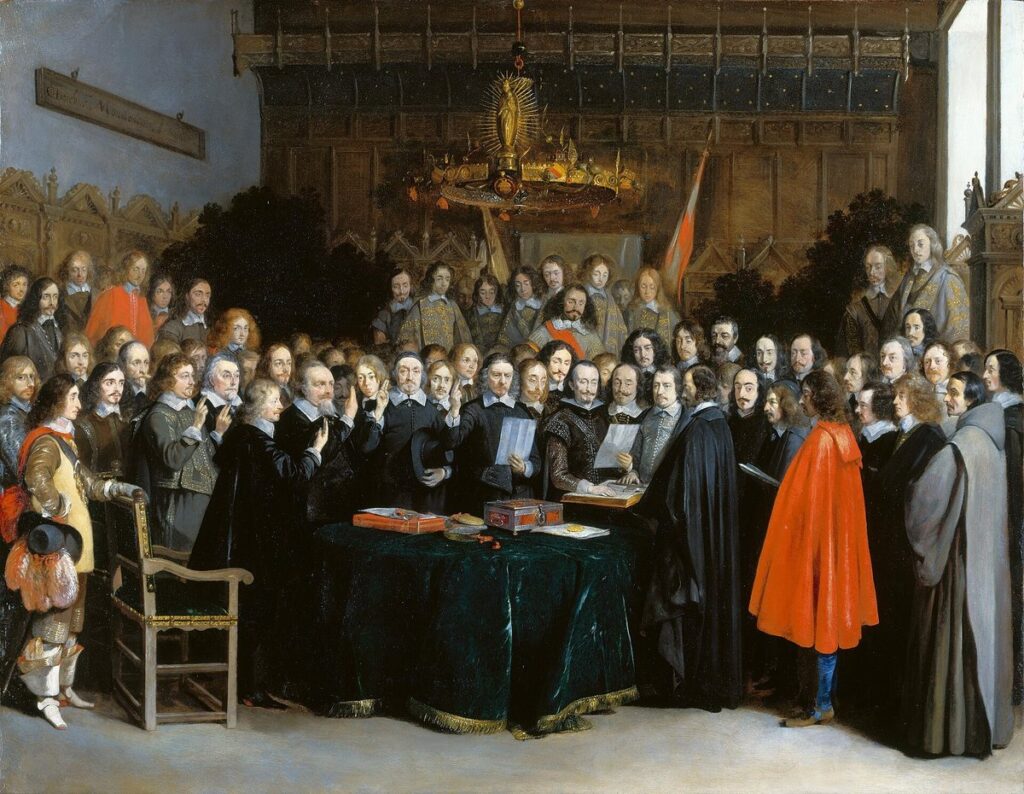
Image credits — In-article images: Image by Gerard ter Borch via Wikimedia Commons, Public Domain.
