

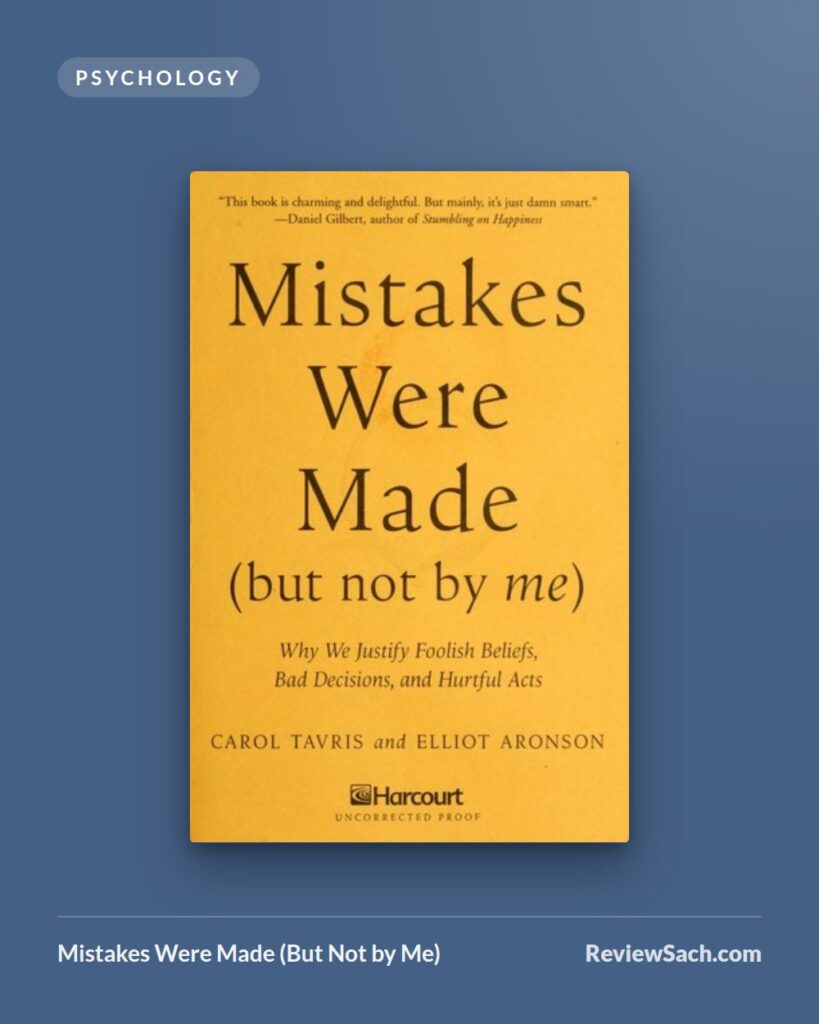
Author: Carol Tavris and Elliot Aronson · Published: 2007 · Genre: Psychology, Social Psychology
Mistakes Were Made (But Not by Me) is one of the best popular psychology books on why people dig in when they are wrong, and its biggest strength is that it makes you catch yourself doing it. Its main limitation is that it hangs nearly everything on one theory, cognitive dissonance, whose classic experiments are now being re-examined. It is worth reading for anyone who argues, manages people, works in law, medicine or therapy, or shares a home with someone.

The big idea
Tavris, a social psychologist and writer, and Aronson, a former student of Leon Festinger and a leading dissonance researcher, build the book on Festinger’s theory: the discomfort we feel when two beliefs, or a belief and an action, clash. The quickest way to ease that discomfort is usually not to change our behavior but to justify it. Because most of us see ourselves as smart and decent, evidence that we did something foolish or harmful is the hardest kind to accept, so we explain it away.
The book’s key image is the pyramid of choice. Two students with similar attitudes are tempted to cheat on an exam. One gives in and one resists. Each then justifies the choice, and over time they slide down opposite sides of the pyramid until they hold strongly opposed views about cheating. Small first steps, the authors argue, harden into large and confident commitments.
The title mocks the passive-voice non-apology that politicians use to admit error without naming anyone responsible.
What’s great
- Range of examples. The authors trace self-justification through the doomsday group Festinger studied, recovered-memory therapy and the day-care abuse panics of the 1980s, police and prosecutors who resist evidence of wrongful convictions even after DNA exonerations, and the search for Iraq’s missing weapons of mass destruction.
- Memory. The chapter on memory as a self-justifying historian is excellent. It shows how we quietly revise our own past to fit the story we prefer, without consciously lying.
- Couples. The chapter on marriage shows how small self-justifications harden into blame and contempt, and it is among the most practically useful parts of the book.
- A way out. The final chapters argue for separating a mistake from your identity. Admitting that you did something stupid is far easier once it no longer means you are stupid.
What’s weak
The book uses dissonance as a master key, and some of its cases could be explained just as well by incentives, ideology or plain ignorance. The underlying science has also been questioned. In 2024 a replication across 39 labs in 19 countries, led by David Vaidis and Willem Sleegers, retested a classic induced-compliance design. Writing an essay against one’s own views did shift attitudes, but having a free choice about writing it made no difference, contradicting a central prediction of the theory. That does not refute dissonance, but it shows that some textbook findings rest on small, decades-old studies.
The political examples may feel one-sided to some readers, and the central point is repeated many times. Updated editions in 2015 and 2020 add newer examples, so the latest edition is the one to get.
Who should read it
Read it if you want to understand why intelligent people double down, from courtrooms to family dinners. It pairs well with Daniel Kahneman’s Thinking, Fast and Slow for a broader picture of how reasoning goes wrong.
Rating: 4/5
Image credits — Featured image: cover image via Open Library; cover design © the publisher, shown for review purposes. In-article images: Photo by Dragon White Munthe on Unsplash.
