

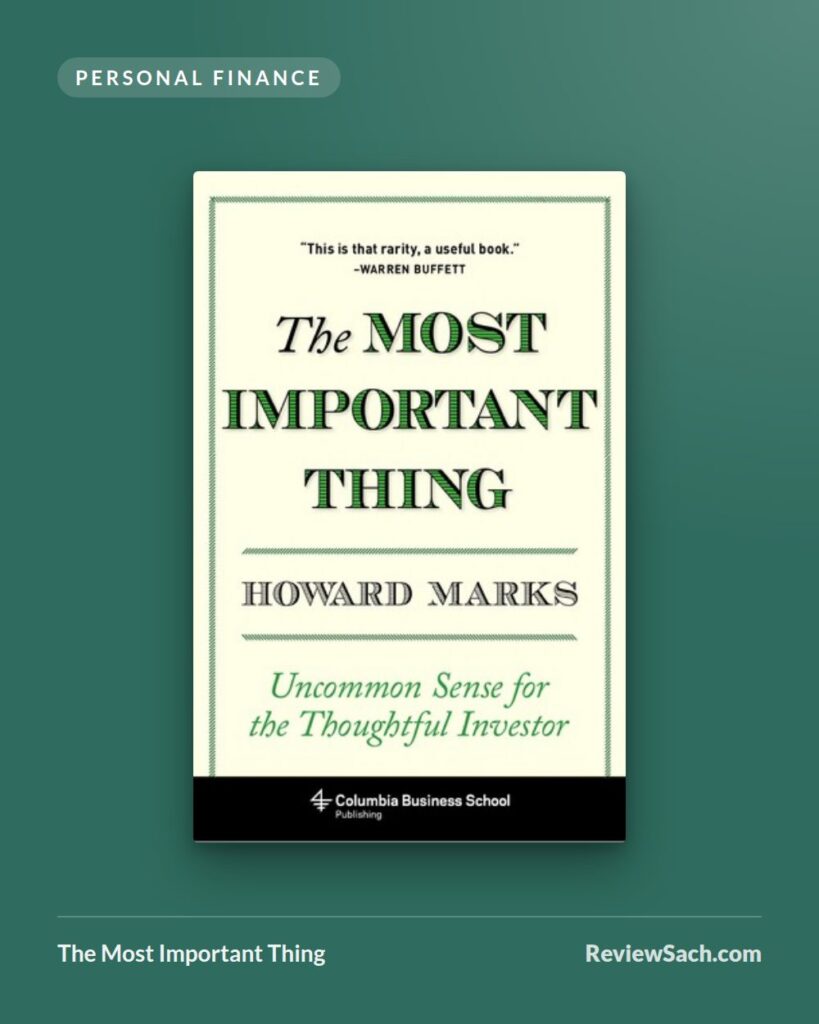
Author: Howard Marks · Published: 2011 · Genre: Investing, Personal Finance
The Most Important Thing is one of the clearest books on how an experienced investor thinks about risk, and its biggest strength is the way it makes market psychology concrete. Its biggest limitation is that it gives principles, not a system: there are no screens, formulas or step-by-step rules, and it repeats itself. It is worth reading for anyone who invests seriously or wants to understand how professional value investors reason.
The big idea
Marks co-founded Oaktree Capital Management, a firm known for credit and distressed-debt investing, and the book grows out of the memos he has written to clients since 1990. Nearly all of its short chapters name one “most important thing”, and together they argue that investing well depends less on forecasting than on understanding risk, price and human behavior.
The ideas that matter most:
- Second-level thinking. First-level thinking says a company is good, so buy the stock. Second-level thinking asks what everyone else already believes, what is already in the price, and what could prove the consensus wrong.
- Risk is the chance of permanent loss, not volatility. It is highest when people feel safest, because confidence pushes prices up and margins of safety down.
- The pendulum and cycles. Investor psychology swings between greed and fear, euphoria and despair. You can’t predict the timing, Marks says, but you can judge roughly where we stand.
- Price versus value. A great asset bought at too high a price can be a bad investment, and an unloved one bought cheaply can be a good one.
- Defensive investing. Avoiding big losses matters more than catching every winner. Marks’s ideal is to keep up reasonably in good markets and lose much less in bad ones.
What’s great
The book is honest about luck and uncertainty. Marks borrows from Nassim Taleb’s Fooled by Randomness and keeps reminding readers that a good outcome doesn’t prove a good decision. His point that being too far ahead of your time looks the same as being wrong is one every contrarian needs to hear.
It is also grounded in experience. His January 2000 memo, titled bubble.com, warned about technology stocks before the crash, and he draws lessons from both the dot-com collapse and the 2008 financial crisis. Warren Buffett’s cover blurb calls it that rarity, a useful book, and that is fair.
What’s weak
The abstraction cuts both ways. Readers looking for actionable steps will find mostly attitudes: be patient, be contrarian, know what you don’t know. Those are easy to agree with and hard to apply, and the book gives little guidance on how an ordinary investor would recognize a bargain.
It is also written from the vantage point of a professional with analysts, access to niche markets and the ability to buy distressed debt. Marks himself argues that mainstream markets are fairly efficient and hard to beat, which raises a question the book never fully addresses: how many of its readers can realistically apply its methods. The chapters overlap heavily too, and the same points about risk and psychology return again and again.
Who should read it
Read it if you already know the basics and want a deeper way of thinking about risk and market cycles. Complete beginners may get more from a broad introduction first. The 2013 edition, The Most Important Thing Illuminated, adds commentary from investors including Seth Klarman and Joel Greenblatt. This review describes the book’s ideas and is not investment advice.
Rating: 4/5
Image credits — Featured image: cover image via Open Library; cover design © the publisher, shown for review purposes. In-article images: Photo by Maxim Hopman on Unsplash.
