

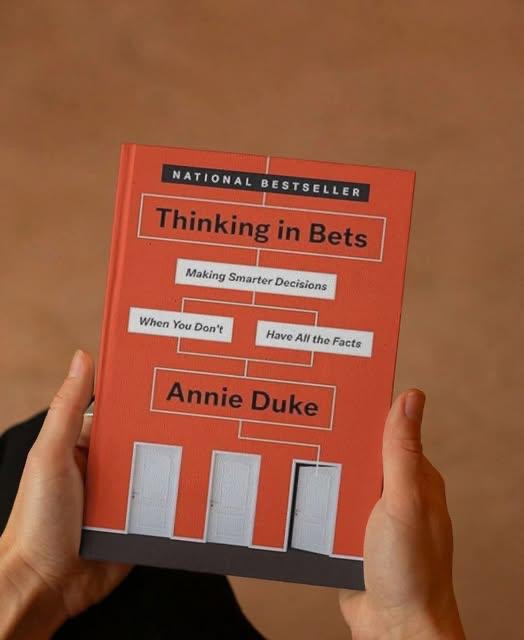
Author: Annie Duke · Published: 2018 · Genre: Psychology, Decision-Making
I have a confession. For years, I graded my decisions by how they turned out. If something went well, I’d made a genius move. If it went badly, I was obviously an idiot. Annie Duke’s Thinking in Bets politely escorted that habit out of the building.
Duke studied cognitive psychology at the University of Pennsylvania before spending about two decades as a professional poker player, and she won a World Series of Poker bracelet along the way. That mix is what makes the book work. She knows the research, and she also knows how it feels to make the right call and still watch your chips slide across the table to someone else.
Life is poker, not chess
The core idea is simple. Chess has no hidden information and very little luck, so if you lose, you probably made a mistake. Life is more like poker. You decide with incomplete information, luck plays a real part, and a good decision can still end badly.
Duke’s name for judging a decision by its outcome is “resulting.” Her opening example is Pete Carroll’s infamous call in Super Bowl XLIX. It was second-and-goal from the one-yard line, and Seattle threw a pass instead of handing the ball to Marshawn Lynch. The pass was intercepted, and the internet crowned it the worst call in history. Duke argues that the play was defensible. Interceptions in that situation are rare, and the pass saved time for more attempts. People hated the call mainly because it failed, and nobody would remember it if it had worked. I laughed, and then felt slightly called out. I do the same thing with everything from stock picks to choosing the “fast” checkout line.
“Wanna bet?”
The most useful idea in the book is to treat your beliefs as bets. When someone asks “wanna bet?”, confidence gets humble very quickly. Duke suggests stating beliefs as probabilities (“I’m about 70% sure”) instead of all-or-nothing claims. It sounds nerdy, and it is. It also makes it much easier to change your mind without feeling like you’ve lost a fight.
She also shows how our brains protect our egos. We take credit for good outcomes and blame bad luck for poor ones. Being smart doesn’t save you, either. Smart people are often better at motivated reasoning, because they’re better at building a convincing case for what they already believe.
Build a truthseeking crew
One chapter argues for a small “truthseeking group”: a few people who agree to hold each other to accuracy rather than comfort. As ground rules, Duke borrows the sociologist Robert K. Merton’s CUDOS norms (communism, universalism, disinterestedness and organized skepticism). In this context, communism simply means sharing all the information, including the unflattering parts. I’m not ready to hand my friends a scoring sheet. Still, the habit of asking “what would have to be true for me to be wrong?” has stuck with me.
Time travel for grown-ups
The final section is about bringing your future self to the table. Duke’s tools include:
- 10-10-10: Suzy Welch’s question of how you will feel about a choice in 10 minutes, 10 months and 10 years.
- Ulysses contracts: decisions you lock in ahead of time, like not keeping cookies in the house.
- Premortems: imagining the plan has already failed and working backward to find out why.
What I didn’t love
The book repeats itself, and some poker stories run a hand or two too long. If you’ve read Daniel Kahneman, parts of it will feel familiar. It’s more a friendly nudge than a rigorous manual.
Verdict
Thinking in Bets won’t make you lucky. It will make you less likely to confuse luck with skill, which is almost as good and a lot cheaper. Read it if you make decisions under uncertainty, which means you should read it if you are a person.
Rating: 4/5
