

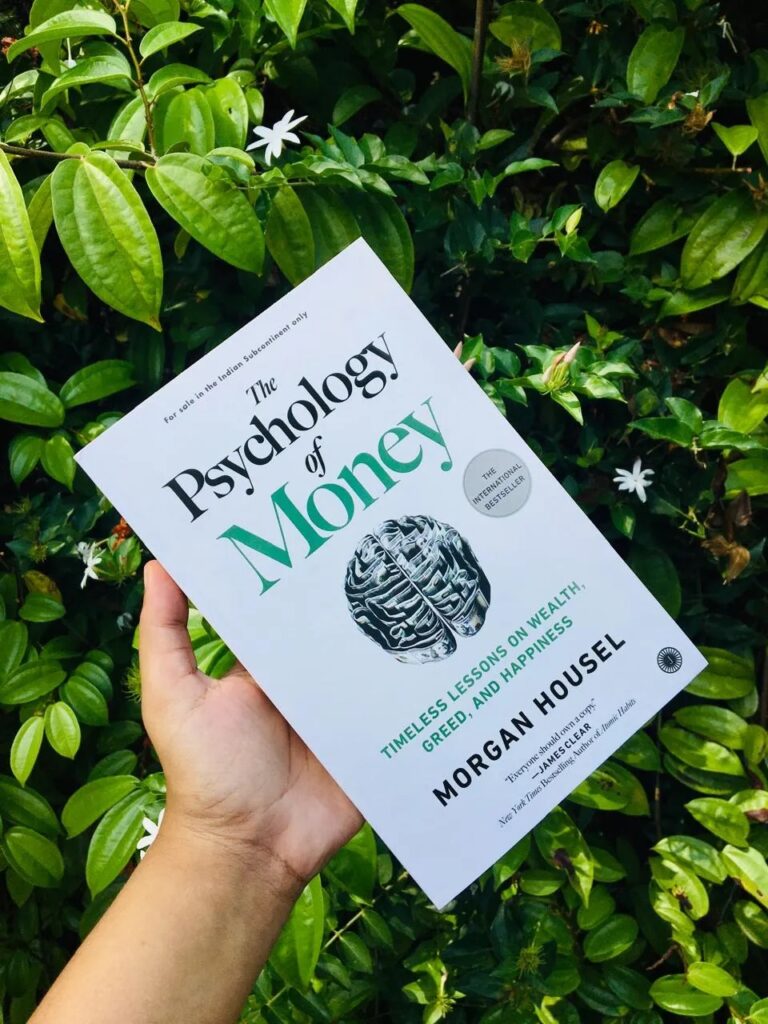
Author: Morgan Housel · Published: 2020 · Genre: Personal Finance, Behavioral Psychology
Morgan Housel opens The Psychology of Money with two men. Ronald Read was a gas station attendant and janitor in Vermont. When he died in 2014 at age 92, he left an estate of about $8 million, most of which he donated to his local hospital and library. Richard Fuscone was a Harvard-educated Merrill Lynch executive who borrowed heavily to fund a lavish life, including an enormous house in Greenwich, Connecticut. After the 2008 financial crisis, he filed for bankruptcy.
Housel’s point is that in money, behavior matters more than intelligence or credentials. A janitor who saves patiently can beat a Wall Street executive who spends to impress.
Short chapters, big ideas
The book is a collection of about twenty short chapters, each built around one idea. Among them:
- No one’s crazy: people’s money decisions make sense in light of their own experiences.
- Luck and risk: both play a bigger role than we admit.
- Compounding: of Warren Buffett’s $84.5 billion net worth when the book was written, $81.5 billion came after his mid-60s. His real secret is time.
- Room for error: plan for things to go wrong, because they will.
- Enough: if the goalposts keep moving, you will never feel rich.
The obsession with looking rich
The heart of the book, for me, is two chapters: “The Man in the Car Paradox” and “Wealth Is What You Don’t See.”
When Housel worked as a valet at a luxury hotel, he noticed something. Whenever a driver pulled up in a Ferrari, he never thought “that person is cool.” He imagined himself driving the car. Most of us do the same. We buy expensive things hoping people will admire us, but they’re mostly imagining themselves in our place.
Housel then separates “rich” from “wealthy.” Being rich is about current income and visible spending. Wealth is the money you didn’t spend: the car you didn’t buy, the upgrade you skipped, the investments you left alone. That’s why wealth is invisible. If you see someone driving a $100,000 car, the only thing you know for sure is that they now have $100,000 less, or $100,000 more debt. Spending money to show people how much money you have is the fastest way to have less money.
Social media makes this worse. We compare ourselves with other people’s highlight reels, the bar keeps rising, and “looking rich” quietly eats the savings that could have made us wealthy.
The mirror image: The Millionaire Next Door
Thomas J. Stanley and William D. Danko reached the same conclusion with survey data in The Millionaire Next Door (1996). The typical millionaire they studied didn’t look like one. They lived in ordinary neighborhoods, drove older cars, bought suits off the rack and often ran unglamorous small businesses. Meanwhile, many high earners in upscale suburbs had surprisingly little net worth: “big hat, no cattle,” as the authors put it.
They even offered a rule of thumb. Your expected net worth is your age multiplied by your pretax household income, divided by ten. People well above that number are “prodigious accumulators of wealth.” People well below it, often the ones who look the richest, are “under accumulators.”
Read side by side, the books show the same picture from two angles. The Millionaire Next Door shows who actually becomes wealthy, and The Psychology of Money explains why the rest of us keep chasing the look instead. The flashy neighbor with the leased luxury SUV may be one bad year away from trouble. The quiet retiree in the ten-year-old sedan may be the real millionaire on the street.
Weaknesses
Housel is light on step-by-step advice, and a few chapters overlap. The Millionaire Next Door is decades old and US-focused, so some of its numbers feel dated. Neither flaw weakens the central message.
Verdict
Read Housel for the mindset and Stanley and Danko for the evidence. Together, they’ll make you think twice before you spend money for other people to see.
Rating: 4.5/5
