

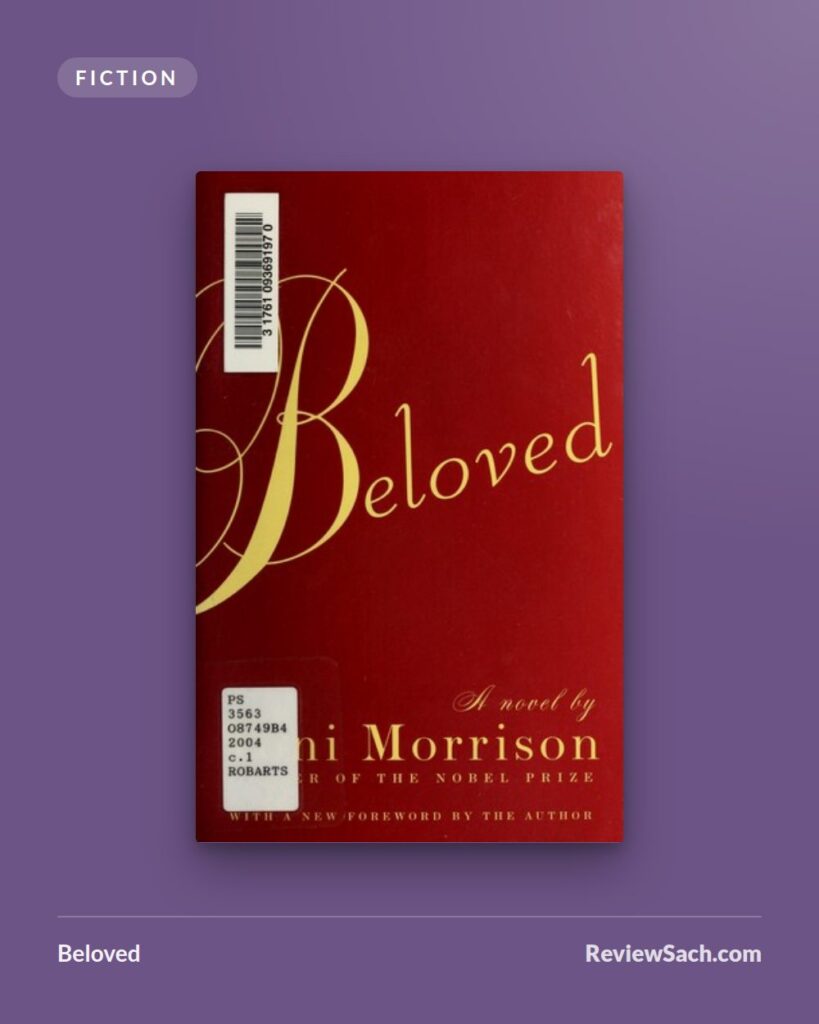
Author: Toni Morrison · Published: 1987 · Genre: Literary Fiction, Historical Fiction
Beloved is one of the great American novels, and its biggest strength is the way it makes the history of slavery felt as memory, grief and haunting rather than as a history lesson. Its biggest challenge is its style: the story arrives in fragments, out of order and through shifting voices, so readers who want a straightforward plot may struggle. It is worth reading for anyone serious about American literature or history, and it rewards a second reading.

What it’s about
The novel is set in 1873 at 124 Bluestone Road, a house outside Cincinnati, Ohio. Sethe, who escaped slavery on a Kentucky farm called Sweet Home eighteen years earlier, lives there with her daughter Denver. Her two sons have run away, and her mother-in-law, Baby Suggs, a preacher who once gathered the community in a clearing in the woods, has died. The house is haunted by the angry spirit of Sethe’s dead baby daughter.
Then Paul D, one of the men Sethe knew at Sweet Home, arrives and drives the ghost out. Soon afterward a mysterious young woman who calls herself Beloved appears at the house, and the family is pulled into a past Sethe has spent years trying not to remember. Morrison drew on the true story of Margaret Garner, a woman who fled slavery in Kentucky in 1856.
What’s great
- Memory as structure. Morrison’s coined word “rememory”, for memories that seem to exist outside a person and can be stumbled into, shapes the whole book. The story keeps circling back to the same events and reveals a little more each time, which mirrors the way trauma resurfaces.
- Characters. Sethe’s fierce love, Denver’s slow growth out of isolation and Paul D’s struggle to let himself feel again are drawn with great depth. Baby Suggs’s sermon in the Clearing, urging people who had been treated as property to love their own bodies, is one of the most moving passages in American fiction.
- Moral seriousness. The book refuses easy judgments, and it shows how slavery stripped people of the right to claim even their own children and feelings. Its violence is real but never gratuitous.
- Language. The prose moves between plain speech, poetry and broken fragments, and many passages ask to be read aloud.
What’s weak
The difficulty is real. The opening chapters drop you into a situation nobody explains, the timeline jumps without warning, and some sections dissolve into stream of consciousness. Many readers give up early; those who persist find the pieces fall into place. The subject matter, including the cruelty of slavery, is harrowing.
Not every critic was convinced. Stanley Crouch, in a famously hostile 1987 review in The New Republic, dismissed it as melodrama that traded on suffering. When it failed to win the National Book Award, 48 Black writers and critics published a tribute to Morrison in The New York Times Book Review, and in 1988 the novel won the Pulitzer Prize for Fiction. It has also been challenged in schools, most visibly in Virginia, where one parent’s campaign against it became an issue in the 2021 governor’s race.
Who should read it
Read it if you care about literature, American history or the legacy of slavery. Give yourself time, read slowly, and don’t worry about feeling lost early on. Adults and mature older teenagers are the right audience.
Rating: 5/5
Image credits — Featured image: cover image via Open Library; cover design © the publisher, shown for review purposes. In-article images: Photo by Ginger Jordan on Unsplash.
