

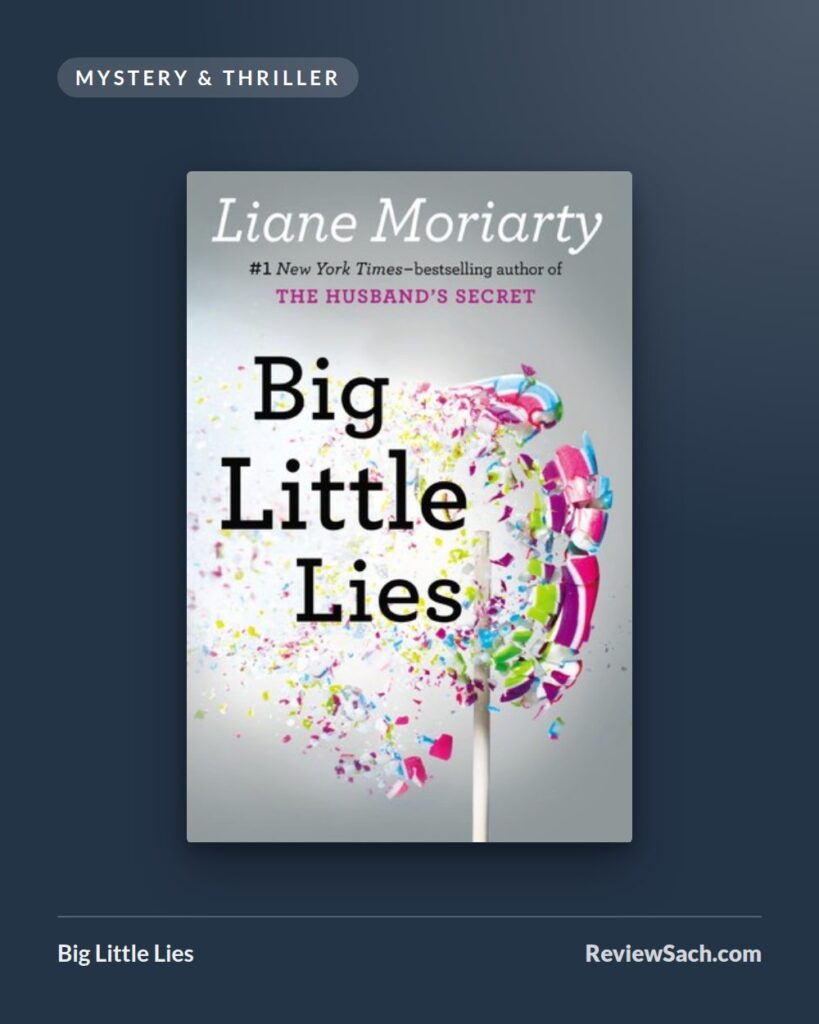
Author: Liane Moriarty · Published: 2014 · Genre: Domestic Suspense, Mystery
Big Little Lies is a murder mystery in which you don’t learn who died until near the end, and it works far better than that sounds. Liane Moriarty mixes sharp playground satire with a serious, carefully handled story about domestic abuse. Read it if you like character-driven suspense more than clue-hunting. It’s also a good pick for readers who think they don’t like thrillers.
What it’s about
Someone dies at the trivia night of Pirriwee Public School, on a wealthy beach peninsula near Sydney. The parents had come dressed as Audrey Hepburn and Elvis. That’s all we learn at the start. The novel then rewinds six months and counts down to the night itself.
Three mothers carry the story. Madeline is funny, loyal and quick to pick a fight. She is still sore that her ex-husband, Nathan, and his serene new wife, Bonnie, have a daughter in the same kindergarten class as her youngest. Celeste is rich and beautiful, with twin boys and a husband, Perry, whom everyone admires. Jane is a young single mother, new in town, with a five-year-old son, Ziggy. On orientation day, Ziggy is accused of hurting Amabella, the daughter of Renata, a high-powered working mother. The parents split into camps, and a petition starts to circulate.
Between chapters, Moriarty cuts to short statements from other parents, given after the death. They’re gossipy, self-serving and often very funny.
What works
- The chorus of witnesses. The statement snippets do two jobs. They remind you that a death is coming, and they skewer school-gate culture: the parents contradict each other, settle scores and get basic facts wrong.
- Tone control. On the surface, the book is light, with jokes about costume themes, blended families and a teenage daughter who wants to move in with her father. Underneath, Celeste’s marriage is written with a real grasp of how abuse hides in plain sight: the shame, the excuses, and the good days that make leaving harder. Moriarty never turns it into spectacle.
- Madeline. She’s the book’s comic engine: petty, generous and furious on her friends’ behalf. Her running feud with Bonnie, her ex-husband’s calm new wife, is a sharp and rueful portrait of co-parenting after divorce.
- Jane’s story. Jane arrives carrying a private trauma that shapes how she sees her son and herself. Her arc gives the novel its emotional weight, and Moriarty ties it into the mystery neatly.
- A fair payoff. When trivia night finally arrives, the threads come together in a way that is both surprising and properly set up. I won’t say more.
What doesn’t
The book is long for what it is. The middle circles the same petition, the same playdates and the same sniping more times than it needs to. Some readers will struggle to care about costume politics and book-club drama for this many pages, and the wealthy setting can feel smug.
The “who died?” framing is also a gimmick you will either enjoy or resent. If you want a classic whodunit with clues to weigh, this isn’t it. The question is less who did it than how these people got there, and the answer depends more on character than on detection.
The HBO series, starring Reese Witherspoon, Nicole Kidman and Shailene Woodley, moved the story to Monterey, California. If you’ve seen it, you know the outcome. The book is still worth your time for its Australian humour and its more detailed inner lives, especially Celeste’s.
Who should read it
Readers who like domestic suspense with humour and heart, and anyone who has survived a school parents’ group chat. Skip it if you want a tight, clue-driven puzzle, or if stories about domestic violence are hard for you right now.
Rating: 4/5
Image credits — Cover image via Open Library. Cover design © the publisher, shown for review purposes.
