


Author: Thomas Piketty · Published: 2013 · Genre: Economics, Economic History · Original title: Le Capital au XXIe siècle
Capital in the Twenty-First Century argues that, left alone, capitalism tends to concentrate wealth, because the return on capital usually outpaces economic growth. Its biggest strength is the data: long historical series from tax records and national accounts for France, Britain, the United States and other countries, which gave a picture of wealth and top incomes that hadn’t existed before. Its biggest weakness is that the grand theory built on that data is more contested than the data itself, and at roughly 700 pages the book makes you work for it. Read it if you want to argue seriously about inequality, from either side.
The core ideas
- r > g. When the rate of return on capital (r) exceeds the growth rate of the economy (g), inherited wealth grows faster than incomes, and the past starts to dominate the future. Piketty argues this has been the normal historical condition.
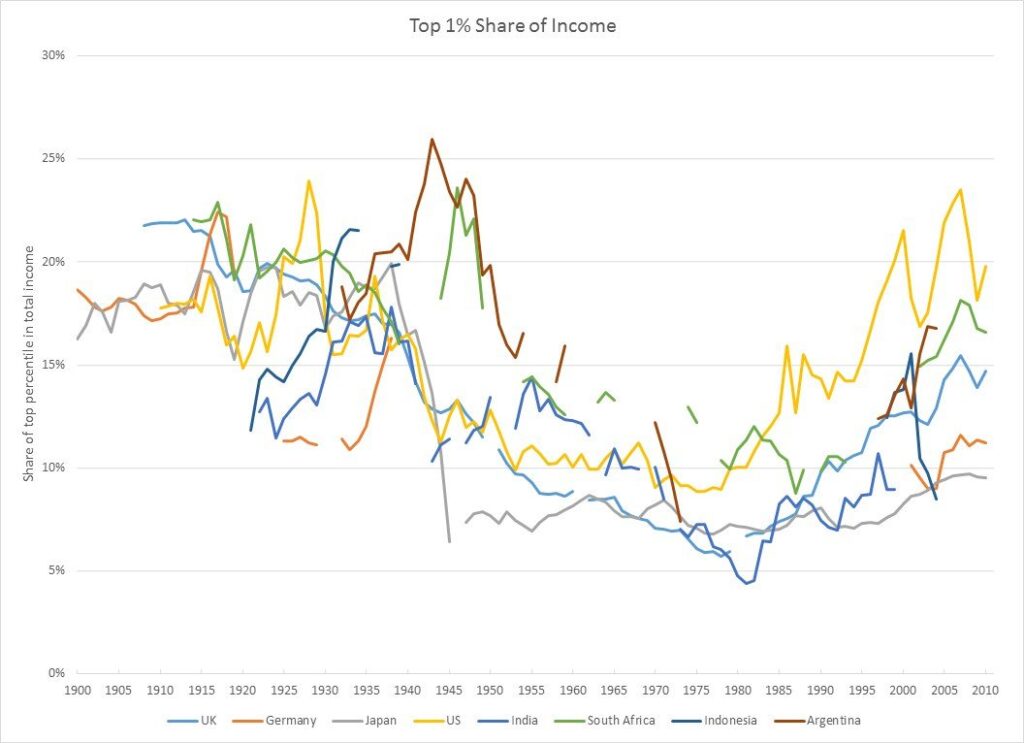
- The 20th century was the exception. Two world wars, the Depression, inflation and new taxes destroyed or taxed away huge fortunes between 1914 and the postwar decades, and fast growth did the rest. The relatively equal mid-century world was the result of shocks and policy, not a natural stage of development.
- Capital is coming back. In Europe, private wealth relative to national income collapsed in the early 20th century and has since climbed back toward its 19th-century levels. Piketty uses Balzac and Jane Austen to show what a society of inherited fortunes felt like.
- Supermanagers. In the United States, much of the rise in inequality comes from very high pay at the top rather than from capital, which he links to social norms and falling top tax rates.
- The remedy. A progressive global tax on wealth, plus top income-tax rates as high as about 80 percent on very high incomes. He admits the global wealth tax is utopian.
What’s great
The data project is the real contribution. Piketty, working with Emmanuel Saez, Anthony Atkinson and others, built long series on top income shares that changed how economists and journalists talk about the top 1 percent. The U-shaped curves of inequality across the 20th century are hard to forget.
He writes for a general audience, explains his terms, and makes the history vivid. The literary examples are more than decoration: they show how central inheritance and marriage were to wealth in the 19th century.
The controversy
The debates are real, and fair readers should know both sides.
- The data dispute. In May 2014 the Financial Times, in an analysis by Chris Giles, reported errors and unexplained adjustments in some of Piketty’s spreadsheets and argued they exaggerated the rise in wealth inequality, especially in Britain. Piketty replied that his adjustments were justified, that he had published the data so it could be checked, and that later work, such as research by Saez and Gabriel Zucman, found an even larger rise in US wealth concentration. Many economists who examined the dispute concluded the errors did not overturn the main trends, though the episode showed how rough historical wealth data can be.
- The theory dispute. Lawrence Summers and others argued that returns on capital should fall as capital piles up, weakening r > g. Matthew Rognlie found that the rise in capital’s share of income is mostly about housing. Daron Acemoglu and James Robinson argued that institutions and politics, not a general law, drive inequality. Piketty himself later wrote that r > g is not the main tool for explaining rising pay inequality.
The book is also repetitive, and the policy chapters are thinner than the history.
Who should read it
Anyone interested in inequality, tax policy or economic history should try it; the introduction lays out the whole argument if you want a preview. Read one of the major critiques alongside it. Piketty’s follow-up, Capital and Ideology (2019), extends the story to the politics that justify inequality.
Rating: 4/5
Image credits — In-article images: Image by Bkwillwm via Wikimedia Commons, CC BY-SA 4.0.
