

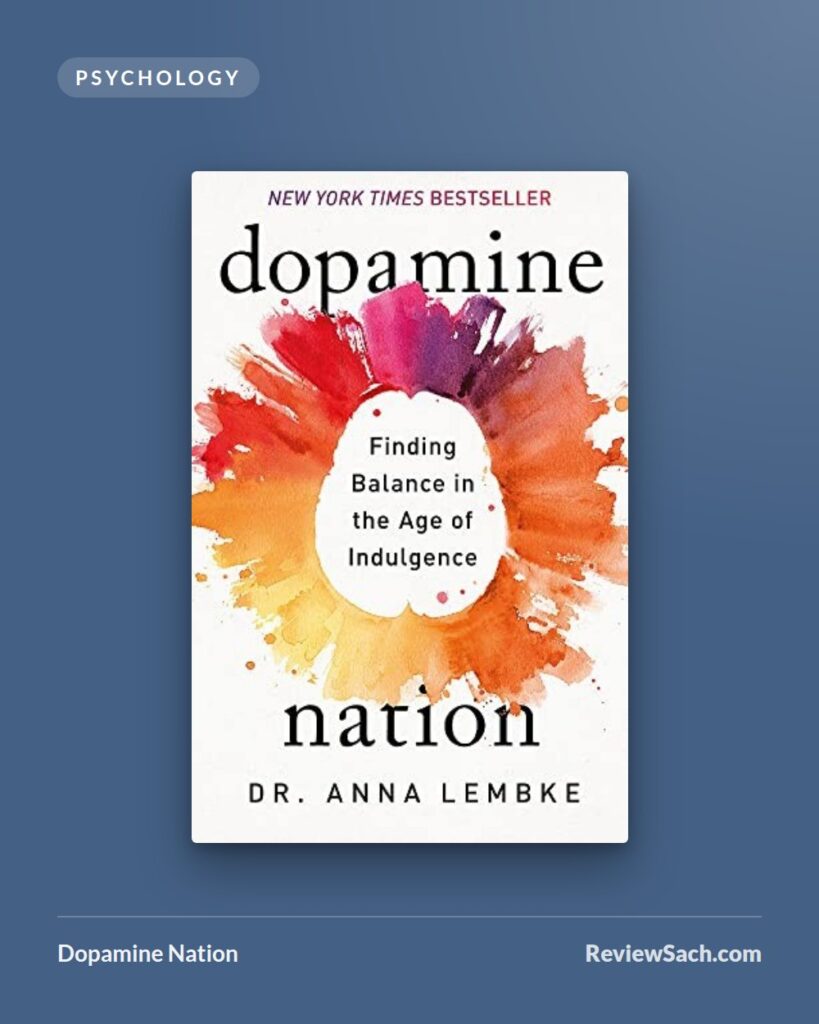
Author: Anna Lembke · Published: 2021 · Genre: Psychology, Addiction
Dopamine Nation argues that modern life floods us with easy pleasures, from drugs and food to phones and pornography, and that the brain answers each hit by tilting toward pain, leaving us anxious and wanting more. Its biggest strength is Lembke’s clinical experience: the patient stories are vivid and her tools for cutting back are concrete. Its biggest weakness is the brain science, which reduces a complex system to a single seesaw and treats ordinary habits as near-addictions. It is worth reading for anyone who suspects a habit is running them, as long as they take the neuroscience loosely.

The big idea
Lembke, a psychiatrist and medical director of addiction medicine at Stanford, describes pleasure and pain as two sides of a balance. When you indulge, the balance tips toward pleasure, and the brain pushes back toward pain to restore level. Repeat the indulgence often enough and the brain’s resting state shifts toward the pain side, so you need the substance just to feel normal. That, she argues, is why people in rich countries can be surrounded by comfort and still feel miserable.
The book has three parts. The first explains the balance. The second covers self-binding: putting barriers between yourself and the thing you crave. The third argues for deliberately seeking small doses of pain, from cold water to exercise, because the brain’s counter-response leaves you feeling better afterward. That part also covers radical honesty and shame, and the book closes with a short list of lessons.
What’s great
- The patients. Jacob, a man in his sixties, describes a compulsive sexual habit that took over his life. David, a college student, slid into misuse of a prescribed stimulant. Chris, recovering from heroin on buprenorphine, shows that medication can be part of recovery. These cases are told with sympathy and without lurid detail.
- Candor. Lembke admits that in her forties she became hooked on romance novels after reading the Twilight series, reading them even between patients until she abstained for a month.
- Usable tools. Her DOPAMINE framework walks through data, objectives, problems, abstinence, mindfulness, insight, next steps and experiment, with about a month of abstinence at its center. She splits self-binding into physical barriers, time limits and categories you avoid entirely.
- Honesty and shame. Her argument that telling the truth, even about small things, supports recovery, and that shame can be prosocial when it comes with acceptance, is humane and practical.
What’s weak
The neuroscience is simplified. Researchers have long argued that dopamine is mostly about wanting and motivation rather than pleasure itself, and that addiction involves many brain systems, not one balance. Lembke nods to this, but the seesaw image does most of the work, and readers may come away thinking a “dopamine fast” resets the brain. It is better understood as a period of abstinence that helps you see your habit clearly.
The book also stretches addiction to cover nearly everything. Lembke’s evidence comes largely from patients with severe problems, yet her conclusions are pitched at everyone who scrolls, snacks or binge-watches. Problematic social media or food use remains debated as a diagnosis, and treating every enjoyable habit as a threat can add guilt without adding help.
Finally, the pain-seeking chapter mixes solid ideas, like exercise, with practices whose benefits are less established, such as cold-water immersion.
Who should read it
Read it if your phone, a substance or another habit feels out of control, or if you work with people who struggle with addiction. If you have a serious substance problem, treat it as a companion to professional care, not a replacement.
Rating: 3.5/5
Image credits — Featured image: cover image via Open Library; cover design © the publisher, shown for review purposes. In-article images: Photo by Andrew Guan on Unsplash.
