

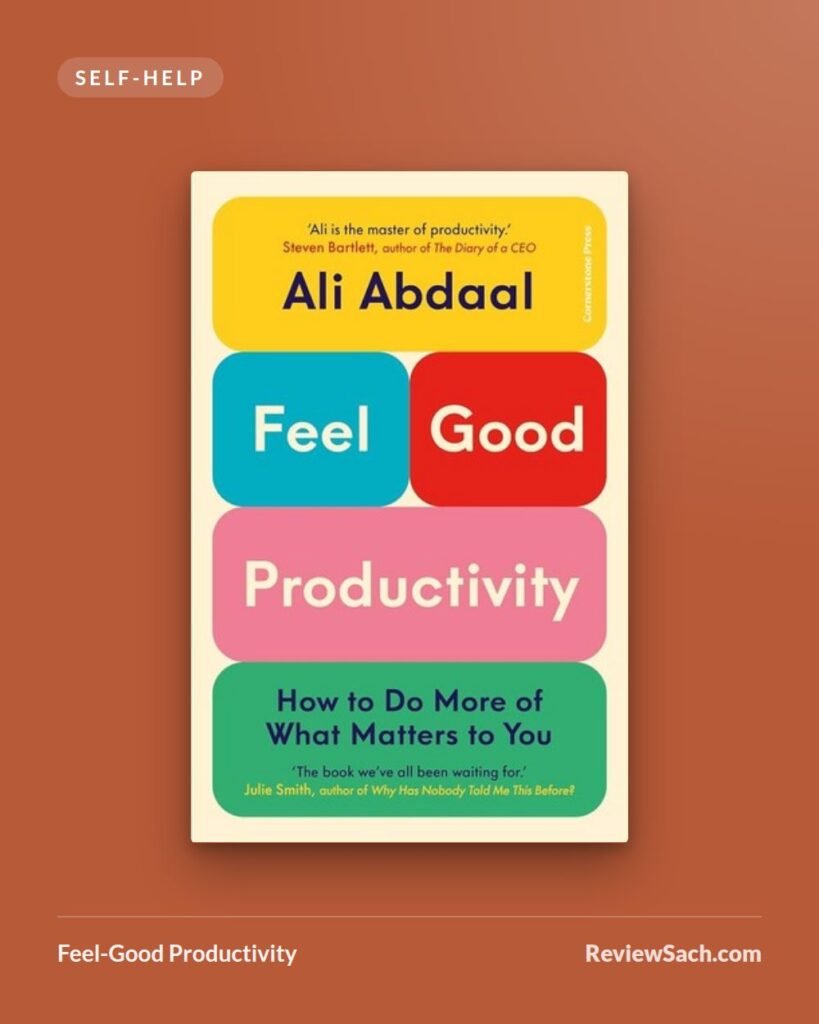
Author: Ali Abdaal · Published: 2023 · Genre: Self-Help, Productivity
Feel-Good Productivity argues that the secret to getting more done isn’t discipline but enjoyment: when work feels good, you do more of it. Ali Abdaal, a former NHS doctor turned YouTuber, turns that idea into a clear framework full of small, practical experiments. It’s an excellent starting point for newcomers to productivity writing. But if you’ve read much in the genre, it will feel like a well-packaged greatest-hits album.
The big idea
Abdaal’s premise flips the usual story. Instead of success leading to happiness, he argues, positive feelings make it easier to do good work in the first place. The book is organized in three parts.
Energize. Three sources of good feeling: play, power and people. Play means approaching work with curiosity and lightness; he retells how Richard Feynman, feeling burned out, rediscovered his love of physics by working out why a plate tossed in a cafeteria wobbled as it spun. Abdaal also suggests treating tasks as “side quests,” as in a video game, and offers a set of play personalities, such as the explorer, the competitor and the storyteller, to help readers find which kind of fun suits them. Power means feeling competent and in control. People means connection, collaboration and helping others.
Unblock. Procrastination, he says, comes from three blockers: uncertainty, fear and inertia. For uncertainty, clarify why and what you’re doing, including setting NICE goals (near-term, input-based, controllable and energizing) as an alternative to the familiar SMART goals. For fear, techniques include adopting an alter ego, which he links to what researchers call the “Batman effect”; Beyoncé’s stage persona, Sasha Fierce, is one of his examples. For inertia, make starting as easy as possible, for example by deciding exactly when and where you’ll begin.
Sustain. Three kinds of burnout: from overexertion, from depletion and from misalignment with what you actually value. Each gets its own remedies, from doing less, to real rest, to reconnecting with long-term goals.
What works
- The structure. Energize, unblock, sustain is easy to remember and covers the whole cycle, from getting started to avoiding burnout.
- Experiments, not rules. Each chapter offers small things to try, and Abdaal encourages readers to test what works for them rather than follow a rigid system.
- The tone. He’s warm, funny and self-deprecating, and the book avoids the grind-culture shaming common in productivity writing. It’s a kind book.
- Burnout gets serious attention. The final part is the most balanced, and his point that productivity should serve a life you value is a useful corrective to the genre.
What doesn’t
- Little is new. Much of the material, from implementation intentions to the Wheel of Life, is borrowed from other books and research and lightly repackaged. Experienced readers will recognize most of it.
- Research told quickly. Studies are summarized in a sentence or two and presented confidently, with few caveats about sample sizes or replication. The central claim, that feeling good causes better work, rests on research that is suggestive rather than settled.
- Assumes some control. Advice to make work more playful, or to choose tasks that energize you, assumes a degree of freedom over your work that many jobs don’t allow. A junior employee can’t simply drop the tasks that drain them.
- YouTube style on the page. The anecdote-then-tip rhythm works well on video, but across a whole book it can feel formulaic.
Who should read it
Read it if you’re new to productivity books, or if discipline-based advice has left you tired and guilty. Readers who already know Atomic Habits and similar titles can skim the first two parts and focus on the section on sustaining energy and avoiding burnout.
Rating: 3.5/5
Image credits — Cover image via Open Library. Cover design © the publisher, shown for review purposes.
