

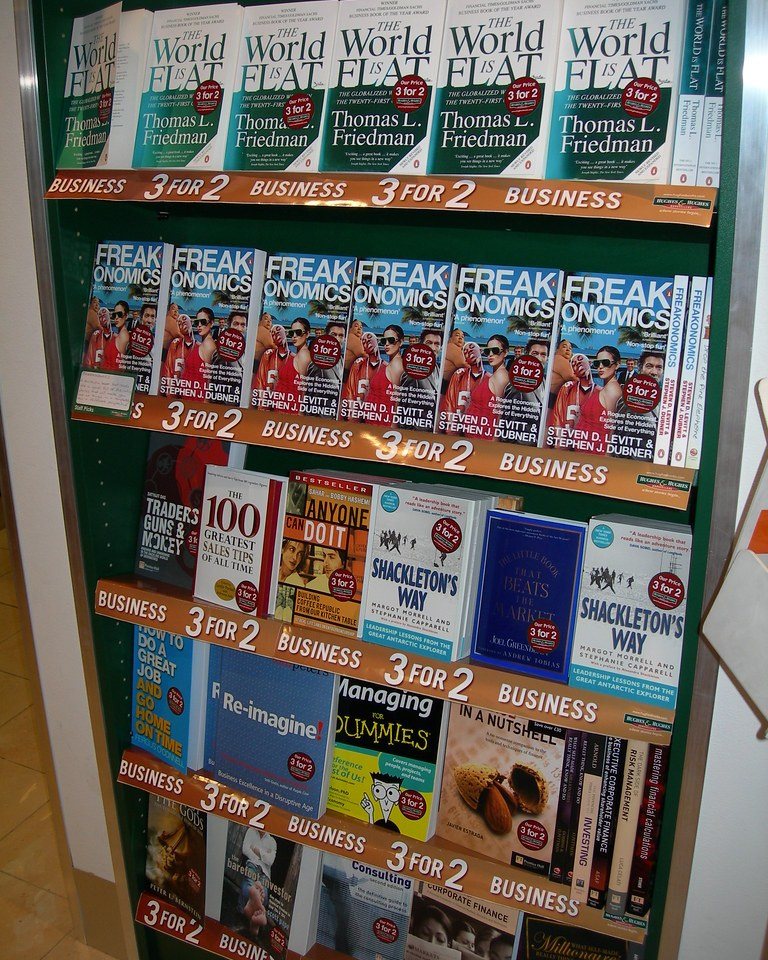
Author: Steven D. Levitt and Stephen J. Dubner · Published: 2005 · Genre: Economics, Popular Science
Freakonomics applies an economist’s tools, incentives and data, to questions economists usually ignore, from cheating teachers to baby names. Its biggest strength is the habit of mind it teaches: ask what incentives are really at work, and don’t trust conventional wisdom without evidence. Its biggest weakness is that its most famous claim, that legalized abortion helped cut crime in the 1990s, is far less settled than the breezy tone suggests. It’s worth reading for curious general readers, as long as they treat it as a starting point rather than a verdict.
The core ideas
The book admits it has no unifying theme, but a few ideas run through it:
- Incentives explain behavior, including cheating. Levitt found patterns in Chicago public school test answers pointing to teachers who altered results. In sumo, wrestlers at 7–7 on the last day of a tournament, who need one more win to protect their ranking, beat 8–6 opponents far more often than their records predict.
- Information asymmetry. Real-estate agents keep their own homes on the market longer and sell them for more than they do clients’ homes, because a small extra gain matters far more to the owner than to the agent’s commission.
- Crack gangs work like corporations. Using a gang’s financial records that the sociologist Sudhir Venkatesh obtained in Chicago, the authors show that street-level dealers earned less than minimum wage while leaders took most of the money. That’s why so many dealers still live with their moms.
- Parenting and names. The data suggest that who parents are, such as how educated they are, matters more for children’s test scores than many things parents do. And a distinctively Black first name, on its own, doesn’t appear to predict worse life outcomes once family background is accounted for.
What’s great
The writing is fast and fun. Dubner, a journalist, turns Levitt’s academic papers into stories, and the method is contagious: after the sumo chapter you start asking who benefits from every system you meet. Several examples, like the teacher-cheating and sumo studies, rest on solid, peer-reviewed research.
Levitt had won the John Bates Clark Medal, one of economics’ top honors for younger economists, in 2003, and his talent for finding clever natural experiments in messy real-world data is on full display.

The controversy
The abortion chapter draws on a 2001 paper by John Donohue and Levitt. It argues that legalization in the early 1970s, culminating in Roe v. Wade in 1973, meant fewer children were born into circumstances that raise the risk of crime, and that this explains a large share of the crime drop that began in the early 1990s, possibly as much as half.
In 2005 two researchers at the Federal Reserve Bank of Boston, Christopher Foote and Christopher Goetz, found a programming error in the original paper and argued that once arrests were measured per person rather than as raw totals, the effect largely disappeared. Levitt acknowledged the error, but he and Donohue re-ran the analysis with improved abortion data and reported results close to the original. In 2019 they published an update claiming the prediction had held for two more decades. Other researchers, including Ted Joyce, argue that the rise and fall of the crack epidemic explains the pattern better, and some point to the phase-out of leaded gasoline. The question remains open.
The broader style has aged unevenly too. It favors surprising results, and the global-warming chapter of the sequel, SuperFreakonomics, drew sharp criticism from climate scientists.
Who should read it
Read it if you want an entertaining introduction to thinking with data and incentives, especially as a student. Then read up on the abortion–crime debate before repeating the book’s most famous claim.
Rating: 3.5/5
Image credits — Featured image: Image by Lars Plougmann via Flickr, CC BY-SA 2.0, cropped. In-article images: Image by ftrc via Flickr, CC BY-SA 2.0; Image by davidgsteadman via Wikimedia Commons, Public Domain.
