

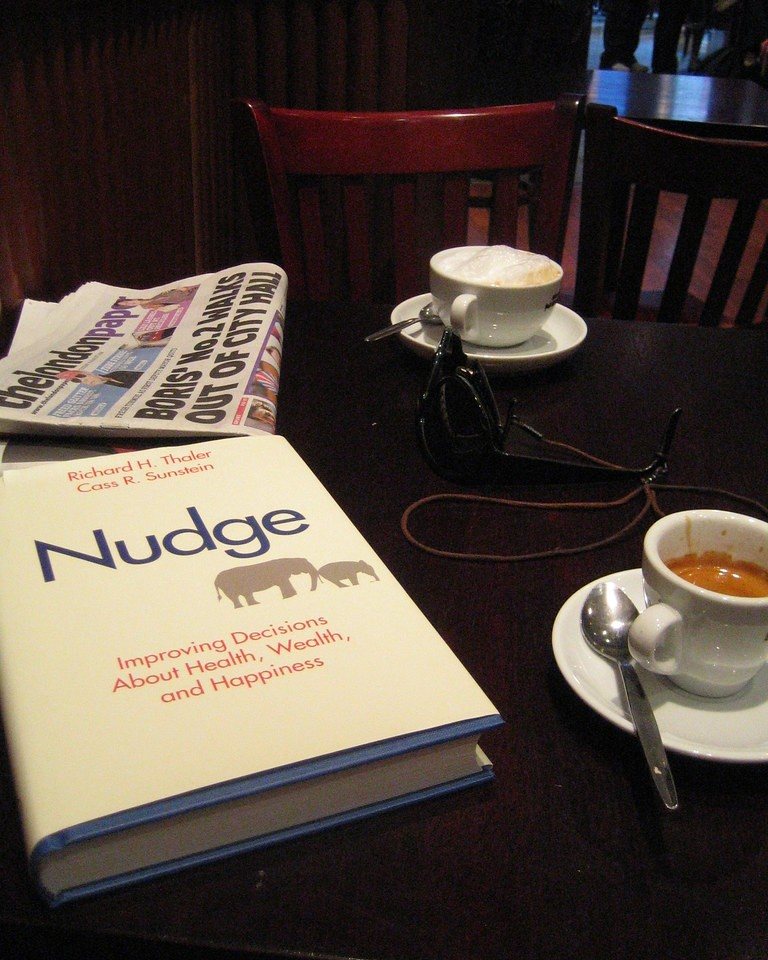
Author: Richard H. Thaler and Cass R. Sunstein · Published: 2008 · Genre: Psychology, Behavioral Economics, Public Policy
Nudge argues that because people make predictable mistakes, governments and organizations should design choices so the easy option is also the good one, without banning anything. It is one of the most influential books of its era and helped launch government behavioral units around the world. It is also dry in places, and newer research suggests many nudges have smaller effects than the book implies. Still worth reading for anyone in policy, business or design.
The big idea
Thaler, an economist who later won the 2017 Nobel Prize, and Sunstein, a legal scholar, start from the gap between Econs, the perfectly rational agents of textbook economics, and Humans, who procrastinate, follow the crowd and stick with whatever is already set.
The opening example sets the tone: a school food director discovers she can change what children eat simply by rearranging how dishes are displayed in the cafeteria line. Since every choice has to be presented somehow, there is no neutral design. Someone decides the order of food in a school cafeteria, the default option on a retirement plan and the layout of a form. The authors call this person a choice architect, and argue that choice architects should steer people toward the options those people would pick for themselves if they paid full attention. They call this philosophy libertarian paternalism: guidance without coercion, with opt-outs always available.
The book then applies the idea to savings, health care, organ donation, the environment and even marriage.
What works
- Defaults. The strongest material shows how much defaults matter. When employers automatically enroll workers in retirement plans, participation jumps. Thaler’s Save More Tomorrow plan, developed with Shlomo Benartzi, lets workers commit in advance to saving part of future raises, getting around both inertia and the pain of seeing take-home pay fall.
- Memorable examples. An etched image of a fly in the urinals at Amsterdam’s Schiphol airport improves men’s aim. White lines painted across a dangerous curve on Chicago’s Lake Shore Drive, spaced closer and closer together, make drivers feel they’re speeding up, so they slow down.
- Real impact. The ideas moved quickly into practice. The British government created its Behavioural Insights Team in 2010, and Sunstein went on to run the White House regulatory affairs office under President Obama.
- A clear philosophy. The insistence that people must always be free to opt out gives the approach a principled limit that many critics overlook.
What doesn’t
The later chapters are slow. Long discussions of US prescription drug plans and Sweden’s pension reform will interest policy specialists more than general readers, and some of the detail has dated. The authors revised the book in 2021 as Nudge: The Final Edition.
The evidence has also shifted. A widely cited 2022 meta-analysis reported a meaningful average effect for nudges, but other researchers responded that after correcting for publication bias, the evidence for nudging as a general tool was weak. The likely truth is that some nudges, especially defaults, work well while many others do little. Organ donation shows the limits: the authors themselves preferred prompting people to make an active choice over a simple opt-out default, and later evidence supports their caution, since donation rates depend heavily on families and hospital systems.
Critics from both sides object to the philosophy. Some libertarians see nudging as manipulation by officials who have their own biases. Others argue that it offers small design tweaks where stronger regulation is needed, letting governments look busy without tackling hard problems.
Who should read it
Policymakers, HR and product managers, and anyone who designs forms, websites or public programs. General readers may prefer the updated Final Edition or Thaler’s livelier, more personal Misbehaving.
Rating: 4/5
Photo credits — Featured image: Photo by Gordon Joly via Flickr, CC BY-SA 2.0, cropped.
