

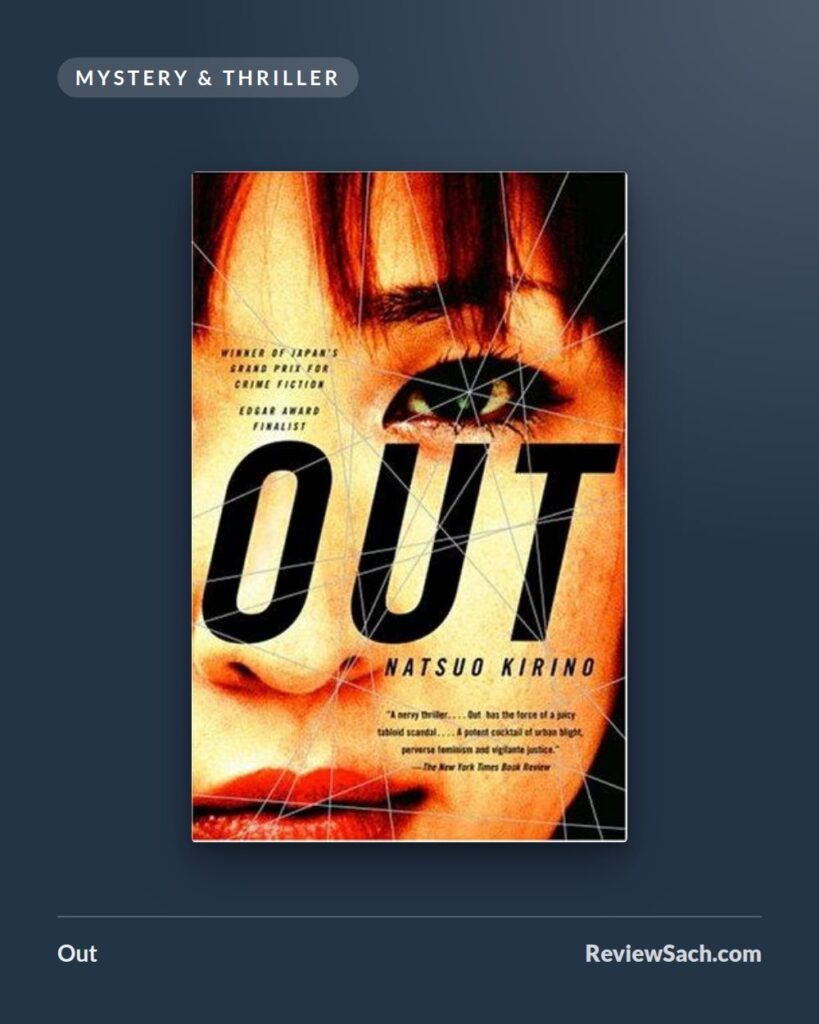
Author: Natsuo Kirino · Published: 1997 · Genre: Crime Fiction, Noir
Out‘s biggest strength is its picture of women ground down by work, money and family, which makes a grisly crime feel almost logical. Its weakness is excess: it is long and unrelentingly grim, and its violence, including sexual violence, will be too much for many readers. Read it if you like dark, intelligent crime fiction that cares more about why people do things than about whodunit.

What it’s about
Four women work the night shift on a boxed-lunch assembly line in the suburbs of Tokyo. Masako, cool, capable and the group’s unofficial leader, is estranged from her husband and teenage son. Yoshie cares for her bedridden mother-in-law on almost no money. Kuniko, younger and vain, is sinking under consumer debt. Yayoi, a mother of two small boys, is married to Kenji, who gambles, drinks and abuses her.
One night Yayoi kills Kenji in a moment of rage and turns to Masako for help. Masako agrees to make the body disappear and draws in Yoshie and Kuniko, each for her own reasons, mostly money. That is the setup, laid out in the opening chapters. The rest of the novel follows how the crime spreads outward: the police investigation, a loan shark who senses an opportunity, and Satake, the owner of a hostess club with whom Kenji clashed shortly before his death.
What’s great
- Work as setting. Kirino describes the factory with real precision: the cold, the hairnets, the pace of the conveyor belt, the aching backs. The night shift is not a backdrop. It explains who these women are and why they cross the line.
- Motive without melodrama. Nobody here is a criminal mastermind. The women act out of exhaustion, resentment and money worries, and Kirino makes each decision feel disturbingly ordinary.
- Masako. She is one of crime fiction’s great protagonists: competent, unsentimental and quietly furious at a life that offers her nothing. Her calm practicality is more unnerving than any villain.
- Social bite. Beneath the thriller is a portrait of late-1990s Japan: debt and consumerism, a rigid gender hierarchy, the precarious lives of immigrant workers, including a lonely Japanese-Brazilian man on the factory staff, and the near-invisibility of middle-aged women. The novel won the Mystery Writers of Japan Award, and Stephen Snyder’s English translation was shortlisted for the Edgar Award for Best Novel in 2004.
What’s weak
It is long, and Kirino lingers. The middle section, as the investigation grinds on and the women’s lives keep unravelling, sags, and some subplots, especially Kuniko’s debts, are stretched thin. Several characters exist mainly to be miserable, and the bleakness can feel monotonous rather than revealing.
The book is also far more explicit than most mainstream crime fiction. The handling of the body is described in clinical detail, and the novel contains sexual violence that some readers will find gratuitous. The most extreme material comes in the later chapters, where the story moves away from grounded social realism toward something more lurid and operatic. Some readers find that shift thrilling, while others feel it betrays the careful first half. Either way, this is not a cosy mystery, and it offers no comfortable moral centre.
Who should read it
Readers who like dark, character-driven crime in the vein of Patricia Highsmith, and anyone curious about Japanese fiction beyond Haruki Murakami. It is also essential for fans of the wider wave of translated Japanese crime fiction. Avoid it if graphic violence or sexual violence is a dealbreaker.
Rating: 4/5
Image credits — Featured image: cover image via Open Library; cover design © the publisher, shown for review purposes. In-article images: Photo by Andre Benz on Unsplash.
