

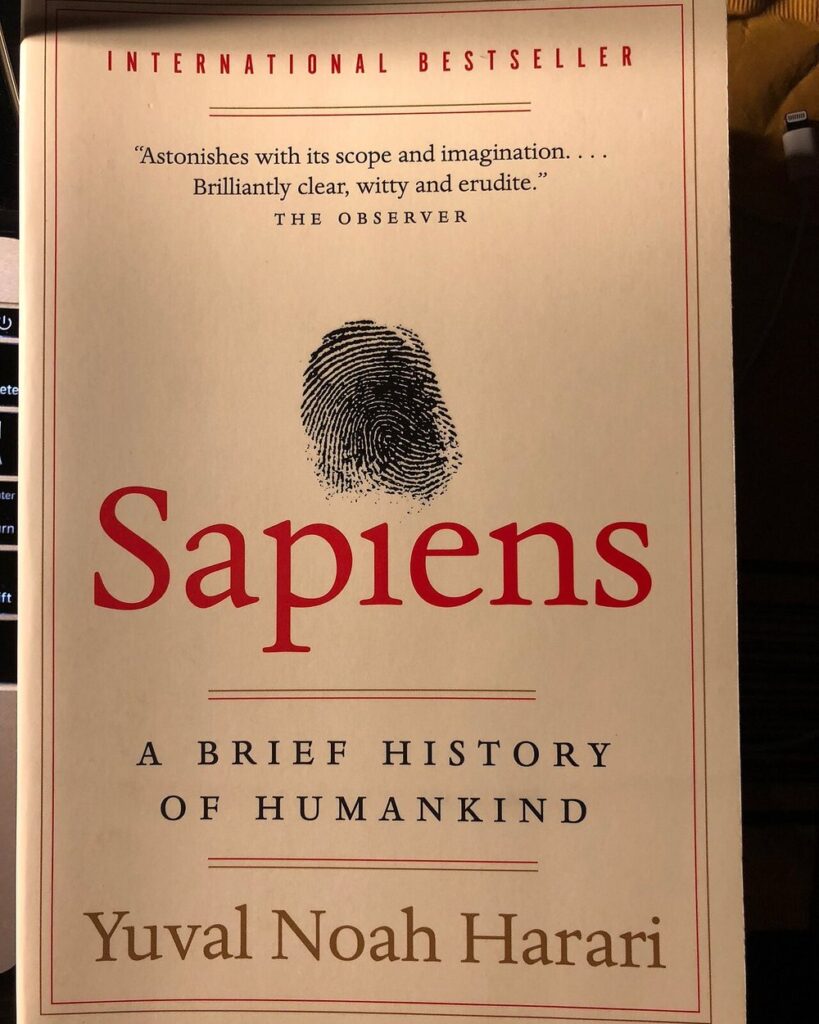
Author: Yuval Noah Harari · Published: 2011 · Genre: History, Anthropology
Sapiens tells the 70,000-year story of our species with extraordinary confidence and clarity. Its biggest strength is one big, memorable idea: humans dominate the planet because we can cooperate in huge numbers around shared fictions. Its biggest weakness is that the same confidence carries it well past the evidence, and specialists have documented many errors and oversimplifications. It’s worth reading for curious generalists who treat it as a provocation, not a textbook.
The core ideas
First published in Hebrew in 2011, with the English edition following in 2014, the book is built around a series of revolutions:
- The Cognitive Revolution. About 70,000 years ago, Harari argues, Sapiens gained the ability to talk about things that don’t exist. Gods, nations, money and companies (he uses Peugeot as an example of a legal fiction) let strangers cooperate at a scale no other animal can.
- The Agricultural Revolution. Farming multiplied the population but, he says, made most individual lives worse: harder work, poorer diets, more disease. He calls it history’s biggest fraud and suggests wheat domesticated us rather than the other way round.
- The unification of humankind. Money, empires and universal religions pulled humanity toward a single global order. Money, in his account, is the most universal system of mutual trust ever devised.
- The Scientific Revolution. Modern science began when Europeans were willing to admit their ignorance, and it grew hand in hand with empire and capitalism.
What’s great
- Clarity. Harari explains abstractions such as the imagined orders that hold up law, markets and human rights in plain language with vivid examples.
- Uncomfortable questions. He asks whether all this progress made people any happier, and he treats the suffering of farm animals as a serious moral issue, which most big histories ignore.
- A mental map. Linking biology, economics and religion in one frame gives readers a structure to hang later reading on, which is why the book became a gateway to history for millions.
The controversy
Sapiens is a huge bestseller, but many academic reviewers have been harsh:
- Anthropologist Christopher Hallpike argued it makes no serious contribution to knowledge: where its facts are right they aren’t new, and where Harari strikes out on his own he often gets things wrong.
- Philosopher Galen Strawson, reviewing it in the Guardian, faulted its carelessness, exaggeration and sensationalism.
- Neuroscientist Darshana Narayanan, who fact-checked it for Current Affairs in 2022, described its scientific errors as numerous and substantial.
- Anatomist Alice Roberts singled out an early sentence about human evolution as badly wrong.
On substance, many archaeologists doubt there was a sudden cognitive revolution at all; evidence of symbolic behavior in Africa builds up gradually over a much longer period. The agriculture-as-fraud thesis sharpens an older argument but plays down how farming’s surpluses made cities, writing and eventually modern medicine possible. Critics also note the book rarely signals which claims are consensus and which are Harari’s own speculation, so readers can’t easily tell the difference.
Who should read it
Read it if you want a thrilling overview of human history and are willing to follow up with sources. Pair it with specialist works, such as David Graeber and David Wengrow’s The Dawn of Everything, which challenges the standard story of farming and inequality. Skip it if you need a reliable reference.
Rating: 3.5/5
Image credits — Featured image: Image by 宋世怡 via Wikimedia Commons, CC BY-SA 4.0, cropped. In-article images: Image by EU+Mexico via Wikimedia Commons, CC0; Image by HTO via Wikimedia Commons, Public Domain.
