

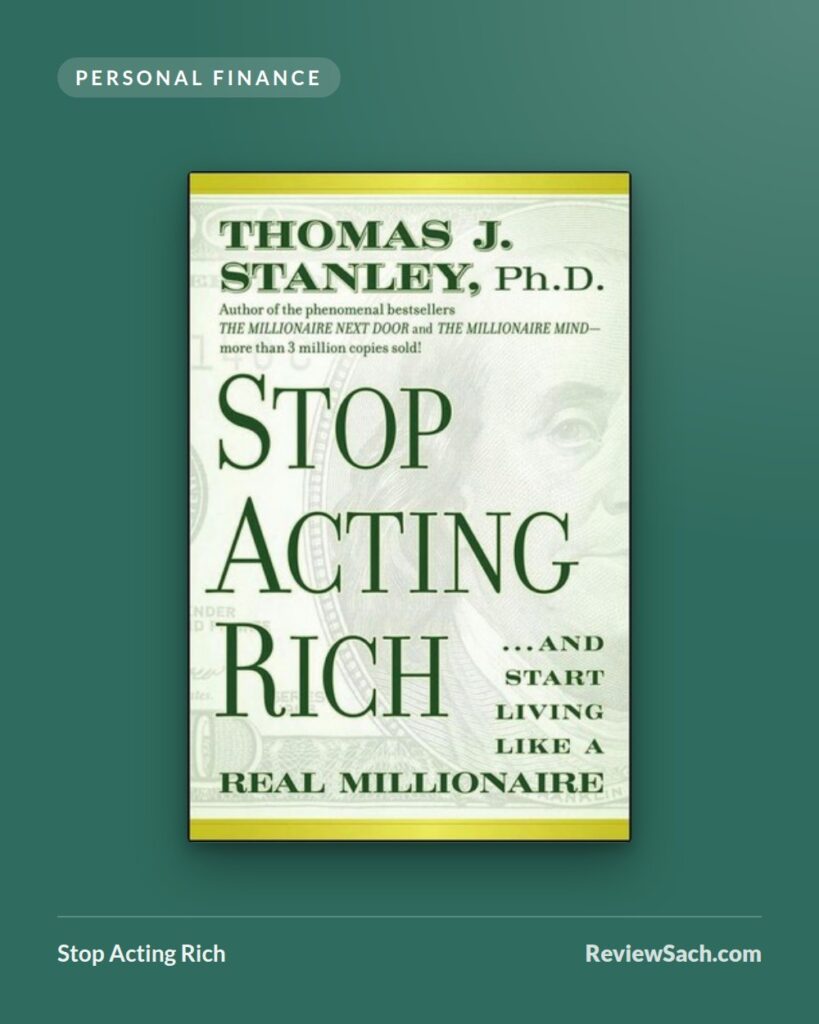
Author: Thomas J. Stanley · Published: 2009 · Genre: Personal Finance, Wealth
Stop Acting Rich argues that many high earners stay financially stuck because they spend to look wealthy, while most actual millionaires live surprisingly modest lives. Its biggest strength is its survey data on what millionaires really buy, which makes the point concrete in a way that moralizing never could. Its biggest weakness is repetition: one good idea is stretched across a whole book, and readers of Stanley’s earlier work will find little new. It is worth reading for anyone who earns well but wonders why their net worth doesn’t show it.

The big idea
Stanley, a marketing scholar who spent decades surveying wealthy Americans, made his name with The Millionaire Next Door (1996, with William Danko). That book showed that many millionaires are self-employed, frugal people who live in ordinary houses and drive ordinary cars. Stop Acting Rich, published in the aftermath of the financial crisis, turns the lens on the opposite group: people with high incomes and big spending but little accumulated wealth.
His central distinction is between acting rich and being wealthy. Acting rich means buying the signals of success, such as luxury cars, designer clothes, expensive watches, fine wine and a house in a prestigious neighborhood. Being wealthy means owning assets that give you security and freedom. The book argues that the pressure to keep up with affluent neighbors and colleagues is what keeps many professionals from making that switch.
The chapters work through status purchases one by one, from shoes and watches to spirits, wine, cars and houses. An appendix explains how he found and surveyed his millionaires.
What’s great
- Concrete numbers. Stanley reports that most prestige cars are driven by people who are not millionaires, and that far more millionaires live in homes worth under $300,000 than in homes worth $1 million or more. Details on their haircuts, wine and shoe brands make the same point at a smaller scale.
- A useful reframe. Separating income from wealth is the most valuable idea in the book. A big salary and an expensive lifestyle can coexist with very little net worth.
- Status, not greed. Stanley shows that overspending is often social: people buy what their neighborhood, workplace and peers expect. That explanation is more useful than blaming individual weakness.
- Happiness. He argues that people who stop acting rich gain something status spending cannot buy: less pressure, more security and more freedom over how they spend their time.
What’s weak
The book is repetitive. Each chapter makes the same argument with a new product, and after the first few the pattern is predictable. Reviewers have noted that readers of The Millionaire Next Door will recognize most of it.
The method has limits too. Stanley’s findings rest on self-reported surveys of people who already became millionaires. Nassim Nicholas Taleb criticized The Millionaire Next Door for survivorship bias, since frugal people who never grew rich are not in the sample, and the same objection applies here. Thrift may be one cause of wealth, but the surveys cannot separate it from luck, inheritance, career choice or decades of rising markets.
Some of it has dated, since prices, housing markets and the shape of careers have changed since 2009. And the book says little about people for whom the problem is not luxury spending but low income.
Who should read it
Read it if you earn a high income and feel pressure to spend like your peers, or if you want concrete evidence that wealth often looks ordinary. If you have already read The Millionaire Next Door, a skim will do.
Rating: 3/5
Image credits — Featured image: cover image via Open Library; cover design © the publisher, shown for review purposes. In-article images: Photo by Leonard Conte on Unsplash.
