

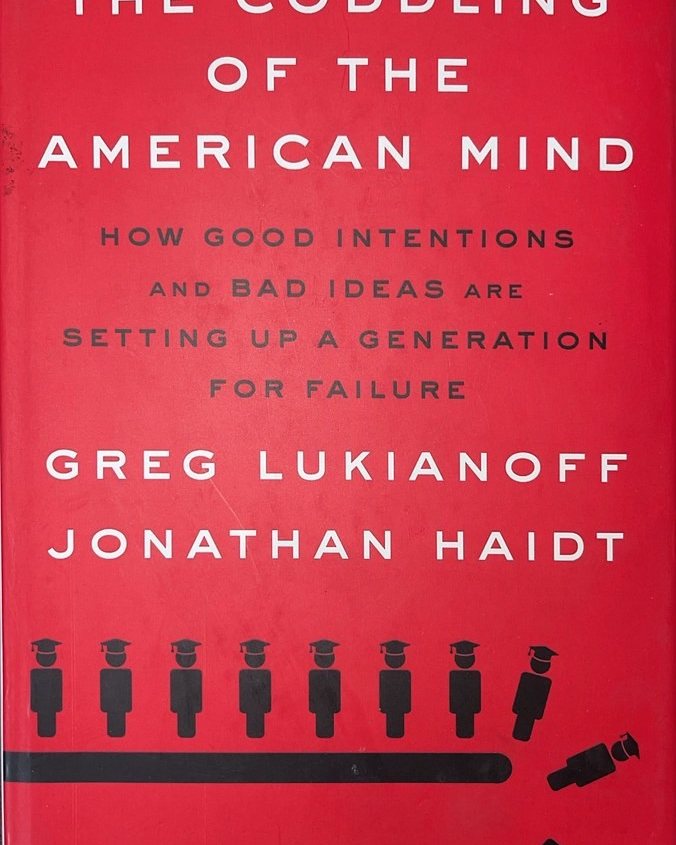
Author: Greg Lukianoff and Jonathan Haidt · Published: 2018 · Genre: Psychology, Education, Social Science
The Coddling of the American Mind argues that a generation of American students absorbed three bad ideas that make them more anxious and less tolerant, and that universities made things worse. Its framework, borrowed from cognitive behavioral therapy, is clear and useful. Its account of a campus crisis leans heavily on vivid incidents and remains disputed. Worth reading for parents, educators and anyone following the free speech debate.
The big idea
The book grew out of a 2015 Atlantic article by the same authors. Lukianoff, a free-speech lawyer at the campus-rights group FIRE, noticed that the arguments students were making for trigger warnings and speaker bans resembled the cognitive distortions that CBT teaches people to challenge. Lukianoff had himself used CBT to recover from depression.
They name three Great Untruths: – The Untruth of Fragility: what doesn’t kill you makes you weaker. – The Untruth of Emotional Reasoning: always trust your feelings. – The Untruth of Us Versus Them: life is a battle between good people and evil people.
Each contradicts ancient wisdom and modern psychology, they argue, and each harms the people who believe it. They call the resulting culture safetyism: treating safety as a sacred value, so that people refuse to weigh it against any other practical or moral concern.
They then offer six explanatory threads: rising political polarization, rising teen anxiety and depression, paranoid parenting, the decline of free play, the growth of campus bureaucracy, and a rising passion for justice.
What works
- The CBT framework is the book’s best contribution. Seeing catastrophizing, black-and-white thinking and mind-reading as habits that can be unlearned is useful far beyond campus politics.
- The antifragility argument is persuasive. Drawing on Nassim Nicholas Taleb, they argue that children, like immune systems, need exposure to challenge to grow stronger. Their example of peanut allergies, which appear to have become more common partly because parents kept children away from peanuts, makes the point memorably.
- The case studies are well told. Chapters on the 2017 protests against Charles Murray at Middlebury College and the turmoil at Evergreen State College illustrate the argument vividly.
- It offers practical steps. The closing chapters give concrete advice to parents, schools and universities, from encouraging independence to adopting clear free-expression principles. One appendix explains how to practice CBT; another reprints the University of Chicago’s statement on free expression, which the authors urge other colleges to adopt.
What doesn’t
The main criticism is that the evidence for a broad campus crisis is thin. Much of the book rests on high-profile incidents at a small number of selective colleges. Critics argued that these episodes, though real, are rare compared with the millions of students attending college without incident, and that the authors generalize too readily from them. Supporters reply that surveys show many students hesitate to speak freely, so the problem is wider than the headlines.
Some reviewers also argued that the book puts too much blame on students for problems created by institutions and a harsher economy, and that it gives too little weight to genuine grievances. Others felt its treatment of social justice activism was one-sided, even though the authors do criticize harassment of professors from the right as well.
The social media argument previews Haidt’s later The Anxious Generation, and it faces the same objection: the link between smartphones and adolescent mental health is largely correlational and contested. Here it is one of six threads, but it carries a lot of weight.
Who should read it
Parents, teachers and university staff will find the CBT framework and the chapters on childhood independence directly useful. Readers skeptical of its politics should still read the first part, which stands on its own as good practical psychology.
Rating: 3.5/5
Photo credits — Featured image: Photo by Ged Carroll via Flickr, CC BY 2.0, cropped.
