

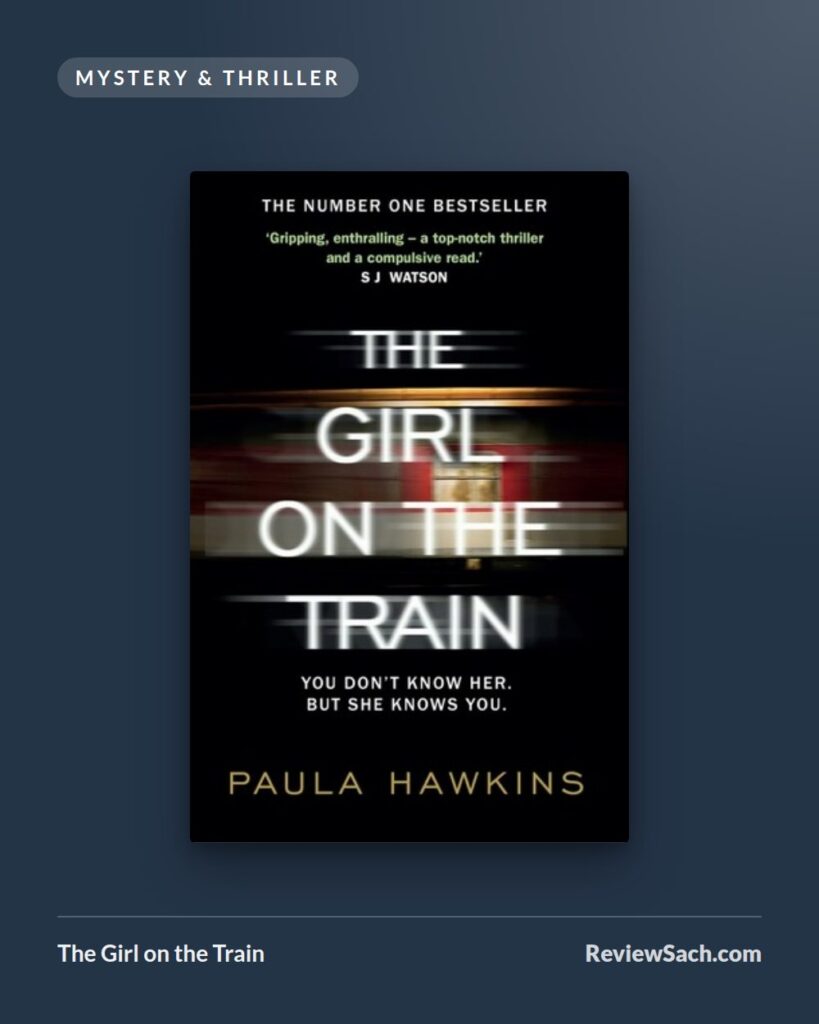
Author: Paula Hawkins · Published: 2015 · Genre: Psychological Thriller, Domestic Suspense
The Girl on the Train is a compulsive, bleak thriller about memory, drinking and voyeurism. Its hook, a commuter who sees something she should not and cannot trust her own mind, is excellent. The characters are uniformly miserable and the solution is easier to predict than the hype suggests, but it is a solid, fast page-turner.
What it’s about Every weekday, Rachel Watson takes the same commuter train into London. She is in her thirties, divorced, drinking heavily and out of a job, though she keeps making the trip so her flatmate will not find out. When the train stops at a signal, she can see into the back gardens of a row of houses by the track. She has become fixated on one couple she does not know, names them Jess and Jason, and imagines a perfect life for them.
The houses are on the street where Rachel used to live with her ex-husband, Tom, who still lives there with his new wife, Anna, and their baby daughter. One morning Rachel sees something in the couple’s garden that shocks her. Soon afterwards, the woman, whose real name is Megan Hipwell, disappears. Rachel wakes after a night she cannot remember, hurt and frightened, and starts inserting herself into the investigation, contacting Megan’s husband, Scott, and irritating the police.
The story is told by three women: Rachel in the present, Megan in the months before she vanished, and Anna, who has every reason to want Rachel gone from her life.
What works – The premise. Seeing strangers’ lives from a train window is a brilliant image for how we invent other people, and Hawkins uses it for both voyeurism and loneliness. – Rachel’s blackouts. Hawkins turns alcoholic memory loss into a mystery engine: the answer may be in Rachel’s own head, and she cannot reach it. It is a fresh take on the unreliable narrator, and it makes Rachel’s desperation feel real. – Three voices. Megan’s and Anna’s chapters complicate what Rachel thinks she has seen, and the shifting timelines create steady suspense. – Unglamorous detail. The commuter-belt world, from delayed trains and station platforms to the cans of premixed gin and tonic Rachel drinks on board, is precise and grubby. It is a welcome change from glossier thrillers full of beautiful homes. – Themes. Beneath the thriller is a serious story about shame, loneliness and the way women are judged for drinking, for not having children and for their sex lives. Hawkins takes those pressures seriously.
What doesn’t Almost everyone in the book is unpleasant or pitiable, and spending a whole novel inside Rachel’s self-destruction can be draining. Megan’s chapters, which carry much of the emotional weight, sometimes read like a list of wounds rather than a life. The three narrators’ voices also sound too alike, so it is easy to lose track of whose chapter you are in. The pool of suspects is small, and many readers guess the solution well before the end. The police are largely sidelined to make room for Rachel’s amateur sleuthing, which strains belief.
The book was also sold from the start as the next Gone Girl, which set expectations it cannot quite meet. It is grimmer and less witty, and its satire is much narrower. The 2016 film starring Emily Blunt moved the story from London to New York and lost some of its suburban English texture in the process.
Who should read it Fans of domestic suspense and unreliable narrators, and anyone who wants a quick, dark read for their own commute. If you want likable characters or a truly surprising solution, it may disappoint.
Rating: 3.5/5
Image credits — Cover image via Open Library. Cover design © the publisher, shown for review purposes.
