

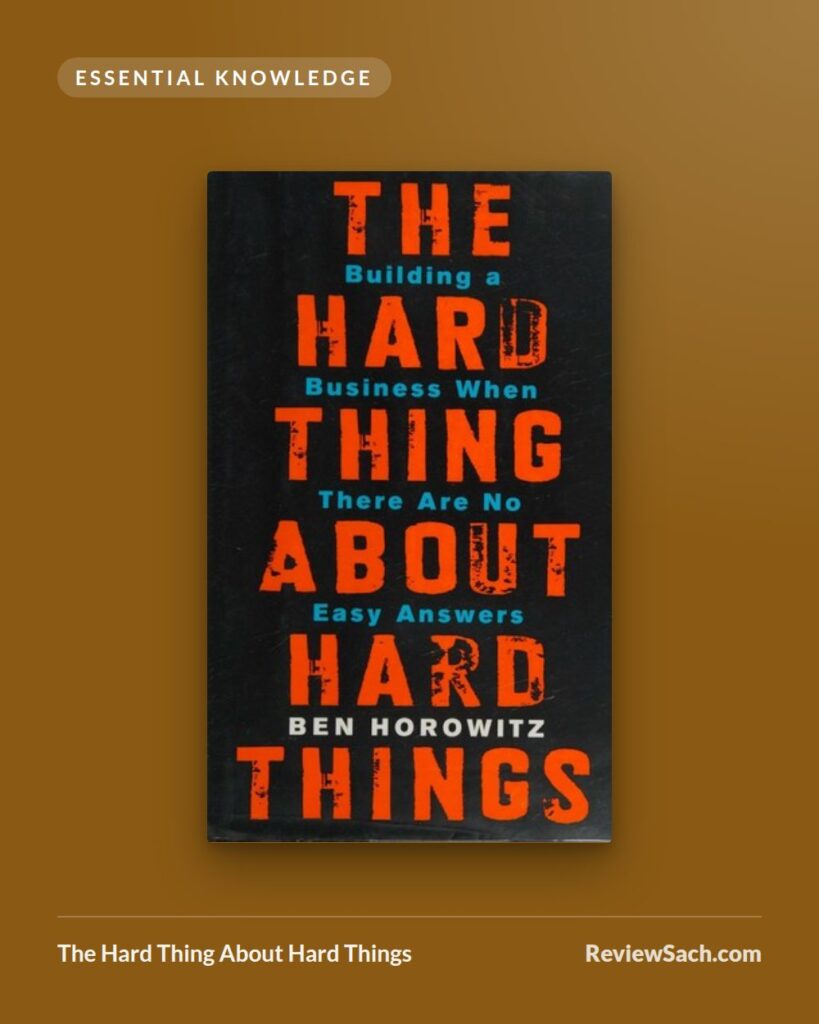
Author: Ben Horowitz · Published: 2014 · Genre: Business, Management
The Hard Thing About Hard Things‘s biggest strength is its honesty about the ugly parts of running a company: layoffs, firing friends, near-bankruptcy and the private fear that comes with them. Its biggest weakness is its narrow audience. The advice is built for venture-backed technology CEOs, and it rests on one leader’s experience rather than wider evidence. It’s worth reading for founders and senior managers in fast-growing companies.

The core ideas
- The Struggle. Every CEO hits stretches where nothing works and no framework helps. Horowitz argues that surviving them is the real job, and that most management books skip this part.
- People, products, profits, in that order. Taking care of your people comes first, because without a good place to work, the rest falls apart.
- Do the hard things properly. Layoffs, firing executives and demoting a loyal friend all have a right way. For layoffs, he says the CEO should explain the decision to the company personally, and each manager should tell their own people rather than hand the job to HR.
- Peacetime vs. wartime CEO. In peacetime a company can expand and experiment. In wartime, facing an existential threat, the CEO must focus hard, break rules and act fast.
- Manage your own psychology. The hardest skill is controlling your own mind under pressure, so you can keep making decisions when every option looks bad.
What’s great
The story behind the advice is gripping. Horowitz co-founded Loudcloud during the dot-com boom, took it public in 2001 as the market collapsed, then sold its services business to EDS and rebuilt what remained as a software company, Opsware. For a while EDS supplied most of Opsware’s revenue and threatened to leave, and a rival, BladeLogic, was winning deals. Horowitz describes rallying the team around a better product instead of hunting for a quick fix, summed up in his phrase about having no silver bullets, only lead bullets. HP bought Opsware in 2007 for about $1.6 billion.
Unlike many business books, this one gives scripts, not slogans. The chapters on laying people off, firing an executive and training new staff are specific enough to use the week you need them. His memo contrasting good and bad product managers, first written to train product managers years earlier, is still widely shared.
He is also frank about his own doubts and errors, which makes the advice more credible than the usual CEO memoir.
What’s weak
The audience is narrow. Most chapters assume you are a venture-backed tech CEO with a board, a burn rate and a need to raise more money. Managers in small firms, nonprofits or big corporations will need to translate a lot.
The book grew out of Horowitz’s blog, and it shows. After the strong opening story, the chapters become a loosely organized set of essays, and some points repeat. The hip-hop lyrics that open each chapter will delight some readers and distract others.
The wartime CEO idea can be misused. It gives a flattering label to abrasive, rule-breaking leadership, and it’s easy for a leader to decide that every quarter is wartime. Horowitz frames it as a temporary mode, but the book spends more energy celebrating toughness than warning about its costs.
Finally, it is one survivor’s story. Plenty of founders fought just as hard and failed, and the book can’t show which of its lessons made the difference.
Who should read it
Startup founders, CEOs and executives at growing companies will get the most from it, ideally before a crisis rather than during one. Read Andy Grove’s High Output Management, a book Horowitz openly admires, for the management fundamentals, and this one for what to do when those fundamentals aren’t enough.
Rating: 4/5
Image credits — Featured image: cover image via Open Library; cover design © the publisher, shown for review purposes. In-article images: Photo by Bruno BD on Unsplash.
