

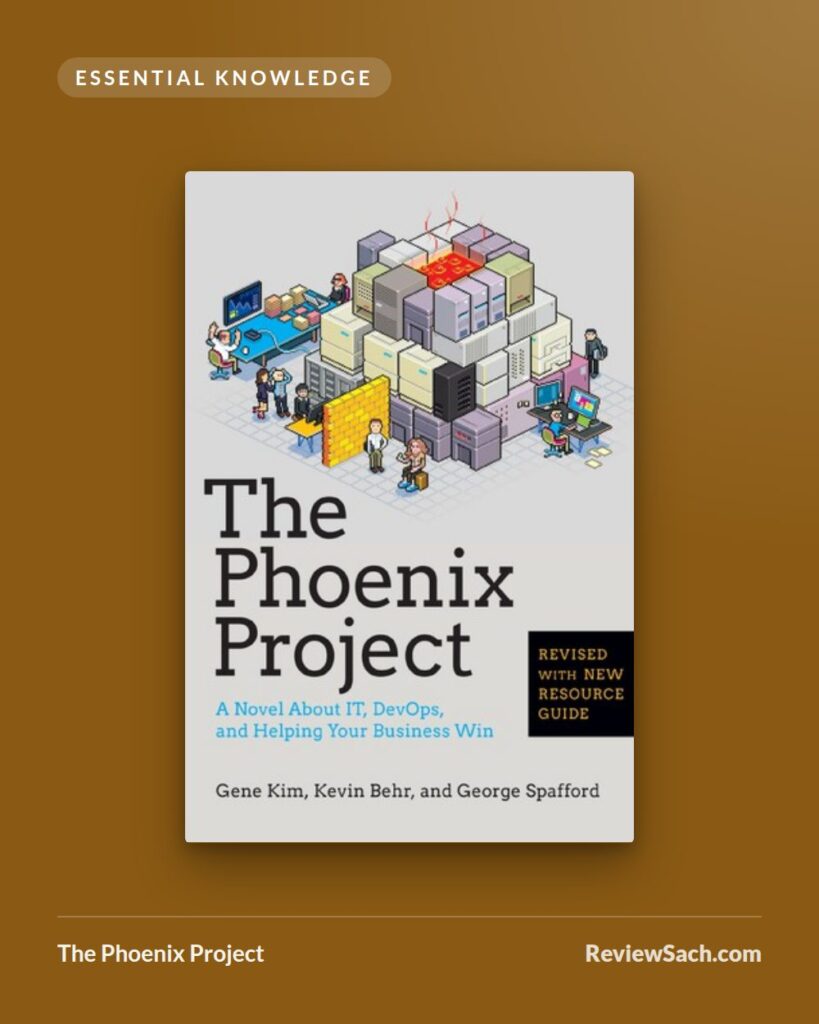
Author: Gene Kim, Kevin Behr and George Spafford · Published: 2013 · Genre: Business fiction, Software Engineering
The Phoenix Project‘s biggest strength is that it makes you feel the chaos of a broken IT department before it explains the fix, so its lessons about flow, bottlenecks and unplanned work actually stick. Its biggest weakness is that it’s a thin novel: the characters are types, and the turnaround is so neat it reads like a parable. It’s worth reading for developers, ops engineers and managers who have never seen why work gets stuck, and for executives who think IT is just a cost center.

The core ideas
Bill Palmer, a manager at the struggling auto-parts company Parts Unlimited, is suddenly promoted to run IT operations. The company is betting everything on the Phoenix Project, a late, over-budget software rollout, while payroll fails and auditors circle. Bill’s guide is Erik Reid, an eccentric prospective board member who drags him onto the factory floor and teaches him to see IT work as a production line.
- Four types of work. Business projects, internal IT projects, changes, and unplanned work. The last one, firefighting, is the killer, because it’s invisible and eats the time planned for everything else.
- The constraint. Brent, the one engineer who knows how everything works, is pulled into nearly every outage and project. Borrowing from Eliyahu Goldratt’s Theory of Constraints, the book argues that time saved anywhere except at the bottleneck is an illusion, so you protect Brent’s time and spread what he knows.
- Work in progress is the enemy. Bill’s team freezes most projects, makes work visible on kanban boards and releases new work only as capacity frees up.
- The Three Ways. First, optimize flow across the whole system, from development through operations to the customer. Second, shorten and amplify feedback so problems surface fast. Third, build a culture of experimentation and learning.
What’s great
- The pain is accurate. Anyone who has lived through a middle-of-the-night outage, a change nobody logged or an audit panic will recognize these scenes. That recognition is what makes the book persuasive.
- It translates Goldratt for software. The authors openly model the book on The Goal, Goldratt’s 1984 novel about a failing factory, and the move from manufacturing plant to IT department is clever and convincing.
- It speaks to the business side. Security, audit, finance and sales are part of the story, not afterthoughts, and the book keeps asking how IT work connects to what the company actually needs.
- It’s fast. It reads like a workplace thriller, which is more than most DevOps material can say.
What’s weak
- Flat characters. Bill is endlessly reasonable, Erik is an all-knowing guru who talks in riddles, and Sarah, the scheming retail executive, is close to a cartoon villain.
- Too tidy. Once the team adopts the right practices, the problems melt away. Real transformations are slower, messier and more political, and the novel skips hard parts like legacy architecture and tooling.
- Light on the how. It explains why automation and small batches matter, and the team works toward the goal of ten deploys a day, but it doesn’t show you how to get there. For that you need The DevOps Handbook (2016) or Accelerate (2018).
- Its setting is aging. Change-approval meetings and ticket queues already feel a little old-fashioned next to today’s cloud platforms.
Who should read it
Read it if you work in or with IT and have never studied lean or DevOps, or if you need to show a non-technical boss why everything is always urgent. Read it before The DevOps Handbook. Developers may also like the 2019 sequel, The Unicorn Project, which tells a parallel story at the same company from a developer’s point of view.
Rating: 4/5
Image credits — Featured image: cover image via Open Library; cover design © the publisher, shown for review purposes. In-article images: Image by Christopher Bowns via Wikimedia Commons, CC BY-SA 2.0.
