

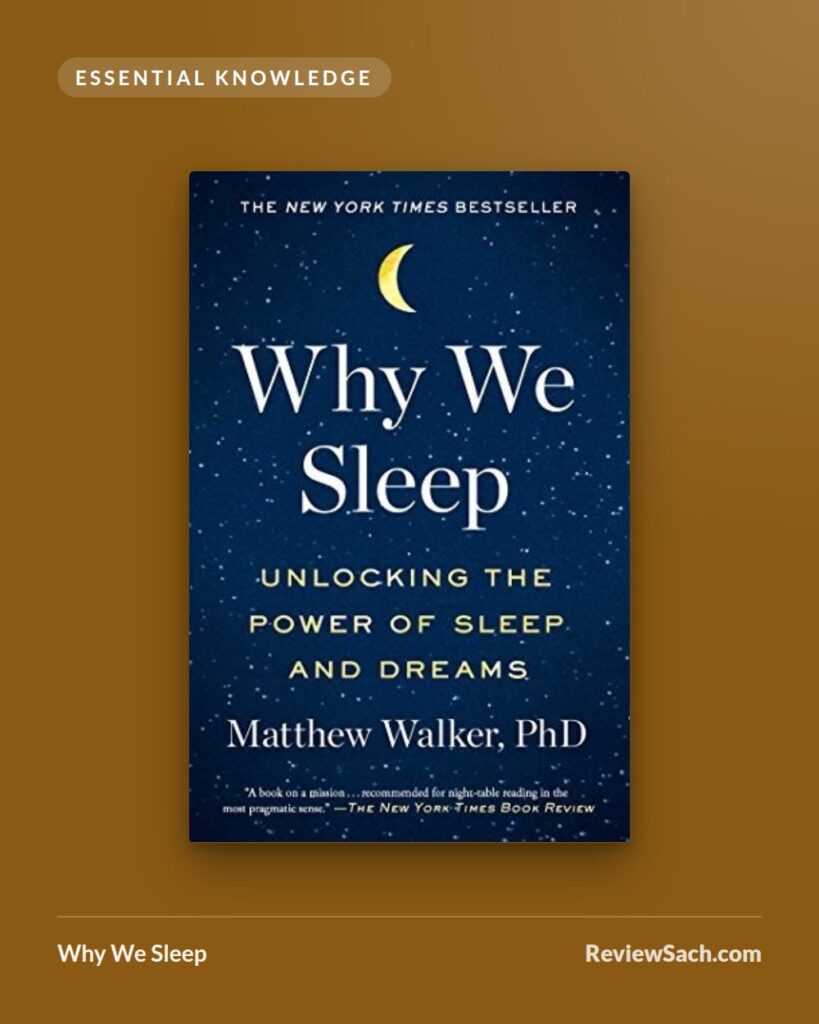
Author: Matthew Walker · Published: 2017 · Genre: Science, Health
Why We Sleep‘s biggest strength is its persuasiveness: Walker, a neuroscientist at UC Berkeley, makes a vivid case that sleep shapes memory, mood, immunity and long-term health, and he has convinced many readers to take it seriously. Its biggest weakness is that he overstates the science, and in 2019 critics documented claims that are exaggerated, unsupported or, in at least one case, based on misrepresented data. Read it for the big picture of sleep research, but don’t treat its scariest claims as settled.
The core ideas
- Two systems control sleep. Your circadian rhythm, a roughly 24-hour internal clock, and sleep pressure from adenosine, a chemical that builds up the longer you’re awake. Caffeine works by blocking adenosine receptors, and because its effects last for hours, an afternoon coffee can still disrupt your night.
- Different stages do different jobs. Walker explains how deep non-REM sleep helps move memories from short-term storage in the hippocampus to long-term storage in the cortex, and argues that REM sleep, when most vivid dreaming happens, helps process emotions and make creative connections.
- Short sleep harms the body. He links too little sleep to Alzheimer’s disease, heart disease, weakened immunity, weight gain and drowsy-driving crashes.
- Society is sleep-deprived. He criticizes early school start times, long shifts for junior doctors and work cultures that brag about sleeping little. His advice includes a regular schedule, a cool, dark bedroom and less alcohol, which fragments sleep and suppresses REM. He argues sleeping pills sedate rather than produce natural sleep.
What’s great
- Clear basics. The explanations of circadian rhythms, adenosine and sleep stages are genuinely good and well supported.
- Practical advice. The guidance on consistency, caffeine timing, alcohol and light is sensible and uncontroversial among sleep researchers.
- A worthwhile argument. The case against glorifying sleep deprivation in schools, hospitals and offices is well made.
The controversy
In November 2019, researcher Alexey Guzey published a detailed essay arguing that the book is riddled with scientific and factual errors. Among the points he and others raised:
- Lifespan. Walker writes that “the shorter your sleep, the shorter your life span,” but large studies show a U-shaped pattern: both very short and very long sleep are associated with higher mortality, and these studies show correlation, not cause.
- Cancer. His claim that routinely sleeping under six or seven hours more than doubles your cancer risk isn’t supported; a large 2018 meta-analysis found no significant link between short sleep and cancer.
- A missing bar. Walker reproduced a graph from a study of sports injuries in adolescent athletes but left out the bar for five hours of sleep, which didn’t fit the pattern he described. Statistician Andrew Gelman called removing it unethical and raised the possibility of research misconduct.
- The WHO. Walker wrote that the World Health Organization had declared a sleep-loss epidemic. It hadn’t; Walker later said he had misremembered and that the epidemic language came from the US Centers for Disease Control and Prevention.
Walker answered reader questions on his blog, but Guzey said the responses didn’t engage with his specific points. To be fair, few sleep scientists dispute that sleep matters; the argument is over how certain and how large the effects are. My own worry is for insomniacs, who hardly need a book suggesting every bad night is shortening their lives.
Who should read it
Read it if you want to understand what sleep does and need motivation to protect it, but read Guzey’s critique alongside it. If you have insomnia, a doctor and cognitive behavioral therapy for insomnia, which Walker himself recommends, will do more good than the book’s warnings.
Rating: 3/5
Image credits — Featured image: cover image via Open Library; cover design © the publisher, shown for review purposes. In-article images: Photo by Jp Valery on Unsplash.
