

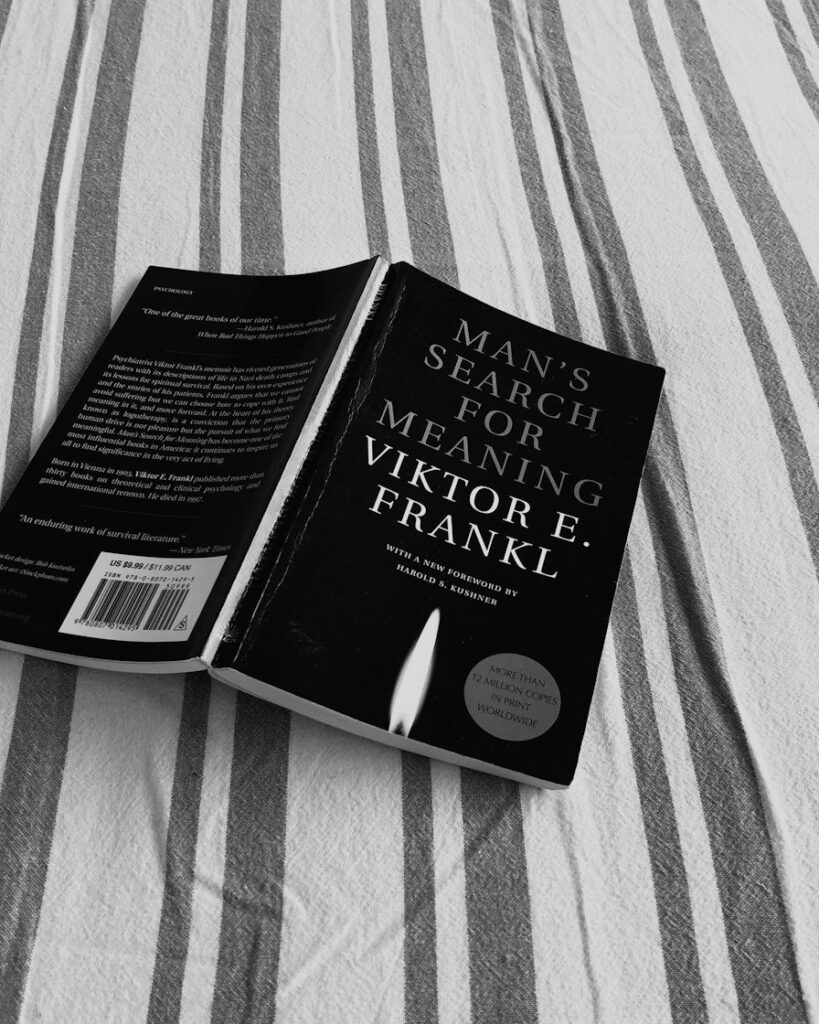
Author: Viktor E. Frankl · Published: 1946 · Genre: Psychology, Memoir
Man’s Search for Meaning is a Viennese psychiatrist’s account of surviving Nazi concentration camps, followed by an outline of the therapy he developed from that experience. Its central claim is that people can endure almost anything if they have a reason to. Read it: it is short, humane and hard to forget, though the theory section is weaker than the memoir.
What it’s about
Frankl was deported with his family in 1942. He passed through Theresienstadt, spent a short time at Auschwitz and ended the war in camps attached to Dachau. His wife, his parents and his brother all died. At Auschwitz he lost the manuscript of a book setting out his ideas, and he describes how the hope of rewriting it helped keep him going through illness and hunger.
The first part is not a chronological memoir. Frankl describes the psychology of prisoners in three phases: the shock of arrival, the apathy of daily camp life, and the numbness and bitterness that followed liberation. He writes about small things with great precision: how prisoners’ inner lives shrank to food and survival, how humor and memories of loved ones helped, and how a sunset could still move starving men.
The second part sets out logotherapy, his school of psychotherapy. Frankl argues that the main human drive is not pleasure, as Freud held, or power, as Adler held, but meaning. He says meaning can be found in three ways: through work or creating something, through love or experiencing something, and through the attitude we take toward suffering we cannot avoid.
What works
- Restraint. Frankl rarely describes violence in detail and spends little time on his own survival. The horror is present, but it is not the point.
- The freedom of attitude. Frankl argues that even when everything else is taken, a person keeps the freedom to choose how to respond. He calls it the last of the human freedoms. The idea has helped generations of readers facing grief, illness and prison.
- Hard evidence from lived experience. He tells of a fellow prisoner who dreamed that liberation would come on a certain date, and who fell ill and died soon after the date passed without rescue. The story makes the case for hope more powerfully than any statistic.
- Brevity. The whole book can be read in an afternoon, and it rewards rereading at different stages of life.
What doesn’t
The theory half is thin. Logotherapy is presented through confident case examples rather than evidence, and techniques such as paradoxical intention, in which patients are encouraged to wish for the thing they fear, read today like early versions of ideas that cognitive and exposure therapies later tested far more carefully.
Critics have also challenged the book’s framing. The literary scholar Lawrence Langer argued that Frankl’s focus on inner attitude can imply that those who died had somehow given up, when survival in the camps depended overwhelmingly on luck and circumstance. He also found Frankl’s tone self-flattering in places. Other writers have questioned parts of Frankl’s wider account of his wartime years, and have pointed out that his time at Auschwitz itself was brief.
Frankl does write that the best prisoners often did not come back, so he doesn’t claim survivors were better people. Still, the tension is real. The book is one survivor’s reflection, not a history of the Holocaust, and it works best when read that way.
Who should read it
Anyone dealing with loss, illness or a crisis of purpose, and anyone who wants perspective on their own problems. It is also a good first book for readers curious about existential approaches to therapy. For a fuller picture of the camps, pair it with Primo Levi’s If This Is a Man.
Rating: 4.5/5
Photo credits — Featured image: Photo by Pop & Zebra on Unsplash. In-article photo: Photo by Ninety Seven Years on Pexels.
