

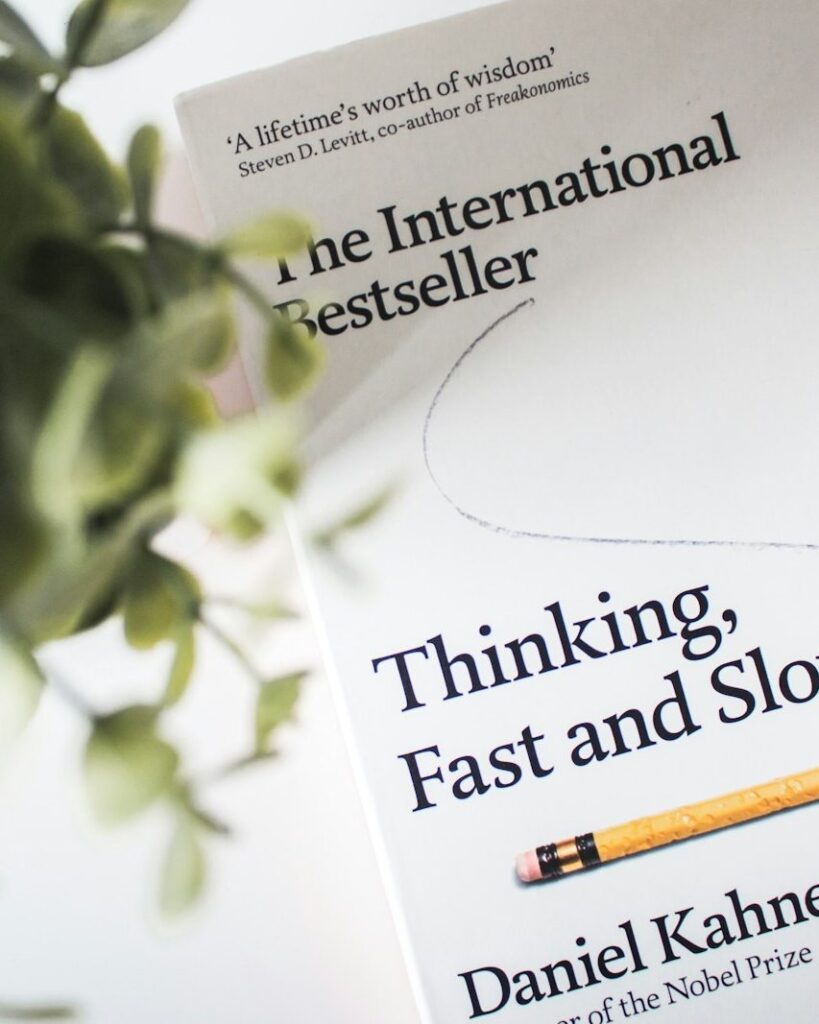
Author: Daniel Kahneman · Published: 2011 · Genre: Psychology, Behavioral Economics
Thinking, Fast and Slow explains how two modes of thought, one quick and intuitive, one slow and effortful, shape nearly every judgment you make, and why the quick one gets so much wrong. It is long, demanding and in places overtaken by the replication crisis. It is still the most important popular psychology book of its generation, and anyone who makes decisions for a living should read it.
The big idea
Kahneman, a psychologist who won the 2002 Nobel Prize in economics, splits the mind into two characters. System 1 runs automatically: it reads faces, finishes phrases and jumps to conclusions. System 2 does the hard work of calculation and self-control, but it is lazy and usually endorses whatever System 1 suggests. Most of our errors happen in that handoff.
The book then walks through decades of research, much of it done with his longtime collaborator Amos Tversky. Anchoring, the availability heuristic, the planning fallacy, overconfidence and loss aversion each get their own chapters. Later sections cover prospect theory, the work behind his Nobel, and end with a striking distinction between the experiencing self, who lives through events, and the remembering self, who keeps score and makes the choices.
What works
- The experiments are the stars. The Linda problem, in which most people rate a specific description as more likely than a broader one that contains it, is a small masterpiece of design. So is the cold-water study showing that people will choose to repeat a longer painful experience if it ends slightly less badly.
- Useful vocabulary. Labels like WYSIATI, short for “what you see is all there is”, and the planning fallacy give you handles for mistakes you make every week, at work and at home.
- Honesty about expertise. Kahneman explains when intuition deserves trust, in regular environments with fast feedback such as chess or firefighting, and when it doesn’t, as in stock picking or long-range political forecasting. That chapter alone could save you money.
- Practical tools. The premortem, borrowed from psychologist Gary Klein, and the advice to check your plans against the track record of similar past projects are simple habits with real payoffs. Kahneman illustrates the planning fallacy with his own story: a textbook project his team expected to finish in about two years took eight.
What doesn’t
Some of the book has aged badly. The chapter on priming presented findings such as people walking more slowly after reading words linked to old age as settled science. Many of those studies later failed to replicate. Kahneman had warned priming researchers in 2012 that their field faced a credibility problem, and in 2017 he publicly admitted he had placed too much faith in small, underpowered studies. That kind of self-correction is rare and to his credit.
The book also leans on ego depletion, the idea that self-control draws on a limited resource that gets used up. A large multi-lab replication in 2016 found little or no effect. It also cites the famous study suggesting Israeli parole judges grew harsher as their meal breaks approached, which critics argue can be explained by how cases were ordered.
None of this touches the core work on heuristics, biases and prospect theory, which has held up well. But readers should treat the priming and willpower material with real caution.
Finally, the book is a slog. It runs to around 500 pages, the chapters vary in quality, and the closing part on well-being feels bolted on rather than earned.
Who should read it
Anyone who wants to understand why smart people make predictable mistakes: managers, investors, doctors, policy people and patient general readers. If you want a lighter way in, read Michael Lewis’s The Undoing Project, about Kahneman and Tversky’s partnership, first, then come back to this.
Rating: 4.5/5
Photo credits — Featured image: Photo by Monica Sauro on Unsplash. In-article photo: Photo by Mukul Joshi on Unsplash.
