

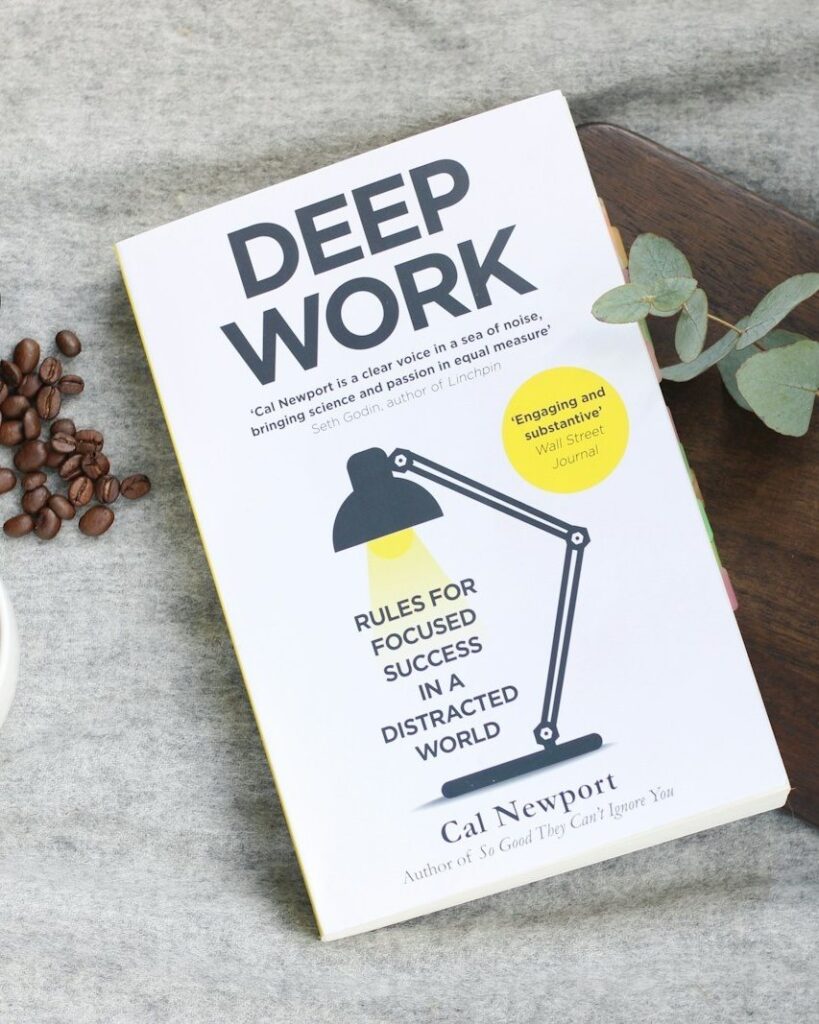
Author: Cal Newport · Published: 2016 · Genre: Self-Help, Productivity
Deep Work argues that the ability to focus without distraction on hard tasks is becoming both more valuable and more rare, so people who train it will thrive. It’s one of the most useful productivity books of the last decade, with a clear thesis and concrete rules. It suits knowledge workers who can shape their own schedules. If your job is mostly meetings and messages by design, you’ll get less out of it.
The big idea
Newport, a computer science professor at Georgetown, splits work into two kinds. Deep work is cognitively demanding and done without distraction; it creates new value and is hard to copy. Shallow work is logistical and easy to replicate: email, routine meetings, admin. Modern workplaces, he says, drift toward shallow work because it looks like being busy, and because constant connectivity is easy to measure while deep output isn’t.
He offers a simple formula: high-quality work produced equals time spent multiplied by intensity of focus. Constant switching kills intensity. He cites Sophie Leroy’s research on attention residue: when you move from one task to another, part of your attention stays stuck on the first, so even a quick inbox check lowers your performance on the next task.
The first half of the book makes the case. The second half gives four rules: work deeply, embrace boredom, quit social media, and drain the shallows.
What works
- Four ways to schedule depth. The monastic approach cuts out almost everything; computer scientist Donald Knuth famously doesn’t use email. The bimodal approach sets aside long stretches for focus, as Carl Jung did at his stone tower in Bollingen. The rhythmic approach makes deep work a daily habit at a fixed time. The journalistic approach fits it in whenever a gap opens. Readers can pick the one that fits their life.
- Embrace boredom. Newport argues that if you reach for your phone every time you’re idle, your brain loses the ability to concentrate. His fix is to schedule the times you’ll go online, and stay offline the rest of the time, rather than taking occasional breaks from distraction.
- Borrowed business discipline. He adapts the Four Disciplines of Execution, a management framework, to personal work: pick a small number of ambitious goals, measure the hours of deep work you put in rather than waiting for results, and keep a visible scoreboard.
- Shutdown ritual. Ending each workday with a fixed routine that reviews open tasks and plans tomorrow lets your mind actually rest in the evening. It’s small and it works.
- A tougher test for tools. Instead of adopting any app that offers some benefit, Newport asks whether a tool’s benefits clearly outweigh its costs for your most important goals. Many social networks don’t pass.
What doesn’t
The book is written from a privileged position. Professors, novelists and senior executives can disappear for days. A nurse, a support agent or a junior employee often can’t, and Newport offers them little beyond suggestions to negotiate with a boss.
The examples lean heavily on famous, exceptional people, and the claim that deep work is growing more valuable in the economy is more asserted than proven. The first half is repetitive, and many readers will want to get to the rules sooner.
The quit social media rule is also more measured than its title suggests. His real advice is to judge each tool on its merits, which is sensible but less dramatic, and it leaves readers in fields that depend on social media to work out the balance themselves.
Who should read it
Read it if you’re a student, programmer, writer, researcher or anyone whose best work depends on concentration. Managers should read it too, since it makes a strong case for cutting the constant interruptions they cause.
Rating: 4/5
Photo credits — Featured image: Photo by Elin Melaas on Unsplash. In-article photo: Photo by Anik Mandal on Unsplash.
