

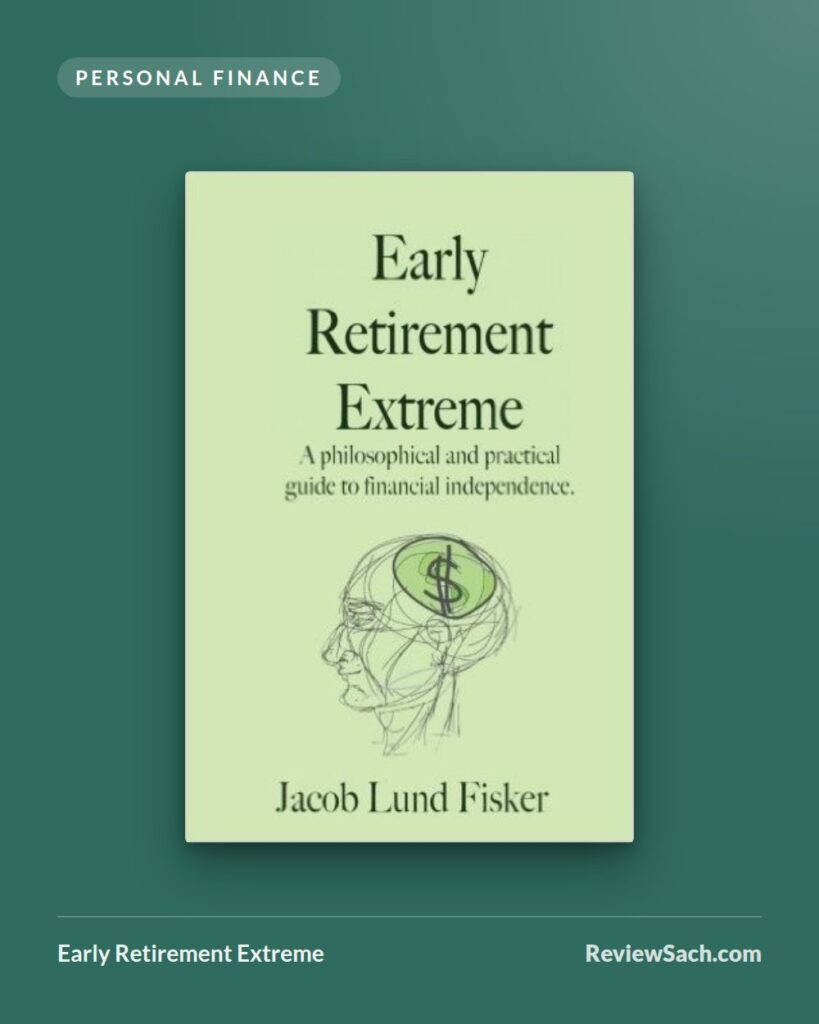
Author: Jacob Lund Fisker · Published: 2010 · Genre: Personal Finance, Philosophy
Early Retirement Extreme is the most radical and intellectually serious book in the financial independence movement. Jacob Lund Fisker argues that most people could buy their freedom within five to ten years by consuming far less and doing far more for themselves. It is dense, demanding and not for everyone, but readers who want to rethink how they live will find nothing else quite like it.
The big idea
Fisker, a Danish physicist, reached financial independence after roughly five years of work by saving around three-quarters of his income, and then lived on about $7,000 a year. The book is not a list of frugal tips. It is a framework for living. He opens with Plato’s allegory of the cave, comparing consumers to prisoners who mistake their jobs and possessions for reality.
His alternative is the “Renaissance man”: someone who learns to cook, mend, build, grow food and repair things, and so needs far less money. Instead of paying others for everything, you bring skills back in-house. The financial arithmetic follows. The lower your spending, the more of your income you can save, and the less you need in total, so the working years shrink from both ends. He treats financial independence as having savings of around 25 years’ worth of expenses.
The book grew out of his blog of the same name, started in 2007, which became an early hub for what is now called the FIRE movement (financial independence, retire early). Many later, friendlier writers borrowed its core logic.
What works
- Systems thinking. Fisker treats a life as a system to design, not a budget to trim. Choices about housing, transport, food and possessions are shown as connected decisions, where one good choice makes several expenses disappear.
- A real critique of consumerism. His argument that many people work to fund spending that the job itself makes necessary, such as commuting, convenience food and stress purchases, is sharp and uncomfortable.
- Skills as wealth. The emphasis on competence, rather than clever investing, is refreshing. Being able to fix a bike or cook from scratch is framed as a form of freedom, not a sacrifice.
- Buying for the long term. His preference for durable, useful goods over cheap disposable ones is frugality of a thoughtful kind.
The controversy
Extreme frugality divides readers. Critics argue that living on a few thousand dollars a year relies on good health, no children, cheap housing and an unusual temperament, and that American healthcare costs alone could break such a plan. Some see it as deprivation dressed up as philosophy, and question whether the approach scales beyond a single, highly disciplined person.
Defenders reply that Fisker isn’t asking everyone to copy his number. He’s asking readers to question which spending actually improves their lives. Even a partial version, such as cutting spending by a third, shortens a working life dramatically, and that is simple arithmetic. Fisker himself later took paid work again for a few years as a quantitative analyst, which critics and fans read differently. To fans, it shows the real point: independence means choosing whether to work, not never working again.
The writing is the bigger barrier. It reads like a textbook, with equations, abstractions and his own classifications of people and ways of working. There are few step-by-step instructions, which frustrates readers who want a plan they can follow on Monday morning.
Who should read it
Readers already interested in early retirement who want its deepest philosophical foundation, and anyone fed up with the cycle of working and spending. Beginners looking for practical money steps should start with something gentler, then come back to Fisker once the basic arithmetic of saving makes sense to them.
Rating: 3.5/5
Image credits — Cover image via Open Library. Cover design © the publisher, shown for review purposes.
