

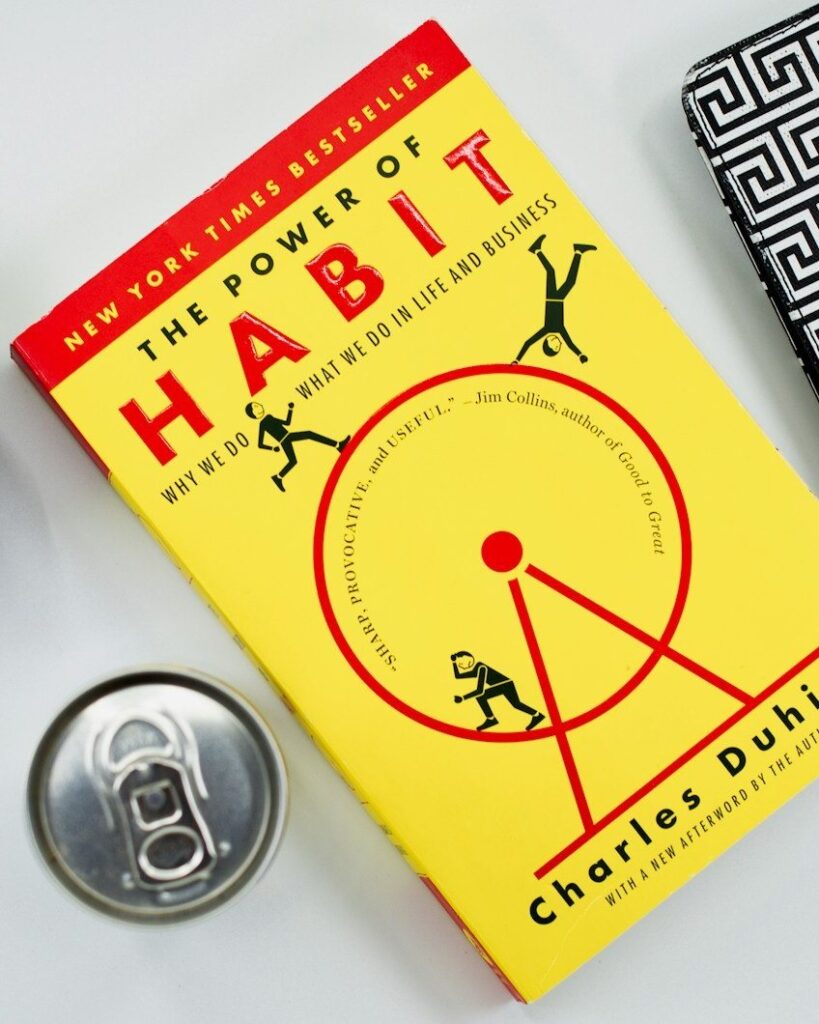
Author: Charles Duhigg · Published: 2012 · Genre: Self-Help, Psychology
The Power of Habit argues that habits run on a simple loop of cue, routine and reward, and that once you see the loop you can change it, in yourself, in companies and even in whole communities. It’s a gripping read by a skilled journalist, and the habit loop is a genuinely useful tool. But the stories are tidier than the science, and some of the research it relies on has since failed to replicate. Read it for the framework and the storytelling, not as the final word.
The big idea
Duhigg, then a New York Times reporter, opens with Lisa Allen, a woman who rebuilt her life after a divorce by first quitting smoking, a single change that led to others. He then splits the book into three parts: individuals, organizations and societies.
For individuals, the key is the habit loop. A cue triggers a routine, which delivers a reward, and over time a craving links the cue to the reward. His golden rule of habit change is that you can’t simply erase a bad habit, but you can keep the old cue and reward and swap in a new routine. He illustrates the loop with Eugene Pauly, a man whose memory was wrecked by brain damage but who could still learn new habits, like taking a daily walk around his block and finding his way home.
For organizations, he argues for keystone habits, small changes that set off wider ones. His main example is Paul O’Neill, who turned around the aluminum giant Alcoa by making worker safety his top priority, which forced better communication across the whole company.
For societies, he uses the Montgomery bus boycott to show how habits of friendship and community helped a protest grow into a movement.
What works
- Storytelling. Duhigg is excellent at pacing. The chapter on Febreze, which only sold once Procter & Gamble linked it to the satisfying end of cleaning a room, and the one on Target’s data team predicting which customers were pregnant, read like the best magazine features.
- A usable method. The appendix walks you through identifying a routine, experimenting with rewards, isolating the cue and making a plan. His own example of breaking an afternoon cookie habit, which turned out to be about wanting to chat with colleagues, is simple and practical.
- Belief matters. His chapter on Alcoholics Anonymous argues that swapping a routine often isn’t enough under stress. Changes last when people believe they can, and that belief usually grows inside a group.
- Range. Showing the same loop at work in hospitals, sports teams and corporations makes habits feel like a lens for understanding behavior rather than a gimmick.
What doesn’t
The science is simplified. Habit research is messier than a three-part loop, and Duhigg admits in the appendix that there’s no single prescription for change. The anecdotes are chosen because they fit the argument, and it’s hard to know, for example, how much of Alcoa’s success came from the safety focus alone.
Some research has aged badly. The Starbucks chapter leans on the idea that willpower is like a muscle that tires with use, citing Roy Baumeister’s well-known experiment in which people who resisted cookies and ate radishes gave up sooner on a later puzzle. That idea, known as ego depletion, fared poorly in a large multi-lab replication published in 2016, and many psychologists now doubt it works as described.
The Target story is also debated. Its most famous detail, a father learning of his daughter’s pregnancy through store coupons, rests on a single anecdote that has never been independently confirmed.
Who should read it
Read it if you enjoy narrative nonfiction and want to understand why habits stick. If you want a step-by-step manual instead, Atomic Habits is more practical.
Rating: 3.5/5
Photo credits — Featured image: Photo by Ahmed Almakhzanji on Unsplash.
