

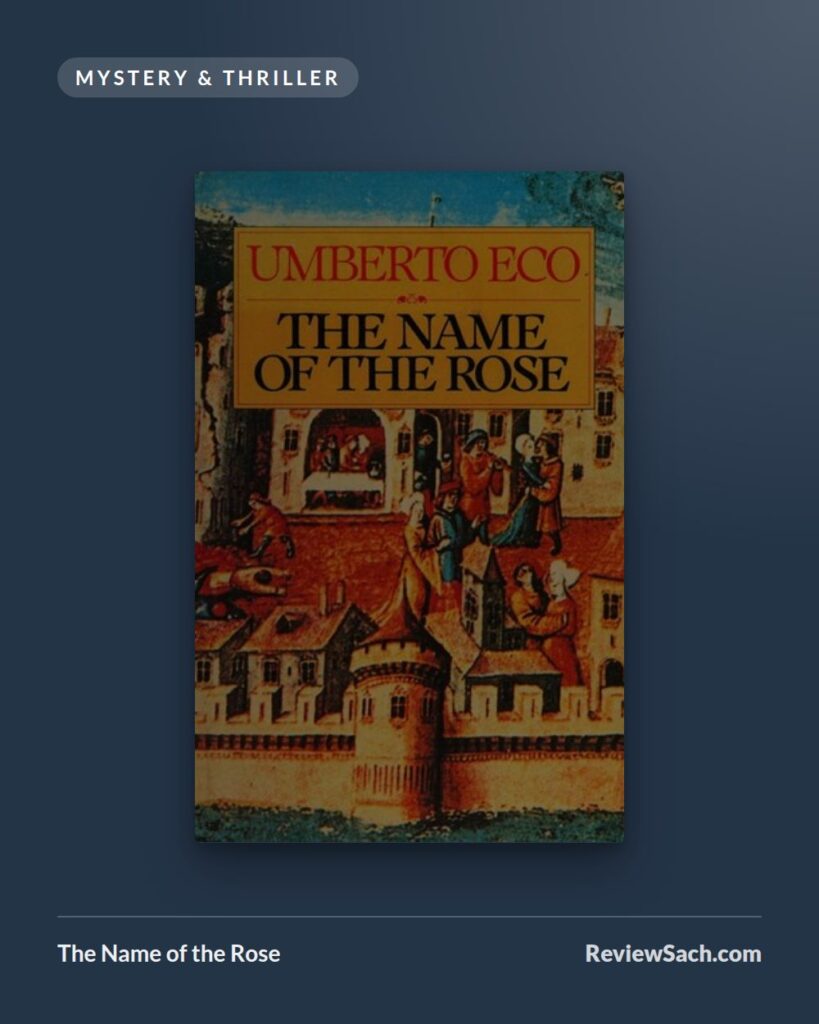
Author: Umberto Eco · Published: 1980 · Genre: Historical Mystery, Literary Fiction · Original title: Il nome della rosa
The Name of the Rose is a murder mystery set in a 14th-century abbey, and also a novel about books, heresy, laughter and how we read signs. It is dense and demanding, with long stretches of theology, but it rewards patience like few crime novels do. Read it if you enjoy ideas and atmosphere as much as plot. Skip it if you need pace.
What it’s about
In 1327, the English Franciscan William of Baskerville arrives at a wealthy Benedictine abbey in northern Italy with his young novice, Adso of Melk. William is there for a tense meeting between Franciscans and envoys of the pope, who are fighting over whether Christ and his apostles owned property. But a young monk who illuminated manuscripts has just died in suspicious circumstances, and the abbot asks William to investigate quietly.
Over seven days, more monks die. The trail leads to the abbey’s library, a vast labyrinth that only the librarian and his assistant may enter, and to the forbidden books it guards. Adso tells the story as an old man looking back on the most important week of his youth.
What works
- A great detective pairing. William is a clear nod to Sherlock Holmes (hence Baskerville) and to the medieval philosopher William of Ockham. He reasons from small signs, such as tracks in the snow on his arrival, and loves his spectacles and his books. Adso is a naive, likeable Watson, and his own crisis of faith and desire gives the novel warmth.
- The library. The labyrinth, with its rooms, mirrors and riddling inscriptions, is one of the great settings in crime fiction. Working out its layout is a puzzle in itself, and the night-time expeditions into it are properly eerie.
- Historical texture. Eco was a scholar of the Middle Ages, and it shows. The scriptorium, the herb garden, the kitchens and the round of daily prayers that structures each chapter feel lived in. You come away feeling you’ve spent a week in the abbey.
- Ideas with teeth. Beneath the whodunit, Eco asks whether truth can be known, who decides what counts as heresy, and whether laughter is dangerous. When the inquisitor Bernard Gui, a real historical figure, arrives, the novel turns frightening: doctrine becomes a weapon, and innocent people are in danger.
- A meaningful solution. Without giving anything away, the resolution is tied to the book’s central arguments, so it lands as an idea as well as a plot twist.
What doesn’t
The opening is hard work. The first hundred or so pages are heavy with church politics, and Eco later admitted he kept them slow on purpose, as a kind of initiation for readers. Untranslated Latin appears throughout. Long debates about poverty and heresy will lose many readers who came for the murders, and some descriptive set pieces, such as catalogues of carvings and visions, go on far too long.
The mystery is also less fair-play than a Golden Age puzzle. You can’t really solve it from the clues on the page, because so much depends on medieval learning that William has and the reader doesn’t. Some of his deductions feel more like authorial showmanship than logic.
William Weaver’s 1983 English translation is excellent and keeps the book’s playful learning intact. The 1986 film with Sean Connery is enjoyable, but it strips out most of what makes the novel special.
Who should read it
Readers who love historical fiction, literary puzzles and books about books. If you enjoy Borges, or long, immersive historical novels, start here. If you want a quick mystery, choose something else, or at least push past the first hundred pages before you decide.
Rating: 4.5/5
Image credits — Cover image via Open Library. Cover design © the publisher, shown for review purposes.
