

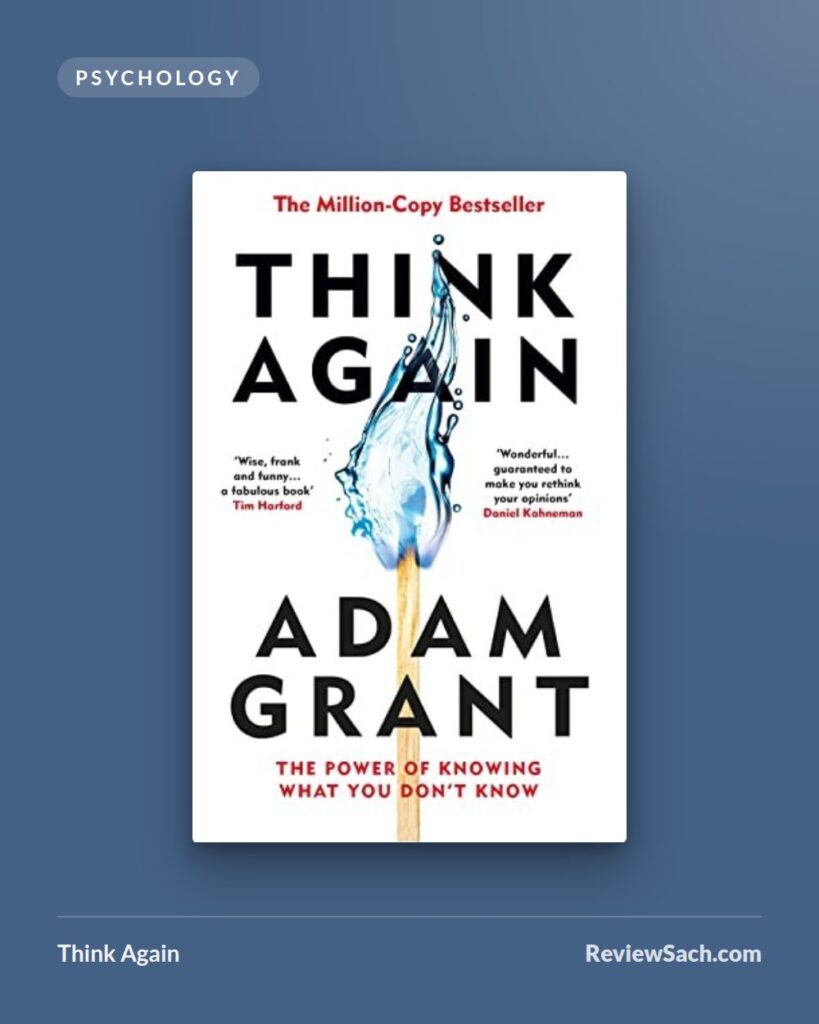
Author: Adam Grant · Published: 2021 · Genre: Psychology, Business, Self-Improvement
Think Again argues that in a fast-changing world, the ability to rethink and unlearn matters more than raw intelligence. Grant, an organizational psychologist at Wharton, packs the book with memorable stories and practical tools for questioning your own views, persuading others and building cultures that learn. It overlaps with other books on the same theme and stays fairly light. Still, it’s an engaging, useful read for managers, teachers and anyone who argues for a living.
The big idea
Grant says we slip into three unhelpful modes when we hold opinions. As preachers, we defend our sacred beliefs. As prosecutors, we attack other people’s. As politicians, we tell audiences what they want to hear. He wants us to think more like scientists: treating views as hypotheses, running experiments and updating when the evidence changes.
The book works on three levels. Individual rethinking covers confidence, humility and the joy of being wrong. Interpersonal rethinking covers persuasion, debate and conflict. Collective rethinking covers schools, workplaces and polarized societies.
Grant opens with the 1949 Mann Gulch fire in Montana, where smokejumper foreman Wagner Dodge survived by rethinking on the spot: he lit an escape fire and lay down in its ashes while the flames passed. He contrasts that with BlackBerry’s Mike Lazaridis, who stuck with the physical keyboard as touchscreen phones took over. He also cites an experiment in which Italian startup founders trained to treat their strategies as hypotheses to test went on to earn more revenue than a comparison group.
What works
- Confident humility is a useful idea. Grant argues the sweet spot is being sure of your ability to learn while doubting your current knowledge. His discussion of impostor feelings as a possible spur to learning, rather than a pure handicap, is reassuring.
- The persuasion chapters are the best. He describes champion debater Harish Natarajan beating IBM’s Project Debater by finding common ground rather than piling up arguments. He also explains motivational interviewing, developed by William Miller and Stephen Rollnick, which helps people find their own reasons to change. A Quebec doctor using it to talk with vaccine-hesitant parents is a standout example.
- The stories are vivid and varied. Daryl Davis, a Black musician who befriended members of the Ku Klux Klan and watched some of them leave it, is one of the most striking.
- The takeaways are clear. Grant suggests building a challenge network of people who will tell you when you’re wrong, and distinguishing productive task conflict from damaging personal conflict. Each chapter ends with ideas you can try right away. The workplace chapters, drawing on NASA’s space shuttle disasters, show how organizations can silence the very doubts they most need to hear.
What doesn’t
Much of the ground is familiar. Readers of Julia Galef’s The Scout Mindset, Philip Tetlock on forecasting or Carol Dweck on mindset will recognize many ideas here, sometimes supported by the same studies.
The book relies heavily on vivid single stories and individual studies. Some research it presents confidently, such as the Dunning-Kruger effect, has faced methodological criticism, and Grant rarely signals how strong the evidence behind a claim is.
It can also feel a little neat. The four-role framework is catchy but blunt, and the chapters on polarization and climate change offer tidy advice for very hard problems. For a book about doubt, it is sometimes surprisingly sure of itself.
Who should read it
Managers, teachers and anyone who has to change minds, including their own, will find it useful and quick to read. If you’ve already read The Scout Mindset, the persuasion chapters are the part most worth your time.
Rating: 4/5
Image credits — Cover image via Open Library. Cover design © the publisher, shown for review purposes.
