

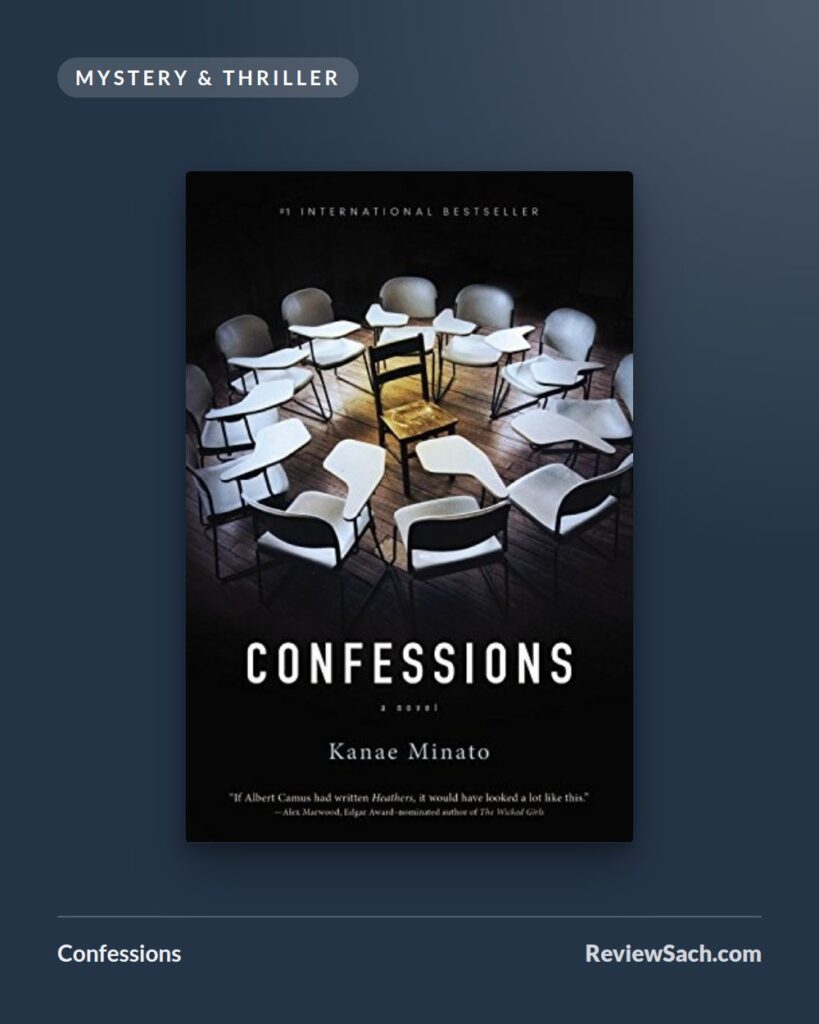
Author: Kanae Minato · Published: 2008 · Genre: Psychological Thriller, Revenge · Original title: Kokuhaku
Confessions is a short, merciless revenge thriller about a teacher, her dead child and the students responsible. It’s gripping and cleverly built, and its opening chapter is one of the most shocking in modern crime fiction. It’s also relentlessly bleak, with nobody to root for. Read it if you can handle very dark material. Skip it if you need any warmth.
What it’s about
On the last day of the school year, middle-school teacher Yuko Moriguchi tells her class that she is resigning. Her four-year-old daughter, Manami, recently drowned in the school pool, and the death was ruled an accident. In a long, calm monologue, Moriguchi explains that it was no accident: two students in the room killed her daughter. She calls them Student A and Student B, but she gives the class enough detail to know exactly who she means. She has no faith that the juvenile justice system will punish thirteen-year-olds, so she has already taken revenge of her own. Her tone is what makes it chilling: she speaks as if delivering a final lesson, patient and polite, while saying things no teacher should say.
The remaining chapters shift to other narrators, including a classmate, a family member’s diary and the two students themselves. Each version exposes what the last one missed or chose to hide, and the story keeps moving forward as it does.
What works
- The opening. The first chapter won Minato a new writers’ prize before the novel existed, and it’s a masterclass in controlled menace. It’s a single monologue in a teacher’s plain, reasonable voice, and it builds to a revelation that will leave you stunned.
- The structure. Every chapter is a confession in a different form, from letters and diaries to online posts. Minato uses the shifting voices to show how each character justifies themselves and misreads everyone else. It’s a whydunit more than a whodunit, and the reasons turn out to be more disturbing than the acts.
- Social bite. The novel takes aim at parents who smother or ignore their children, schools that manage appearances, and a legal system that shields young offenders. Minato doesn’t lecture. She lets the damage speak.
- Economy. It’s short and fast, with no padding. The tension builds chapter by chapter toward an ending you’ll be thinking about for days.
The controversy
Confessions made Minato a star in Japan. It won the Japan Booksellers’ Award, and Tetsuya Nakashima’s acclaimed 2010 film took Best Picture at the Japan Academy Prize. Minato is often called the queen of “iyamisu”, a Japanese label for mysteries designed to leave a nasty aftertaste, and this book shows why.
Its darkness divides readers. The novel deals with the death of a child, bullying, neglectful and suffocating parents, and violence by teenagers, and it offers little consolation. Some readers see a powerful study of revenge, responsibility and the way adults fail children. Others find it gratuitously cruel and misanthropic, with every character either monstrous or weak. Critics have also noted that the medical premise of Moriguchi’s revenge doesn’t hold up. Minato’s flat, almost clinical style makes the cruelty feel colder still, which is either the point or the problem, depending on your taste.
Stephen Snyder’s English translation, published by Mulholland Books in 2014, is cool and precise, which suits the book.
Who should read it
Readers who like dark psychological thrillers, or Japanese crime fiction beyond the classic puzzle mystery. Be warned: the death of a child and deliberate cruelty are central here, not incidental. If you need a character to like, look elsewhere. It’s short enough to finish in an evening or two, which only sharpens its impact.
Rating: 4/5
Image credits — Cover image via Open Library. Cover design © the publisher, shown for review purposes.
