

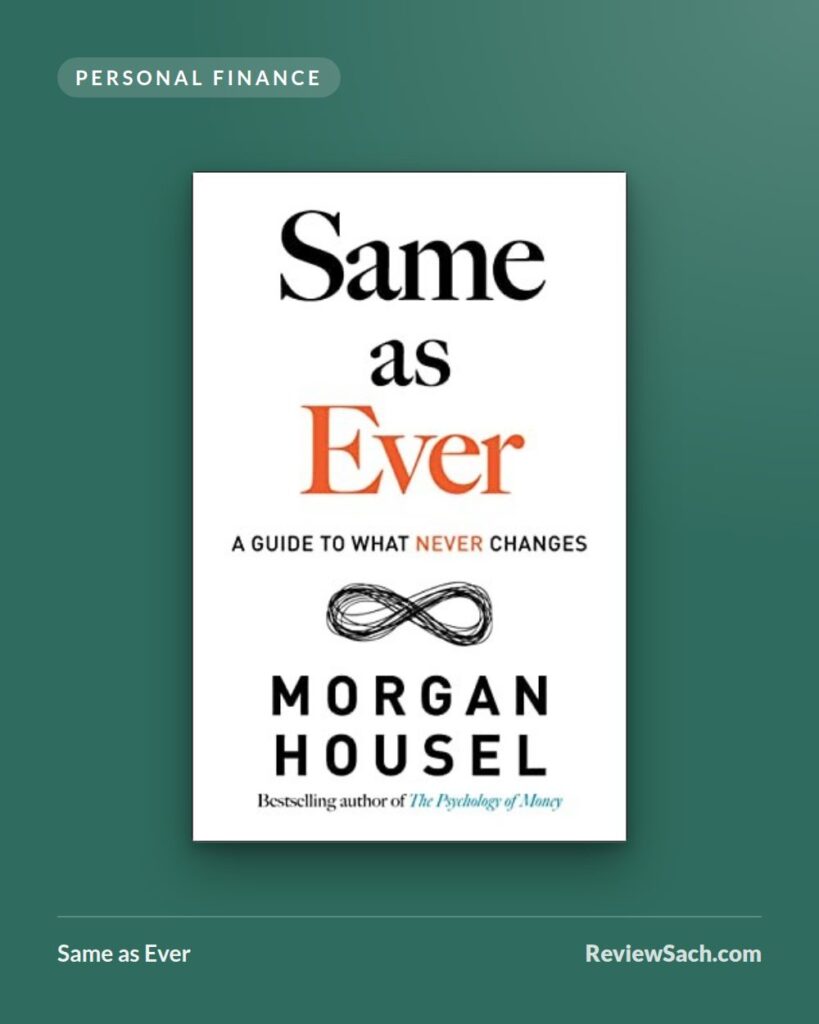
Author: Morgan Housel · Published: 2023 · Genre: Personal Finance, Psychology
Same as Ever is a collection of short essays arguing that while the world changes constantly, human behaviour does not, and that the unchanging parts are the ones worth studying. Morgan Housel writes clearly and tells good stories, but this is looser and less useful than The Psychology of Money. Fans of his first book will enjoy it; readers wanting financial guidance should look elsewhere.
The big idea
Housel, a former columnist for The Motley Fool and The Wall Street Journal, built his reputation on short, story-driven essays about money and behaviour. This book gathers 23 of them, many developed from his blog. The thesis is that predicting specific events is close to impossible, but predicting how people respond to greed, fear, risk and opportunity is much easier. So instead of forecasting, he suggests focusing on things that don’t change and building plans with plenty of room for error.
The book sits closer to popular history and psychology than to personal finance. Money is a recurring theme, but the essays range across war, science, sport and business.
What works
- Expectations and happiness. One of the strongest chapters argues that satisfaction depends on the gap between what you have and what you expected, not on objective conditions. Living standards can rise while contentment falls, because expectations rise faster.
- Calm plants the seeds of crazy. Housel shows how stability encourages the risk-taking that causes the next crisis, an idea associated with the economist Hyman Minsky. He illustrates it beyond finance, with California’s wet years after a drought feeding the vegetation that later burned in wildfires.
- Stress drives progress. He argues that urgency and crisis often produce innovation, noting how much technology emerged from military pressure. Comfortable times, by contrast, tend to produce less.
- Wounds heal, scars last. Housel explains how people who live through a crisis carry its lessons, and its fears, for the rest of their lives. It is a useful way to understand why different generations see money and risk so differently.
- Permanent versus expiring knowledge. He urges readers to spend more time on ideas that stay true for decades, such as how people handle risk, and less on news that will be irrelevant next month.
- Risk you don’t see. A recurring theme is that the biggest risks are the ones nobody is discussing, which is why savings buffers and humility matter more than precise forecasts.
The writing is the real strength. Chapters are short, the prose is clean, and each essay can be read in a few minutes.
What doesn’t
The book is less focused than its predecessor. Critics, including Kirkus, noted that its meandering structure lets good points get lost, that some personal anecdotes connect only loosely to the theme, and that some conclusions contradict one another.
The evidence is mostly anecdotal. A vivid historical story is often treated as proof of a universal pattern, and readers who want data or counter-examples will be left wanting. Many ideas will also be familiar to readers of his blog or of The Psychology of Money, which covers similar ground more tightly.
There is also little practical money advice. Readers expecting guidance on saving, investing or retirement will find reflections instead of steps, which makes it an odd fit on a personal finance shelf. Its lessons apply to money only indirectly, through patience, humility and saving for surprises.
Who should read it
Readers who enjoyed The Psychology of Money and want more of Housel’s storytelling, or anyone who likes short, reflective essays on risk and human nature. It also suits people who prefer big-picture history to spreadsheets. Newcomers to Housel should start with his first book.
Rating: 3.5/5
Image credits — Cover image via Open Library. Cover design © the publisher, shown for review purposes.
