

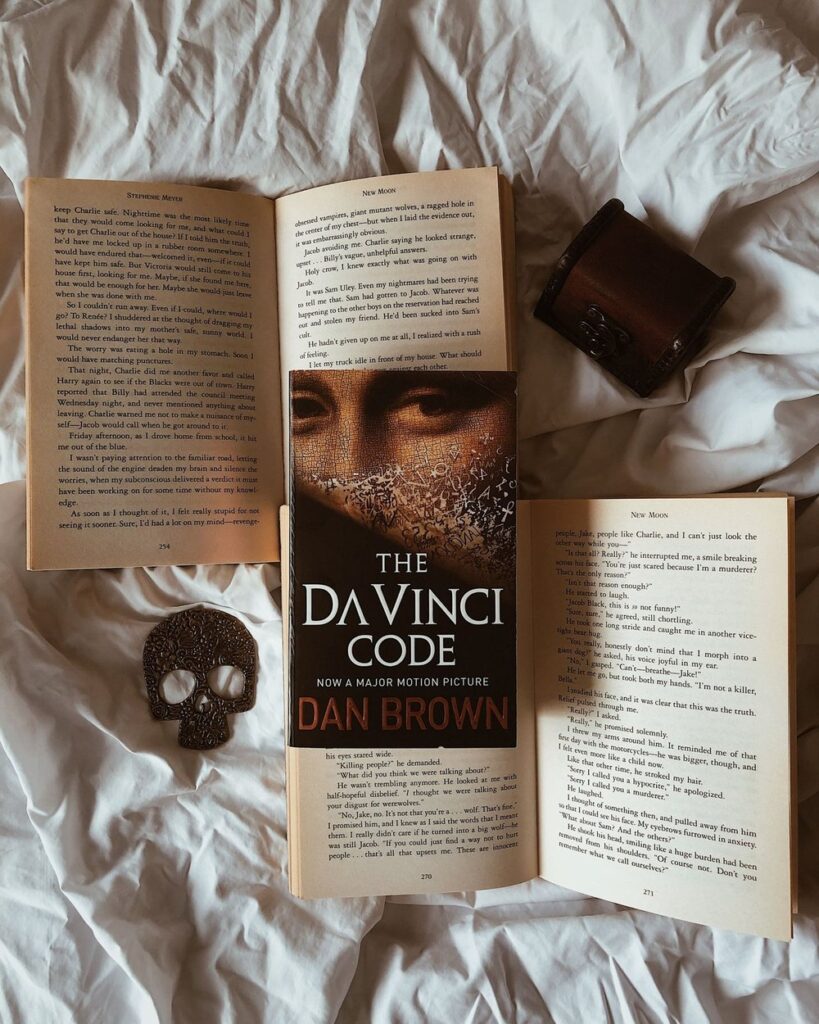
Author: Dan Brown · Published: 2003 · Genre: Thriller, Conspiracy Thriller
The Da Vinci Code is a propulsive treasure hunt with cardboard characters, clunky prose and a great deal of bad history presented as fact. As a page-turner it works: the short chapters and cliffhangers are expertly engineered. Read it as airport entertainment, not as a guide to art history or the origins of Christianity.
What it’s about Late one night, Jacques Saunière, a curator at the Louvre, is murdered in the museum. Before he dies, he arranges his body like Leonardo da Vinci’s Vitruvian Man and leaves a coded message. Robert Langdon, a Harvard professor of symbology who happens to be in Paris, is summoned to the scene by police captain Bezu Fache, who has his own reasons for wanting him there. Sophie Neveu, a police cryptologist and Saunière’s estranged granddaughter, warns Langdon that he is in danger.
Soon the pair are on the run through Paris and then to London, solving puzzles hidden in paintings, a cryptex (a coded cylinder) and old churches. Chasing them is Silas, an albino monk devoted to the Catholic organisation Opus Dei, who takes orders from a mysterious figure known only as the Teacher. At the centre of it all is the Priory of Sion, a secret society supposedly guarding the truth about the Holy Grail, which the novel reinterprets as a secret about Jesus and Mary Magdalene that the Church has suppressed.
What works – Pace. Many chapters are only a few pages long, and most end on a cliffhanger. The action is compressed into roughly a day, and the momentum rarely drops. Brown knows exactly when to cut away. – Puzzles. Anagrams, riddles, number sequences and codes hidden in art give readers the pleasure of a treasure hunt, and each solution is explained clearly enough that you feel clever for following it. – Settings. The Louvre, the church of Saint-Sulpice, London’s Temple Church and Scotland’s Rosslyn Chapel give the chase a sense of place. The book sent crowds of real tourists to all of them. – The hook. The central idea, that a famous painting hides a heresy in plain sight, is irresistible, even if it does not survive contact with historians.
The controversy The book opens with a page headed “Fact”, which states that the Priory of Sion is a real organisation founded in 1099, and that all descriptions of artwork, architecture, documents and secret rituals in the novel are accurate. Historians disagree. The Priory documents were a twentieth-century hoax, largely the work of a Frenchman named Pierre Plantard. Scholars also reject the novel’s claim that Jesus’s divinity was settled by a relatively close vote at the Council of Nicaea, and art historians identify the figure beside Jesus in The Last Supper as the apostle John, not Mary Magdalene. Opus Dei objected to its portrayal, pointing out that it has no monks, and senior Catholic figures urged believers not to read the book. Brown has defended it as fiction, which it is, but the “Fact” page invited readers to treat it as more.
There was also a lawsuit. Michael Baigent and Richard Leigh, two of the authors of the 1982 book The Holy Blood and the Holy Grail, sued Brown’s British publisher, Random House, claiming he had copied their ideas. They lost in 2006. Brown had nodded to them anyway: the name of his character Leigh Teabing is built from theirs.
As fiction, the flaws are just as clear. The prose is clumsy, the dialogue is stiff, the characters exist to deliver lectures, and those lectures regularly stop the plot cold. Langdon has almost no personality beyond his expertise, and Sophie is mostly there to ask questions.
Who should read it Readers who want a fast, puzzle-driven thriller for a flight or a beach and do not mind thin characters. If you want real history or elegant writing, skip it. And if you finish it curious about the Grail, read a historian next, not another Dan Brown.
Rating: 3/5
Photo credits — Featured image: Photo by Book Hut on Pexels. In-article photo: Photo by Symphoney Symphoney via Flickr, CC BY 2.0, cropped.
