

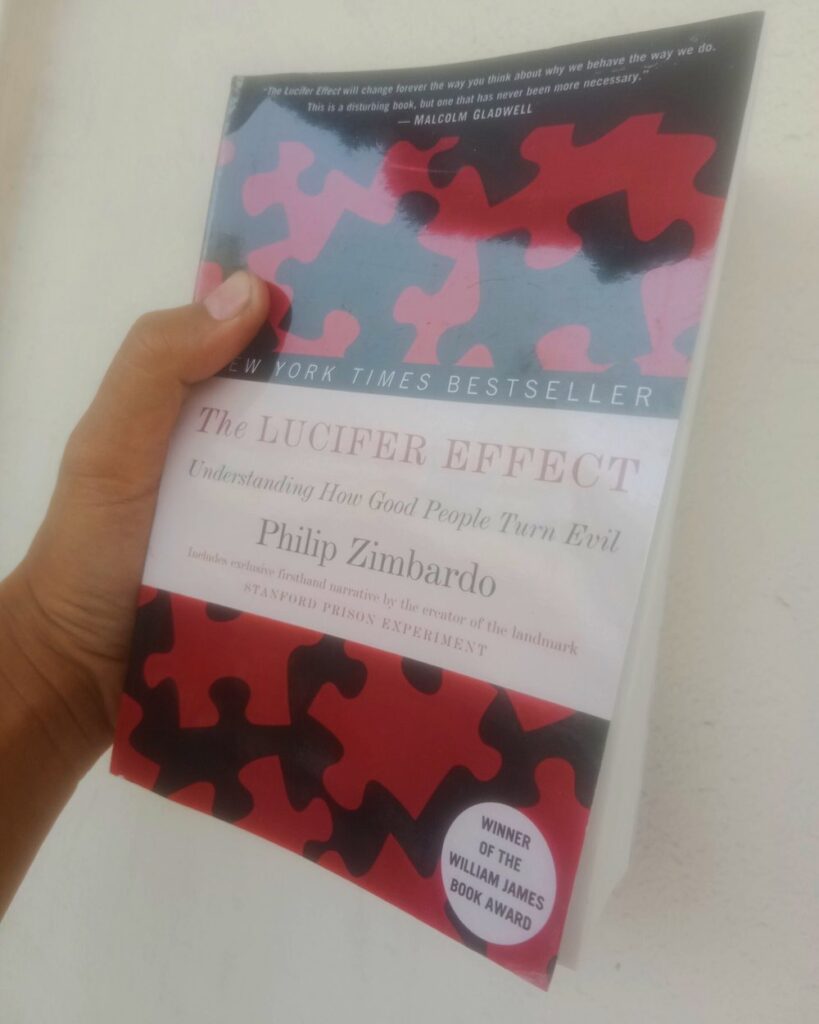
Author: Philip Zimbardo · Published: 2007 · Genre: Psychology, Social Psychology
The Lucifer Effect argues that ordinary, decent people can be turned into abusers by the situations and systems around them. Zimbardo builds the case on his own 1971 Stanford Prison Experiment and on the abuses at Abu Ghraib prison in Iraq. It’s gripping and morally serious, but later investigations into how the experiment was actually run have badly damaged its central evidence. Read it as a historical document, not settled science.
The big idea
Zimbardo’s core claim is that we overrate character and underrate circumstance. When soldiers or guards commit atrocities, we reach for the bad apples explanation. Zimbardo argues the real culprit is often the bad barrel, meaning the situation, and the barrel makers, meaning the system that creates it.
The first and longest part of the book is a day-by-day account of the Stanford Prison Experiment. Zimbardo recruited male college students, randomly assigned them to be guards or prisoners in a mock prison in the basement of Stanford’s psychology building, and ended the study after six days instead of the planned two weeks as guards became abusive and prisoners broke down. He candidly describes how he himself, acting as prison superintendent, got absorbed in the role, and how Christina Maslach, a young psychologist he was dating, persuaded him to stop.
The book then turns to Abu Ghraib, where Zimbardo served as an expert witness for the defense of one of the military police guards. He argues that the abuses flowed from chaotic conditions, poor leadership and command policies rather than a few sadists, and puts the chain of command figuratively on trial.
He closes on a hopeful note. If situations can produce evil, understanding them can help ordinary people resist, and even act heroically.
What works
- The Abu Ghraib analysis is powerful. Zimbardo’s case that responsibility reached far beyond the low-ranking soldiers who were prosecuted is persuasive and well documented.
- The candor about his own failures is striking. His admission that he lost perspective while running the study is one of the most instructive parts of the book.
- The final chapters offer practical resistance. Zimbardo lays out a program for resisting unwanted influence, such as admitting mistakes and staying alert to how situations are framed, and argues that heroes are usually ordinary people.
The controversy
The Stanford Prison Experiment has long drawn criticism. It had no control group and a tiny sample. A 2007 study found that an advertisement for a study of prison life attracted volunteers who scored higher on traits linked to aggression and authoritarianism, raising doubts about who took part.
In 2018, archival research by French scholar Thibault Le Texier and reporting by journalist Ben Blum raised deeper problems. Recordings and documents suggested the guards were coached and encouraged to be tough rather than becoming cruel on their own. The prisoner whose breakdown became famous later said he had faked it to get out. One notoriously cruel guard said he had been deliberately playing a role.
Zimbardo defended the study, arguing it was always a demonstration of what can happen rather than a controlled experiment, and that the guards’ behavior went beyond anything he instructed. But the book presents it as strong evidence for the power of situations, and that framing no longer holds up well. The BBC Prison Study, run by Alex Haslam and Stephen Reicher in 2002, found very different dynamics, with guards reluctant to impose their authority.
The book is also far too long, and the day-by-day narrative takes up a large share of it.
Who should read it
It’s worth reading for anyone studying Abu Ghraib or the history of social psychology. General readers wanting the lessons on situational pressure should pair it with the critiques, or start with a shorter, more current account of the research.
Rating: 2.5/5
Photo credits — Featured image: Photo by Hariadhi via Wikimedia Commons, CC BY-SA 4.0, cropped.
