

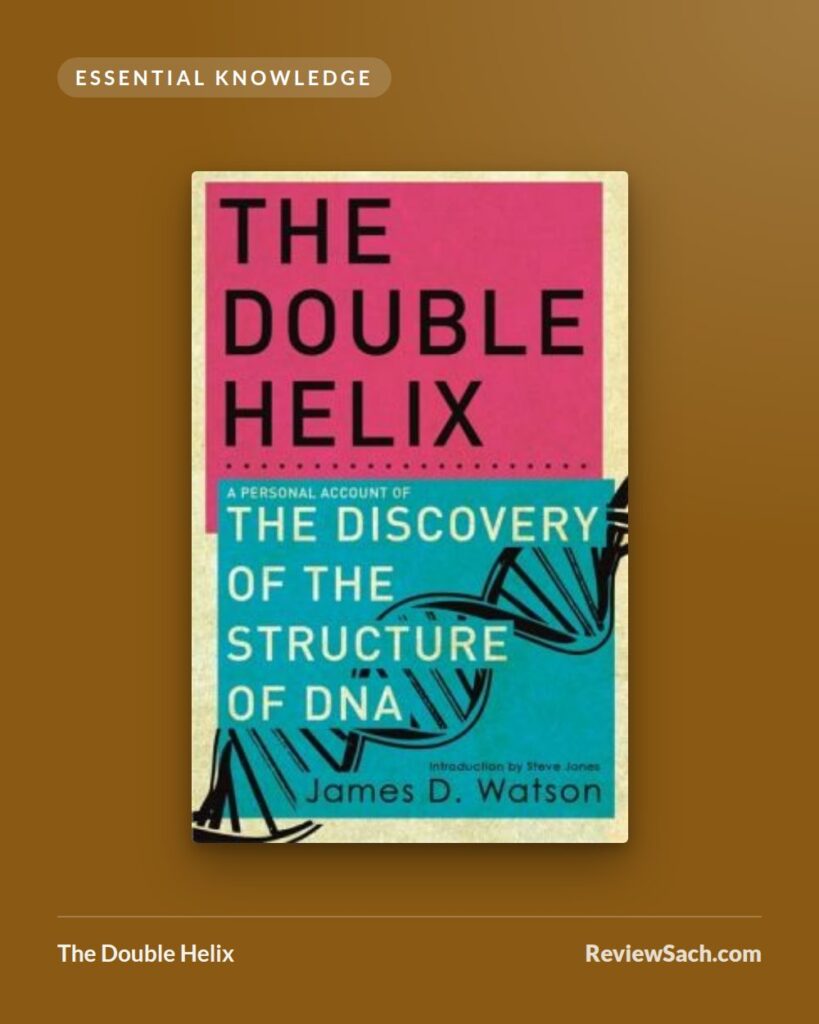
Author: James D. Watson · Published: 1968 · Genre: Memoir, Science
The Double Helix is the most candid insider account of a great discovery ever written, and that candor is both its strength and its problem. Its biggest strength is showing science as it really happens, with rivalry, guesswork and luck. Its biggest weakness is a dismissive, sexist portrait of Rosalind Franklin, whose data was far more central than the story admits. Read it for the drama of 1953, but never as the only account.

The core ideas
- Discovery as a race. Watson, a young American in Cambridge, teams up with Francis Crick to find the structure of DNA before Linus Pauling at Caltech gets there first.
- Model-building on other people’s data. Watson and Crick collected no DNA data of their own. They built physical models guided by others’ results: Erwin Chargaff’s base ratios, a chemistry correction from Jerry Donohue, and X-ray work from King’s College London, where Maurice Wilkins and Franklin worked.
- Failure is part of it. Their first model, a triple helix in late 1951, was quickly demolished by the King’s group, partly because Watson had misremembered Franklin’s figures on water content, and they were told to drop DNA. Pauling’s own triple helix in early 1953 had a basic chemical error, which spurred them back into action.
- The payoff. The final model pairs adenine with thymine and guanine with cytosine, so each strand is a template for copying the other.
What’s great
- It reads like a novel. Short chapters, gossip, cliffhangers and a famous opening line about never having seen Crick in a modest mood.
- It demystified science. In 1968 it was unusual to show great scientists as ambitious, jealous and fallible. That honesty about motives is why it is still assigned in classrooms.
- The science is clear. Even non-biologists come away understanding why base pairing made the structure so exciting.
The controversy
The book was contentious from the start. Crick and Wilkins objected to the manuscript, and Harvard University Press dropped it before a commercial publisher took it on.
The central problem is Franklin. Watson calls her “Rosy,” a name she didn’t use, comments on her clothes and looks, and casts her as a difficult assistant to Wilkins rather than an independent researcher. He describes, with little unease, being shown Photo 51, an X-ray image made by Franklin and her student Raymond Gosling, by Wilkins without her knowledge, and Crick’s use of her results from a Medical Research Council report. Franklin died of ovarian cancer in 1958, at 37, and never read the book. The 1962 Nobel Prize went to Watson, Crick and Wilkins; the prize is not awarded posthumously. Watson’s epilogue concedes his early impressions of her were often wrong, but the main text does the damage.
Anne Sayre’s Rosalind Franklin and DNA (1975) and Brenda Maddox’s 2002 biography rebutted his portrait. In 2023, historians Matthew Cobb and Nathaniel Comfort argued in Nature, using newly found documents, that Franklin understood what her data showed and was an equal member of the quartet that solved the structure, which fits neither Watson’s version nor the simple story of stolen data.
Watson’s later public remarks also shape how readers approach him. In 2007 he told the Sunday Times he was gloomy about Africa’s prospects because, he claimed, testing showed Africans were less intelligent. He left his post at Cold Spring Harbor Laboratory, and after repeating such views in a 2019 PBS documentary, the lab stripped him of his honorary titles. He died in 2025. None of this is in the book, but it colors its casual condescension.
Who should read it
Students and anyone curious about how science really works will enjoy it, but pair it with Maddox’s Rosalind Franklin: The Dark Lady of DNA. The 2012 Annotated and Illustrated Double Helix adds notes, photographs and historical context.
Rating: 3.5/5
Image credits — Featured image: cover image via Open Library; cover design © the publisher, shown for review purposes. In-article images: Image by Flocci Nivis via Wikimedia Commons, CC BY 4.0.
