

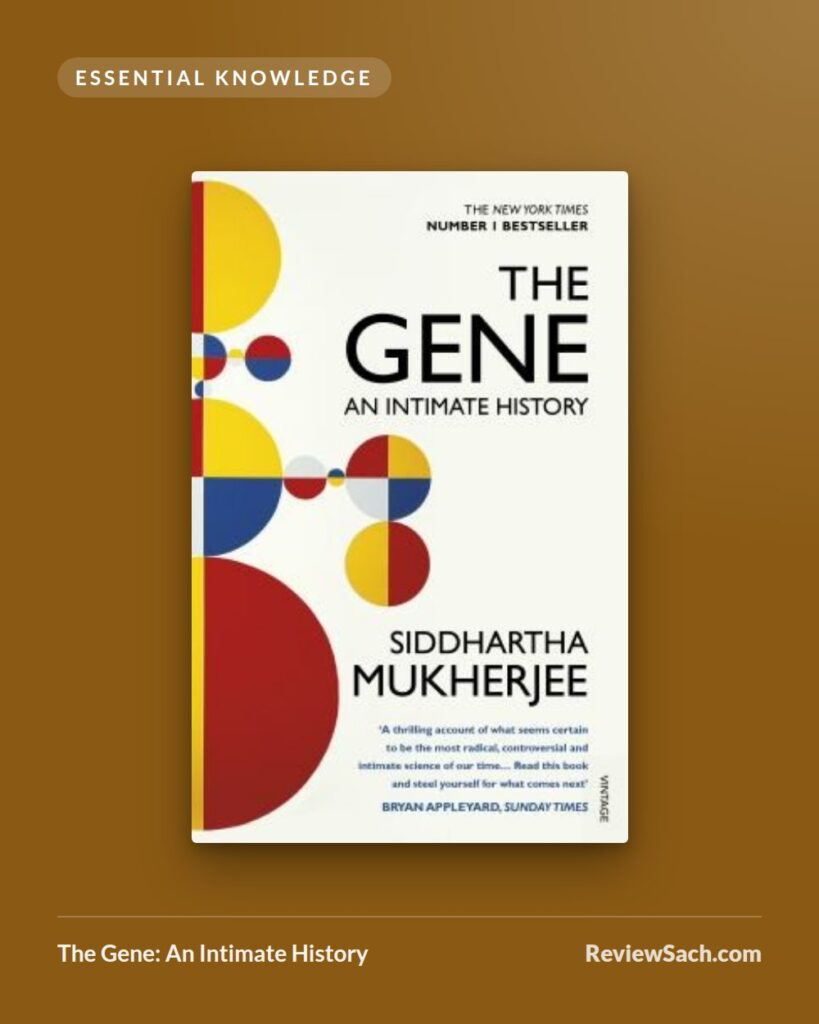
Author: Siddhartha Mukherjee · Published: 2016 · Genre: Science, History of Science
The Gene‘s biggest strength is the way Mukherjee ties the history of genetics to his own family, where serious mental illness, including schizophrenia, has run through two generations, so the question of what we inherit never feels abstract. Its biggest weakness is length and looseness: it’s close to 600 pages, the prose sometimes overreaches, and specialists sharply criticized its account of epigenetics. It’s worth reading for anyone who wants the whole story of genetics, from Mendel to gene editing, with the ethical stakes in view.

The core ideas
- From peas to the double helix. Gregor Mendel’s pea experiments showed that inheritance comes in discrete units. Thomas Hunt Morgan’s fruit flies placed genes on chromosomes, Oswald Avery’s work showed that DNA carries genetic information, and Watson, Crick and Rosalind Franklin’s data revealed its structure.
- The shadow of eugenics. Francis Galton’s ideas fed a movement that led to forced sterilization in the United States, upheld by the Supreme Court in Buck v. Bell (1927), and to Nazi racial murder. That history hangs over every later chapter.
- Reading and writing genes. Recombinant DNA, the 1975 Asilomar conference on its risks, the Human Genome Project and the early setbacks of gene therapy, including the 1999 death of Jesse Gelsinger in a clinical trial.
- Genes are not destiny. Mukherjee stresses that most traits come from many genes interacting with environment and chance, and he explores what genetics can and can’t say about identity, gender, sexuality and race.
- The future. Genetic testing and CRISPR gene editing raise the prospect of changing the human genome itself, and the book asks who should decide.
What’s great
- The family story. The chapters about his cousin and uncles are handled with tenderness, and they give the science emotional weight.
- Scope. Mukherjee connects history, lab science, medicine and ethics in one narrative, as he did for cancer in his Pulitzer-winning The Emperor of All Maladies (2010).
- Ethics taken seriously. He’s candid about the dark history of eugenics and careful about genetic claims regarding race and behavior.
What’s weak
- Epigenetics. When The New Yorker ran an excerpt in May 2016, researchers who study gene regulation, including Mark Ptashne and Steven Henikoff, faulted it for overemphasizing chemical marks on DNA and histones while downplaying transcription factors, the proteins that do most of the work of switching genes on and off. Mukherjee said the piece had been cut down from longer material and acknowledged the omissions. The book’s version is fuller, but it’s still the most contested section.
- Overwritten. The literary flourishes and constant epigraphs can feel self-conscious, and the pace sags in the middle.
- Already dated. It appeared just before gene editing leapt forward: the 2018 births of gene-edited babies in China, the 2020 Nobel Prize for Jennifer Doudna and Emmanuelle Charpentier, and the first approved CRISPR therapy in 2023 all came later.
- Uneven depth. Some key science is rushed while biographical stories get plenty of room.
Who should read it
Read it if you want a readable, humane history of genetics and are ready for a long book. It pairs well with the 2020 Ken Burns PBS documentary based on it. If you want the mechanics of gene regulation in detail, supplement it with a textbook.
Rating: 4/5
Image credits — Featured image: cover image via Open Library; cover design © the publisher, shown for review purposes. In-article images: Image by Josef Reischig via Wikimedia Commons, CC BY-SA 3.0.
