

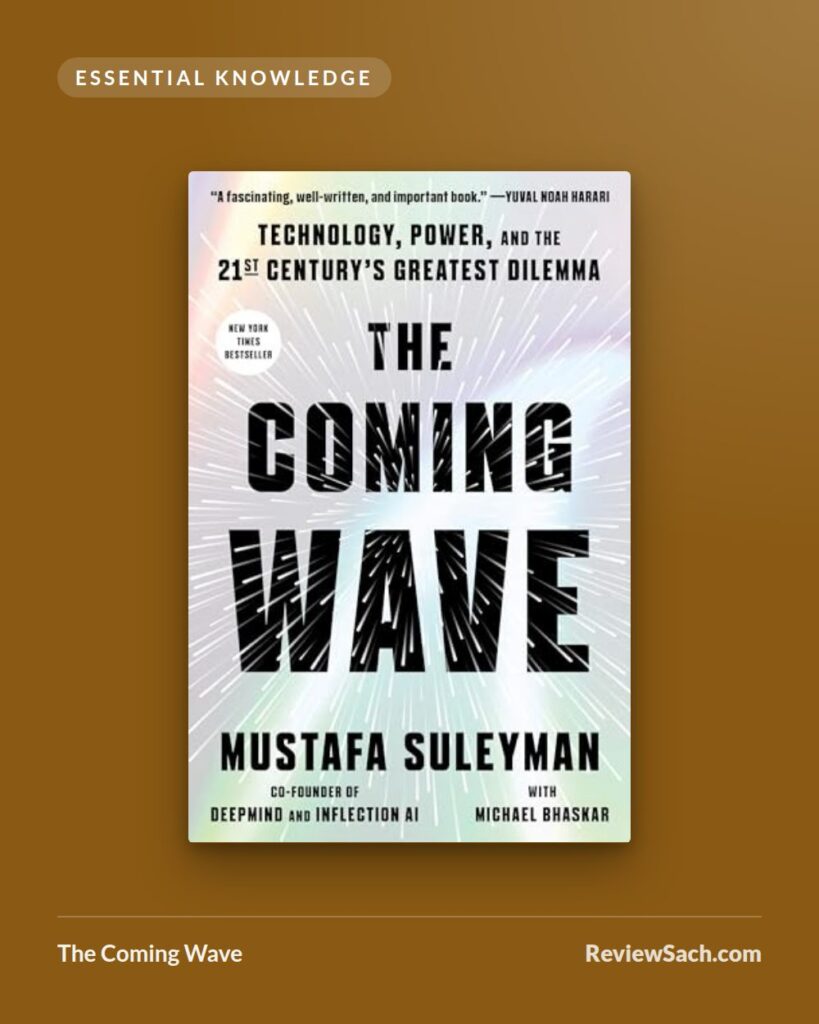
Author: Mustafa Suleyman with Michael Bhaskar · Published: 2023 · Genre: Technology, Politics
The Coming Wave‘s biggest strength is its clear framing of what Suleyman calls the containment problem: AI and synthetic biology are becoming cheap, powerful and widely available, and both letting them spread freely and clamping down hard carry serious dangers. Its biggest weakness is that the proposed solutions are vague and hopeful next to that diagnosis, and the argument repeats itself. It’s worth reading for general readers and policymakers who want an insider’s big-picture view of technology risk.

The core ideas
Suleyman co-founded DeepMind, later co-founded Inflection AI and, after the book appeared, became CEO of Microsoft AI. His argument:
- Waves proliferate. History suggests that once a general-purpose technology arrives, it spreads and gets cheaper, and societies almost never manage to contain it. Containment means being able to monitor, limit and, if necessary, shut a technology down.
- Two core technologies. AI and synthetic biology lead the wave, with robotics and quantum computing behind them. Falling costs for DNA synthesis and gene editing mean dangerous capabilities could reach small groups, not just states.
- Four features. The wave is marked by asymmetry (small actors gain outsized power), hyper-evolution (very fast improvement), omni-use (the same tools serve good and harmful ends) and autonomy.
- The dilemma. Uncontained, the wave risks catastrophe. Contained through heavy surveillance and control, it risks dystopia. Suleyman calls for a narrow path between them.
- Ten steps. His proposals include Apollo-scale funding for safety research, audits, using choke points such as chip export controls to buy time, international treaties and a public movement demanding safeguards.
What’s great
The four features are a genuinely useful lens. They explain why AI and biotech differ from nuclear weapons, which need rare materials and state-scale facilities: the new tools are cheap, general and improving fast.
Suleyman coins a helpful term, pessimism aversion, for the tendency of experts and elites to dismiss dark scenarios because they are uncomfortable to discuss. He also proposes a practical benchmark he calls a modern Turing test: could an AI turn $100,000 into $1 million with minimal human help? That shifts the debate from whether machines are conscious to what they can actually do, which he calls artificial capable intelligence.
The book is readable and serious without being hysterical, and his insider status makes the warning harder to wave away.
What’s weak
The solutions don’t match the problem. After spending most of the book arguing that containment looks nearly impossible, Suleyman concludes that it must be possible, and his ten steps read more like a wish list than a plan. Reviewers in Issues in Science and Technology called the proposals naive and unrealistic, and a review in the US Air Force’s Strategic Studies Quarterly called them grandiose and largely unattainable.
The prose is repetitive, and the synthetic biology sections are thinner than the AI ones, which reflects the author’s background.
Some readers will also question the messenger. Suleyman warns about a race he has helped lead at DeepMind, Inflection and now Microsoft. That gives him inside knowledge, but it also means the call for restraint comes from someone building the technology at the frontier. Others find the book alarmist, with too little attention to how societies adapt and how much good the same tools can do.
Who should read it
Read it if you want a clear, accessible account of why AI and biotech are hard to govern. Pair it with Superintelligence for the deeper theory of AI risk and Co-Intelligence for a more hands-on, optimistic view.
Rating: 3.5/5
Image credits — Featured image: cover image via Open Library; cover design © the publisher, shown for review purposes. In-article images: Photo by National Cancer Institute on Unsplash.
